Sweating Ducts and Vents: What the Moisture Is Actually Telling You
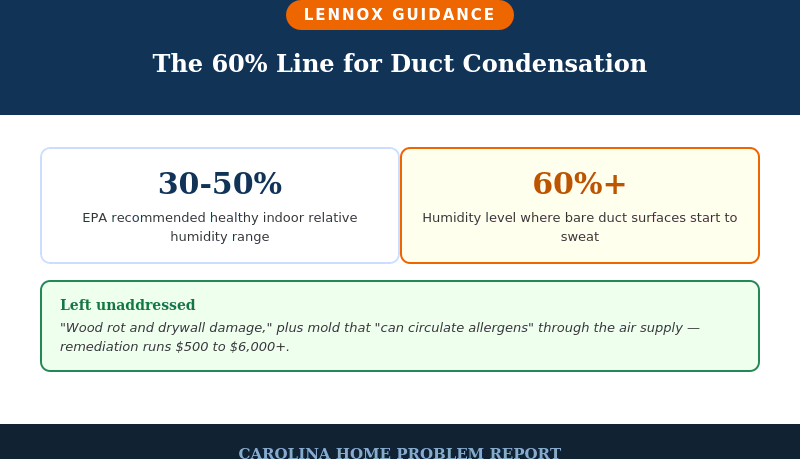
Sweating ducts and vents happen when warm, humid air contacts a cooler duct surface — the same mechanism that fogs a cold glass of iced tea. Once ambient humidity in that space exceeds about 60%, well above the EPA's healthy 30-50% range, there's enough moisture to condense on bare, uninsulated metal ductwork. This isn't cosmetic: left unaddressed it risks wood rot, drywall damage, and mold that can circulate through your home's air supply, with remediation running $500 to $6,000 or more. The fix is insulating exposed ductwork and addressing the underlying humidity source in that space.
⭐ Key Takeaways
- ✓Sweating ducts form when humid air crosses 60% relative humidity and contacts a cooler duct surface
- ✓Insulated flex duct resists sweating; bare rigid metal ductwork conducts cold straight to its surface
- ✓Left unaddressed, it risks wood rot, drywall damage, and mold that can circulate through your air supply
- ✓A steady drip from one point is usually a condensate drain problem, not surface sweating — different fixes
- ✓Sweating ductwork is often a visible signal of a bigger humidity source elsewhere in that attic or crawl space
If you're seeing this in a crawl space specifically, it's worth checking whether that space's humidity is already a known issue — our crawl space and upstairs humidity guide covers how unmanaged crawl space moisture pushes humidity into surrounding areas, which is often the underlying driver behind sweating ductwork rather than the ductwork itself being the root problem.
In This Article
The Mechanism: Why Metal Ducts Sweat
Sweating ducts and vents — visible moisture beading on metal supply registers or dripping from ductwork in an attic or crawl space — is a common summer complaint in Carolina homes, and one that's easy to dismiss as a minor nuisance. It isn't. The same mechanism that fogs a cold glass of iced tea on a humid porch is happening on your ductwork, and left unaddressed, it causes real structural and air-quality problems. HVAC manufacturer Lennox explains the mechanism plainly: "condensation forms when warm, humid air comes into contact with a cooler surface." During summer cooling cycles, supply ducts carrying chilled air create exactly that temperature gradient against the warm, humid air surrounding them — especially in an unconditioned attic or crawl space, where ambient humidity often runs highest. The duct surface acts like the cold glass; the surrounding humid air is doing the rest.
The 60% Threshold
The guidance gives a specific humidity trigger: when indoor (or in this case, surrounding-space) humidity "exceeds 60%, the air contains enough moisture to condense on cool duct surfaces." That's notably higher than the EPA's recommended relative humidity range of 30-50% cited in the same guidance — meaning duct sweating is often a visible signal that humidity in that space has climbed well past a healthy range, not an isolated ductwork problem on its own.
Why Duct Material Matters
Not all ductwork sweats equally. The guidance notes that "flexible, tube-style ductwork has build-in insulation," which keeps its outer surface closer to ambient temperature and less prone to condensation. Rigid metal ductwork, by contrast, conducts the cold refrigerant-cooled air's temperature straight to its bare exterior surface unless it's been retrofitted with insulation — "proper insulation maintains consistent surface temperatures and keeps condensation from forming." A home with older, uninsulated metal trunk lines running through a hot, humid attic is set up almost perfectly for this problem.
What's Actually at Risk
This isn't a cosmetic issue. The consequences the guidance lists are specific: "wood rot and drywall damage" from sustained moisture exposure around ductwork, and "damp, moldy ducts can circulate allergens" directly through your home's air supply — turning a structural moisture problem into an indoor air quality one. There's also an efficiency cost — condensation forming on ducts means the system is fighting a losing battle against ambient heat gain, forcing it "to work harder" and use more energy for the same cooling output.
⚠️ Remediation Isn't Cheap
Mold remediation once it takes hold is not cheap either: the guidance cites a typical range of "$500 to $6,000 or more." Catching sweating ducts early, before mold sets in, is significantly cheaper than remediating it after the fact.
Where the Water Actually Comes From
A useful diagnostic distinction: water actively dripping from a duct joint or connection is more likely a HVAC system's condensate drain problem — a clogged line backing up, or a disconnected drain hose — rather than surface sweating from ambient humidity. Surface sweating typically shows as a film or beading across a broader section of duct or register, not a steady drip from one specific point. Confusing the two leads homeowners to insulate ductwork when the real fix is clearing a condensate line, or vice versa. If you're dealing with a steady drip and a shutoff AC, see our guide to condensate drain line clogs.
A Practical Way to Check Which Ducts Are at Risk
Not every duct run in a home is equally exposed. The runs most likely to sweat are the ones passing through the hottest, most humid unconditioned spaces — typically an attic in peak summer, or a crawl space with unmanaged ground moisture. A simple visual check during a hot, humid afternoon (when the temperature differential between duct and surrounding air is highest) will usually show sweating starting at connection joints and unsheathed metal sections first, since insulated flex duct runs and properly sealed insulated boots are the least exposed. If only certain sections show moisture while insulated runs nearby stay dry, that's a strong sign the fix is targeted insulation at those specific bare spots rather than a whole-system overhaul.
What This Means for a Carolina Home
If you're seeing this in an attic or crawl space specifically, it's worth checking whether that space's humidity is already a known issue — our crawl space and upstairs humidity guide covers how unmanaged crawl space moisture pushes humidity into surrounding areas, which is often the underlying driver behind sweating ductwork rather than the ductwork itself being the root problem.
Frequently Asked Questions
Why are my ducts sweating even though the AC is working fine?
Sweating is caused by ambient humidity around the duct, not by anything wrong with the AC itself. Once the surrounding space's humidity exceeds about 60%, warm humid air condenses on the duct's cooler surface — the same way condensation forms on a cold glass.
How do I tell duct sweating from a drain line leak?
Surface sweating shows as a film or beading across a broad section of duct or register. A steady drip from one specific joint or connection is more likely a condensate drain line problem, which needs a different fix.
Do I need to insulate all my ductwork?
Not necessarily. Check during a hot, humid afternoon — sweating usually appears first at bare metal sections and joints while insulated flex runs stay dry, so a targeted fix at those specific spots is often enough.
Is sweating ductwork dangerous?
Left unaddressed, yes — it risks wood rot, drywall damage, and mold that can circulate through your home's air supply, with remediation costs running $500 to $6,000 or more. It's worth addressing early rather than treating it as cosmetic.
Key Facts About Sweating Ducts and Vents:
- Ducts sweat when ambient humidity around them exceeds about 60% and contacts a cooler duct surface.
- Bare, uninsulated rigid metal ductwork sweats far more readily than insulated flex duct.
- Left unaddressed, it risks wood rot, drywall damage, and mold that can circulate through your air supply.
- A film or beading across a broad section is surface sweating; a steady drip from one point is usually a drain line problem.
- The fix is targeted insulation at exposed sections plus addressing the underlying humidity source in that space.
If sweating ductwork persists after insulating exposed sections, an HVAC professional can check for an underlying humidity or duct-sealing issue.
Find an HVAC Professional Near You →This guide was researched using Lennox's published consumer guidance on ductwork condensation, cross-referenced against our existing crawl space and humidity documentation, to explain why sweating ductwork is a structural and air-quality signal rather than a cosmetic nuisance. We are not contractors or HVAC technicians — we are a research team dedicated to giving Carolina homeowners clear, locally specific, unbiased answers.
Carolina Home Problem Report is an informational resource for homeowners. We are not licensed contractors or HVAC technicians. Always consult a qualified professional before making home repair decisions. See our Disclaimer and Affiliate Disclosure.