Argendon Crawl Space Dehumidifier Review for Carolina Homes (2027)

The Argendon Shield 60P — our top pick for most 1,500–1,800 sq ft Carolina crawl spaces
This Argendon Crawl Space Dehumidifier Review covers Argendon's commercial-grade crawl space and basement dehumidifiers, built for the exact conditions North and South Carolina homes deal with — Carolina crawl spaces that can see humidity up to 95% RH on summer mornings, units designed to hold a sealed space at a 45–55% RH target, winter operation down to 33°F, and continuous unattended drainage.
Across the current 10-unit lineup (70, 145, and 180-pint capacities, with gravity-drain and pump-assisted versions of each), verified buyers report meaningful humidity drops within months — one buyer cited roughly 40% lower crawl space humidity — along with quiet operation and straightforward DIY install with the included hanging kit.
Best for: Carolina homeowners with a sealed or partially sealed crawl space who want a "set it and forget it" unit rated for real humidity loads. Not ideal for: homeowners who haven't sealed vents or installed a vapor barrier yet — see our sizing guide for why the dehumidifier is only one piece of the system.
If you've been searching "Argendon dehumidifier review," you've probably already seen the glossy brand story — the 2018 founding, the engineers, the 10,000+ units. That's useful background, but it's not a review. It doesn't tell you what the unit actually costs by size, where it falls short, or how it stacks up against the other crawl space dehumidifiers NC and SC homeowners are choosing between right now.
That's what this article does. We pulled together verified customer feedback, the full Argendon lineup and pricing, real spec sheets, and a side-by-side against its main competitors — so you can decide whether it's the right unit for your crawl space, not just whether the brand has a good origin story.
Worth noting: at the time of writing, Argendon doesn't appear in any of the major cross-brand crawl space dehumidifier comparisons — not Bob Vila's roundup, not the detailed contractor-sourced guides that cover Santa Fe, AprilAire, and AlorAir side by side.
A dedicated Argendon-only review does exist elsewhere online, but it isn't written for Carolina homeowners or Carolina's specific climate conditions. That's the gap we're filling — not "no one else has reviewed this," but "no one's reviewed it for Carolina homeowners specifically, with the real spec sheet pulled apart."
How we put this review together: we're not a lab-testing outfit — we don't run each unit side-by-side in a controlled chamber. What you're reading is built from Argendon's own current spec sheets and product pages (verified directly, not copied from marketing summaries), their published verified-buyer reviews, independent third-party coverage, and Carolina-specific climate data. Where something is a manufacturer claim rather than an independently confirmed result, we say so.
What Is Argendon?
Argendon is a dehumidifier manufacturer founded in 2018 that specializes in one category: commercial-grade crawl space and basement dehumidifiers built to run continuously, unattended, year-round. Unlike a hardware-store consumer dehumidifier designed for a bedroom, Argendon's units are engineered for the humidity load, temperature range, and accessibility challenges specific to crawl spaces — including operation down to 33°F, which matters for Carolina's cooler months.
That distinction matters because unmanaged crawl space humidity isn't just an annoyance: left unchecked, it's what drives wood rot in floor joists, mold growth, musty indoor air quality upstairs, and — over years — real structural damage, which is why dehumidification is usually paired with crawl space encapsulation and a vapor barrier rather than treated as a stand-alone fix.
Who Created Argendon?
The company was founded by commercial dehumidification engineers who saw a gap in the market: homeowners were stuck choosing between underpowered consumer units that couldn't handle real crawl space humidity loads, or restoration-industry equipment priced for companies with corporate accounts.
Argendon positioned itself in between — commercial build quality at a homeowner price point. The company has since grown to 10,000+ units sold across all 50 states and is ENERGY STAR certified.
Top Benefits of Argendon Dehumidifiers
- Built for crawl space conditions, not bedrooms — operates reliably in the 33°F–100°F+ range Carolina crawl spaces actually see.
- Continuous auto-drain — no daily bucket emptying, which is the single biggest complaint about consumer units in this use case.
- 5-year limited warranty — longer than most consumer dehumidifiers, and in line with what commercial-grade equipment typically carries.
- Washable, reusable filter — lower ongoing cost than disposable-filter units.
- Remote monitoring option — a wired thermostat lets you check and adjust settings without re-entering the crawl space.
Best Features of the Argendon Shield 60P
The Shield 60P is Argendon's mid-tier unit and the one most often recommended for an average 1,500–1,800 sq ft Carolina crawl space. Here's what stands out:
| Feature | Spec |
| Moisture removal | 145 pints/day at saturation / 60 pints/day AHAM-rated (see explanation below) |
| Coverage | Up to 1,800 sq ft |
| Operating range | 33°F – 100°F+ |
| Drainage | Pump-assisted continuous (the "P" in Shield 60P) — a non-pump Shield 60 is also available for crawl spaces with a gravity-drain low point |
| Install method | Floor-standing or hanging kit (pulley system included on select bundles) |
| Warranty | 5-year limited |
| Filter | Washable, reusable |
| Noise level | ~58 dBA during operation — noticeable but typical for this equipment class |
Why the "60" in Shield 60P Doesn't Match the 145-Pint Spec
This confused us at first too, so we checked Argendon's own spec sheet directly rather than guess. The answer: Argendon rates its units two ways. 145 pints/day is the capacity at saturation — maximum moisture removal under extreme humidity. 60 pints/day is the AHAM-standard rating (tested at 80°F / 60% relative humidity),
which is the industry-standard condition manufacturers use to make numbers comparable across brands. The "60" in the model name refers to this AHAM number, not the saturation figure. Competing brands often lead with saturation numbers because they sound more impressive — worth knowing when you're comparing spec sheets side by side, since you want to compare AHAM-to-AHAM, not AHAM-to-saturation.
The MERV-1 Filter: What It Actually Does
Argendon units ship with a replaceable, washable MERV-1 filter. Worth being honest about what that rating means: per the EPA's MERV rating guide, MERV-1 is the lowest tier on the filtration scale, designed to catch larger debris (dust, insulation fibers, insects) to protect the unit's internal coil — it is not a fine air-purification filter and won't meaningfully capture mold spores or fine particulates on its own.
If your goal is actively filtering mold spores out of crawl space air (rather than just controlling the humidity that lets mold grow), that's a separate problem a standalone HEPA air purifier solves — see our Air Purifier For Mold guide. The dehumidifier's job is moisture control, not air filtration — the MERV-1 filter is there for the machine's own protection, not yours.
Auto-Defrost and Humidity Accuracy
Argendon's auto-defrost cycle pauses the compressor while keeping the fan running whenever frost starts forming on the coil — this is what allows the unit to keep operating through cooler Carolina shoulder-season temperatures instead of icing up and shutting down the way many consumer dehumidifiers do. On the control side,
Argendon's own documentation recommends running the unit at 45–55% relative humidity, and states it typically holds within ±3–5% of that setting automatically — in practice, that's the difference between a unit that needs constant adjustment and one you set once and leave alone.
Pump Lift Distance — Why It Matters for Sizing
The built-in pump on "P" models can push condensate up to roughly 19.6 feet vertically, per verified buyer reports. That matters more than it sounds: if your crawl space's nearest drain point or exterior wall is further than that from where the unit will sit, you may need a secondary pump or a different drain routing plan — worth measuring before you buy, not after installation day.

Shield 35M — entry tier, up to 1,000 sq ft

Shield 60 — mid tier, up to 1,800 sq ft

Shield 85P — high capacity, up to 2,300 sq ft
Hanging Install Kit
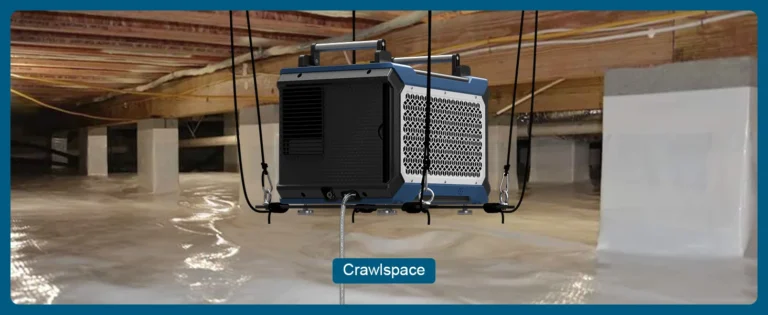
Verified buyer P H Hardy hung his unit from the crawl space joists using the included pulley system, by himself — no contractor. This also makes gravity drainage easier and keeps the unit off a potentially damp floor.
Remote Monitoring
Verified buyer Doug put it plainly: "The remote controller is a must with the dehumidifier if it is located in a difficult access location." For a crawl space — by definition a difficult access location — that's the practical case for the optional wired thermostat: you check and adjust settings without climbing back in.
Argendon Pricing
Argendon sells 10 crawl space and basement units across three capacity tiers. The Shield 35 series and the 60 series (Shield 60/Guardian 60) each come in a gravity-drain version and a pump-assisted ("P") version; the 85 series (Shield 85P, Guardian 85P) is pump-only, and the Sandidry 55c is a single standalone model with no "P" counterpart. Here's the full current lineup (verified directly from argendon.com):
| Model | Capacity | Coverage | Price |
| Shield 35M | 70 pints | 1,000 sq ft | $337.25 |
| Shield 35P | 70 pints | 1,000 sq ft | $372.89 |
| Shield 35P (remote + hanging kit) | 70 pints | 1,000 sq ft | $574.03 |
| Shield 60 | 145 pints | 1,800 sq ft | $459.00 |
| Shield 60P | 145 pints | 1,800 sq ft | $594.15 |
| Guardian 60 | 145 pints | 1,800 sq ft | $534.93 |
| Guardian 60P | 145 pints | 1,800 sq ft | $717.40 |
| Shield 85P | 180 pints | 2,300 sq ft | $639.20 |
| Guardian 85P | 180 pints | 2,300 sq ft | $719.20 |
| Sandidry 55c | 120 pints | 1,300 sq ft | $598.00 |
Prices and discounts fluctuate — confirm current pricing at argendon.com before buying. Use code CHPR3 at checkout for an extra 3% off any model.
Non-pump vs. pump-assisted: the "P" models cost roughly $35–$180 more than their gravity-drain counterparts (Guardian 60 vs. 60P: $534.93 vs. $717.40). Pay for the pump only if your crawl space has no low point to gravity-drain to — otherwise the non-P version does the same job for less.
For comparison: a comparable commercial-grade competitor like the Santa Fe typically runs $1,000–$1,500+. One verified Argendon buyer told us their $1,200 Santa Fe failed after 8 years and they replaced it with a Shield 85P at under half the price, with the same 5-year warranty.
Argendon Pros and Cons
No product is perfect for every situation. Here's where Argendon genuinely delivers, and where it doesn't.
Pros
- Commercial build quality at a homeowner price
- Reliable operation down to 33°F — doesn't ice up and shut down like consumer units in cooler months
- Continuous auto-drain — genuinely hands-off once installed
- DIY-installable with the hanging kit for most homeowners
- 5-year warranty, 30-day return window
- Pre-sales phone support at (888) 770-8483 for sizing questions before you buy
Cons
- Higher upfront cost than a basic hardware-store dehumidifier (though it's solving a different problem — see our Best Dehumidifier NC guide if you need a portable room unit, not a crawl space system)
- A dehumidifier alone won't fix an unsealed crawl space — it needs sealed vents and a vapor barrier to work as intended, which is extra cost if you haven't done that yet
- Pump-assisted drainage is needed if your crawl space has no low point for gravity drain — a gravity drain with nowhere to go is just a full bucket with extra steps, so check this before you buy, not after
- Operating noise is rated around 58 dBA — noticeable if your crawl space is directly under a quiet room, though typical for commercial-grade equipment in this class
- As with any crawl space equipment, sizing matters — a cheaper unit in the wrong crawl space tends to cost more in callbacks and do-overs than paying for the size that actually fits
- Results don't always land neatly inside the recommended band — one verified buyer with an especially humid basement described the unit holding at 40% RH, a few points outside Argendon's recommended 45–55% range rather than inside it; still a major humidity reduction, just a reminder that very humid starting conditions can land just outside your target band rather than precisely in it
Argendon vs. the Alternatives
| Unit | Type | Approx. Price | Best For |
| Argendon Shield 60P | Commercial-grade crawl space | ~$459–$594 | Best value for sealed crawl spaces up to 1,800 sq ft |
| Santa Fe Classic/Compact | Commercial-grade crawl space | $1,000–$1,500+ | Larger budgets, established brand history |
| Hardware-store portable unit | Consumer-grade | $150–$300 | Small, accessible spaces without extreme humidity loads — not a true crawl space fix |
For a full breakdown of every unit we've tested and ranked for Carolina homes, see our Best Crawl Space Dehumidifier for NC & SC Homes roundup.
The Real Cost Comparison: 5-Year Ownership, Not Just Sticker Price
Sticker price alone is misleading. The number that actually matters is what you'll spend over 5 years — purchase price, energy use, filter replacements, and what a warranty claim costs you if something fails. Argendon's washable, reusable filter removes a recurring cost that disposable-filter competitors carry every year,
and the 5-year warranty matches what you'd expect from a $1,000+ commercial unit, at a fraction of the purchase price. If a unit's sticker price looks too good, check what it costs you in filters and failures over the years you'll actually own it.Why Low-Temperature Rating Matters More Than Raw Capacity
Generic dehumidifier buying guides often recommend units built for basements and living spaces — not true crawl spaces. Those units can lose a significant share of their rated capacity once temperatures drop below 65°F, which is a normal spring and fall temperature in a Carolina crawl space, and some fail outright within a couple of years when run continuously outside their intended range. Argendon's 33°F minimum operating rating is the spec that actually matters for this use case — not the pint number on the box.
Does It Actually Work in a Carolina Crawl Space?
Carolina's mixed-humid climate is one of the toughest environments in the country for crawl space moisture control — summer dew points regularly exceed 65°F in Charlotte and Raleigh, and 72–78°F along the SC coast. That's the real-world test any unit needs to pass. Here's what verified buyers report:
"Only had our unit 3–4 months and so far we have been very pleased with it. Easy to install, quiet, and has lowered our large crawl space humidity about 40% lower."
"Pulled the moisture out of my 2,000 square foot crawl space and has been maintaining it at the level I set it to."
"We've had this unit in our crawlspace for about 6 months. It's quiet and it's pumping the moisture out of that crawlspace. Definitely recommend."
"Works well... couldn't bring the humidity in my basement to less than 45%. But it did bring it to 40%."
"The remote controller is a must with the dehumidifier if it is located in a difficult access location."
"I doubt I'll need another for 30+ years, but if I do I'll remember this company."
The consistent pattern across reviews: a meaningful humidity drop within the first few months, quiet-enough operation for most installs, and no reported need to re-enter the crawl space for maintenance once installed and draining properly. The one exception is extreme starting humidity, where results land very good rather than perfect — which tracks with how any dehumidifier, at any price, actually behaves in the real world.
How to Size the Right Argendon Unit
Match your crawl space's square footage to Argendon's rated coverage, then decide gravity-drain vs. pump based on whether your space has a low point to drain to:
- Up to 1,000 sq ft: Shield 35M (gravity) or Shield 35P (pump)
- Up to 1,300 sq ft: Sandidry 55c
- Up to 1,800 sq ft: Shield 60 / Guardian 60 (gravity) or Shield 60P / Guardian 60P (pump)
- Up to 2,300 sq ft, or higher humidity loads: Shield 85P / Guardian 85P
If you're between sizes, size up — Argendon's own guidance, confirmed by their pre-sales line, is that extra capacity in Carolina's climate always works in your favor. Call (888) 770-8483 before buying if you're unsure.
Before You Install: Power, Placement, and a Safety Note on Gas Appliances
Installation is genuinely plug-and-play — Argendon units run on a standard household outlet, with the hanging kit or floor placement as your only real setup decision, plus running the drain hose to your chosen drain point. One thing worth flagging that's easy to overlook:
if your crawl space houses a gas furnace, water heater, or other fuel-burning appliance, sealing the crawl space as part of an encapsulation project changes how that appliance gets its combustion air. That's not a dehumidifier issue specifically, but it's a real safety consideration for anyone sealing vents as part of the broader moisture-control system — worth a conversation with your HVAC contractor before you seal anything if you have gas equipment down there.
Conclusion: Our Argendon Crawl Space Dehumidifier Review Verdict
If your crawl space is sealed (or you're sealing it as part of a moisture-control project) and you want a dehumidifier built for Carolina's humidity loads rather than a bedroom, Argendon is one of the strongest value picks on the market — commercial-grade performance at well under what brands like Santa Fe charge, backed by a 5-year warranty and consistently positive verified buyer feedback.
It's not the right first step if you haven't sealed your vents or installed a vapor barrier yet — in that case, start with our Crawl Space Dehumidifier Sizing Guide to understand the full system before buying any single component.
Ready to check current pricing and availability?
Use code CHPR3 at argendon.com for an extra 3% off | Free shipping | 30-day returns | 5-year warranty
FAQ
Is Argendon legit?
Yes. Argendon has sold 10,000+ units across all 50 states, is ENERGY STAR certified, and has a documented track record of verified customer reviews across its product line.
How long do Argendon dehumidifiers last?
Argendon markets a 10+ year built lifespan based on commercial engineering standards, backed by a 5-year limited warranty.
Does Argendon work in winter?
Yes — Argendon units are rated to operate down to 33°F, unlike most consumer dehumidifiers that ice up and shut down below 65°F.
Is Argendon worth it compared to a cheaper unit?
For an actual crawl space (not a small accessible closet or room), yes — consumer units aren't built for the humidity volume or temperature range a Carolina crawl space produces, and tend to underperform or fail faster in that environment.
Is an Argendon dehumidifier loud?
It runs at roughly 58 dBA, which is noticeable up close but typical for commercial-grade dehumidification equipment. Most homeowners don't notice it from living spaces above a crawl space, but it's worth knowing before you buy if the unit will sit near a frequently-used room.
Is a 70-pint Argendon unit (Shield 35 series) enough for my crawl space?
Argendon rates it for up to 1,000 sq ft, based on the 70-pint figure. Unlike the 60 and 85 series, Argendon doesn't publish a separate AHAM-standard number for this model on their spec sheet — so we can't say for certain how it compares once you apply the same saturation-vs-AHAM gap seen on the larger units. If your crawl space runs close to 1,000 sq ft and sees heavy summer humidity, we'd lean toward sizing up to the Shield 60 series rather than assuming the full 70-pint figure holds under real conditions.
Do I need the pump version or can I use gravity drain?
Only if your crawl space has a drain point lower than where the unit sits, within roughly 19.6 feet of pump lift distance if you do go with a "P" model. No usable low point or drain nearby — get the pump version. Have a natural slope to daylight or a floor drain — the non-pump version saves you money for the same performance.
What if my crawl space still smells musty after installing the dehumidifier?
A lingering musty smell after installation usually means the dehumidifier is running against an unsealed crawl space — open or unsealed vents are still letting humid outside air in faster than one unit can remove it. Check that vents are sealed and a vapor barrier covers the ground before assuming the unit itself is underperforming; see our sizing and sealing guide for the full system.