Mold Smell But No Visible Mold: Where It’s Hiding in Your Carolina Home
A mold smell but no visible mold almost always means mold is growing in a concealed space — crawl space floor joists, HVAC ductwork, inside wall cavities, or the attic. In North Carolina homes, the crawl space is the most likely source by far. The stack effect continuously pulls air from beneath your floor upward into every room, carrying mold odour throughout the house even when the source is completely invisible from the living area.
⭐ Key Takeaways
- ✓In NC homes with crawl spaces, invisible mold is most often growing on floor joists or subflooring beneath the living area — detectable by smell long before it appears on any wall or ceiling
- ✓NC’s 70–90% summer humidity means mold can establish and spread without any visible leak — humidity alone is sufficient to drive active growth in an unmanaged crawl space
- ✓A mold smell that worsens in summer points to the crawl space; a smell strongest when the AC turns on points to the HVAC system — both are common in Carolina construction
- ✓Mold establishes in 24–48 hours when humidity exceeds 60% — in an unmanaged NC crawl space that threshold is exceeded for months at a time each summer
- ✓Most Carolina homeowners can narrow the source to one of five locations before calling anyone — use the diagnosis sequence in this guide to avoid paying for an inspection that finds the wrong thing
The mold smell is unmistakable. You walk in the front door and it’s there — musty, damp, faintly earthy. But you look around and there’s nothing. No visible mold on the walls. No dark spots on the ceiling. No obvious moisture anywhere. The house looks clean. The smell says it isn’t.
A mold smell but no visible mold is one of the most common and most frustrating home problems in North Carolina. It happens more here than in most of the country for a specific reason: the way NC homes are built — predominantly crawl space construction — combined with a climate that keeps homes above mold’s 60% humidity threshold for most of the warm season creates conditions where mold grows in concealed structural spaces that are never visible from the living area.
This guide explains exactly where invisible mold hides in Carolina homes, how to identify which source you have without tearing open walls, and what to do next. Working through this diagnosis before calling anyone saves time, money, and the risk of treating the wrong problem.
In This Article
Why You Get a Mold Smell But No Visible Mold
Mold produces volatile organic compounds — often abbreviated as MVOCs — as a byproduct of its metabolic activity. These are airborne chemical compounds that the human nose detects as that characteristic musty, earthy smell.
According to the US Environmental Protection Agency, mold produces these compounds from the earliest stages of growth — long before it forms visible colonies large enough to see. This is why the smell precedes any visual evidence: the biology of mold means you will nearly always smell it before you can find it.
The second factor is location. In most NC homes the mold is not growing on any surface you can see from the living area — it is growing inside the structure. Floor joists eight feet below the living room floor. Evaporator coil fins inside the air handler cabinet. The interior face of drywall in a wall cavity. The underside of the roof deck in the attic. From the living area, none of these surfaces are visible. But the air carrying their MVOCs is.
The Stack Effect and Why NC Crawl Space Mold Fills Every Room
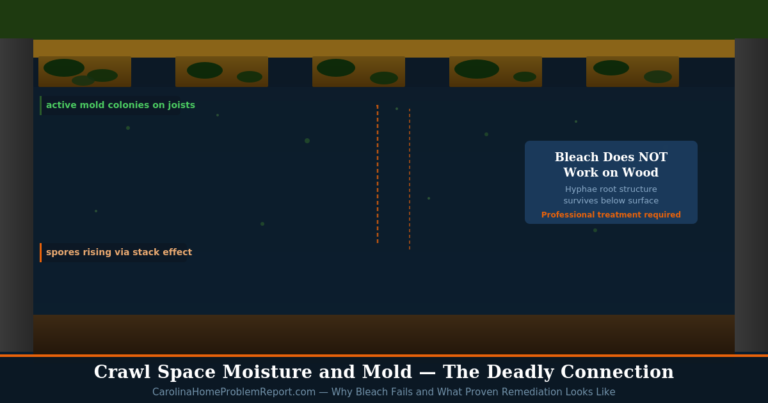
Warm air rises. In a home, this creates a continuous upward pressure: air is drawn in at the bottom of the structure and rises through the floors and walls to exit at the top. In an NC home with a crawl space, this means the crawl space air — and everything in it, including mold spores and MVOCs — is continuously pulled upward through gaps around pipes, wiring, and subflooring into the living area above.
Building Science Corporation research confirms that approximately 50% of the air in a typical crawl space home originates from the crawl space itself. This is why mold growing on floor joists below your bedroom produces a smell that fills the entire house — not just the room nearest the crawl space access hatch.
In North Carolina, this is compounded by climate. Summer relative humidity across the Piedmont and coastal regions regularly runs 70–90%. Mold requires only 60% relative humidity to establish growth. That means NC homes are above the threshold mold needs to grow for most of the year —
which is why NC homes can develop a mold smell but no visible mold despite no plumbing leak and no flooding event. The humidity alone is the fuel source. And the crawl space, unmanaged, provides the growing surface.
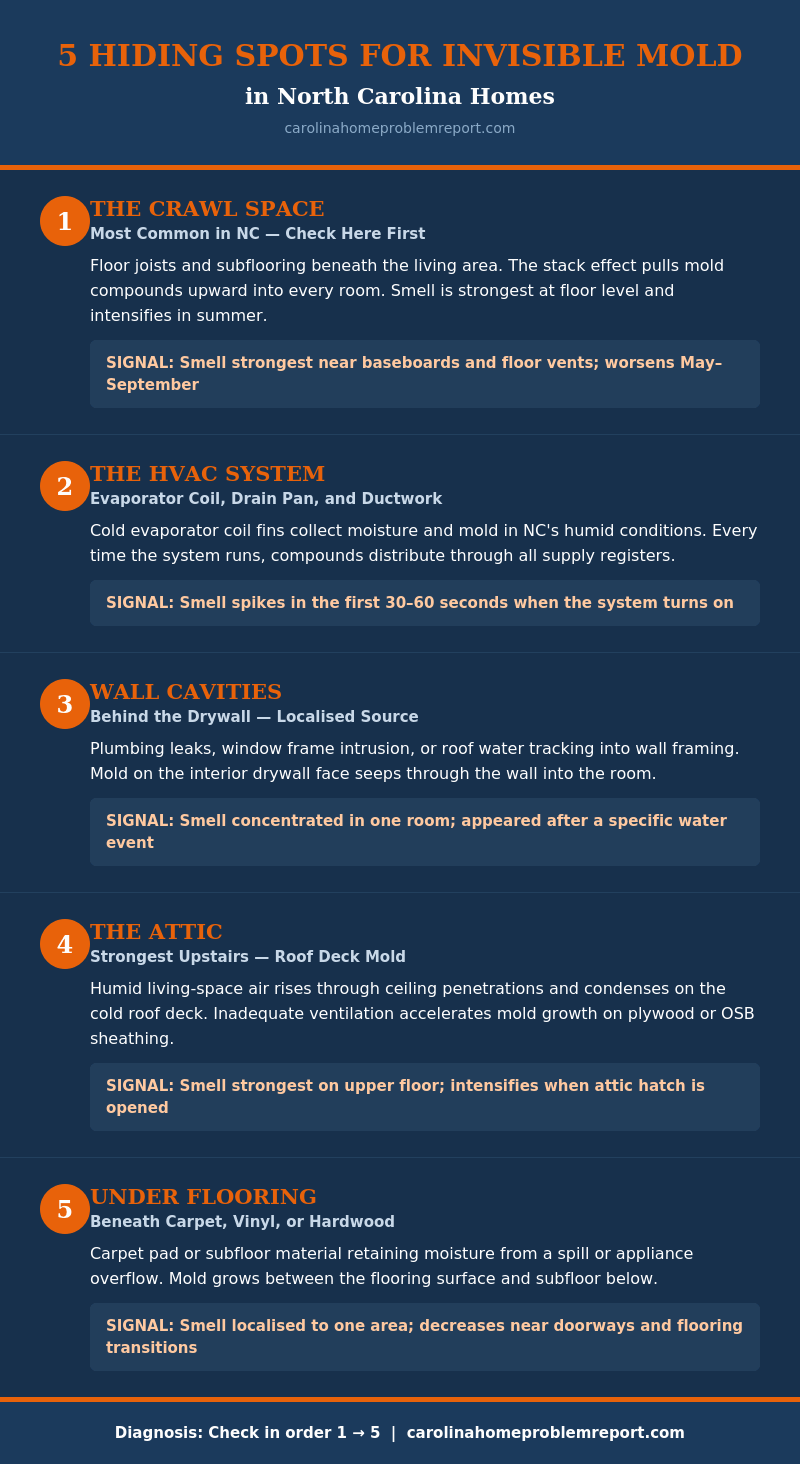
The 5 Hiding Spots for Invisible Mold in NC Homes
How to Track Down the Source — Step by Step
Work through this sequence before calling anyone. It takes under an hour and positions you to either handle the issue yourself or give a professional accurate information about where the problem is — which reduces both inspection time and cost.
Locate the smell precisely by floor level
Get close to the floor in several rooms. Is the smell stronger at floor level than at standing height? If yes, the crawl space is the most likely source — the stack effect makes the smell denser at floor level as mold compounds rise upward from below. If the smell is equally strong at all heights, the HVAC or a wall cavity is more likely.
Open the crawl space access hatch and check immediately
Open the hatch and pause at the opening for 15 seconds without going in. Does the smell intensify noticeably? Even at the hatch opening you can often detect whether the source is below. If you can see any dark staining on the visible floor joists from the hatch opening, or if the crawl space air smells distinctly worse than the living area, the crawl space is confirmed as a source. Do not enter if there is visible mold — note what you can see from the opening and close the hatch.
Run the HVAC and check whether the smell intensifies at the moment it starts
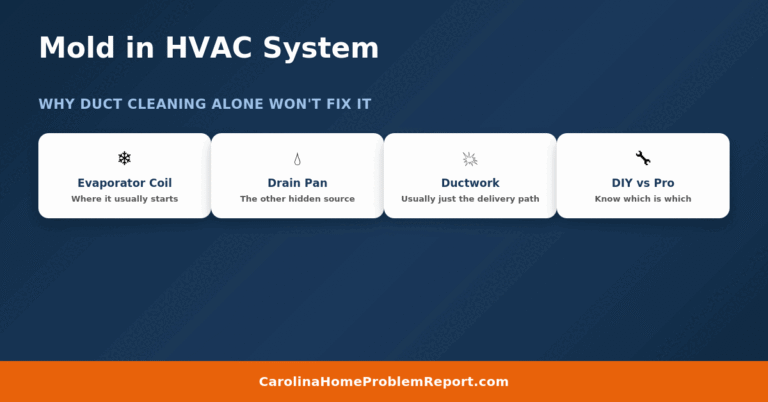
Turn the system off for 30 minutes with windows closed to let the smell settle. Then turn it on and stand near a supply register. Does the smell intensify significantly in the first 30 to 60 seconds of operation? That first blast of air across the evaporator coil carries the highest concentration of HVAC mold compounds. If the smell spikes on start-up, the HVAC system is a source — either the coil, the drain pan, or the ductwork.
Map the smell by room to identify localised sources
Close all interior doors and spend a few minutes in each room separately. Note which rooms smell stronger. If the smell is distributed roughly equally across all rooms, the source is whole-house — crawl space or HVAC. If one room or one area within a room is consistently stronger, a localised source such as a wall cavity or under-flooring mold is more likely. Note the strongest room and check the walls and flooring there for any physical signs: soft drywall, bubbling paint, spongy carpet.
Check the attic access if the smell is strongest upstairs
If your diagnosis from Steps 1–4 points upstairs and the crawl space and HVAC have been ruled out, open the attic hatch. A significant mold smell at the attic opening is usually immediately obvious. Look toward the roof sheathing with a flashlight — dark staining or fuzzy growth on the underside of the plywood or OSB confirms attic mold. Note what you see and close the hatch.
How Long Can You Wait Before Taking Action?
This is a common question with an uncomfortable answer: not long, and not without cost. Mold does not pause while you decide what to do. In an NC crawl space maintaining 70–80% humidity through the summer, mold colonies on wood surfaces grow continuously from the time they establish until conditions change. According to the EPA, mold can cause significant material damage to wood surfaces within days of establishing.
Low additional damage risk. Begin diagnosis. Identify the source using the steps above. Note the smell intensity as a baseline. Arrange professional inspection within the week.
Moderate and growing damage risk. Mold spreading across floor joists. Wood moisture content rising. Insulation becoming contaminated. HVAC mold distributing spores through the house with every cycle. Cost of remediation typically increases meaningfully in this window.
High damage risk. In a Carolina summer, one month of unaddressed crawl space mold can produce growth across large sections of floor framing. Wood rot can begin in the most affected areas. Remediation cost at this stage is typically 2–4x the cost of early intervention.
DIY vs Professional for a Mold Smell But No Visible Mold
The diagnosis steps above are DIY-appropriate for any homeowner. The remediation decisions that follow depend on what you find.
✅ You can handle it yourself if:
- Mold coverage on any single surface is under 10 square feet
- Source has been identified and is accessible without demolition
- Moisture source has been addressed or eliminated first
- Under-flooring mold from a contained appliance spill
- HVAC coil cleaning by a licensed HVAC technician (not DIY)
⚠️ Call a professional if:
- Mold coverage exceeds 10 square feet on any surface
- Mold is in the crawl space on structural framing members
- You or household members have respiratory issues or allergies
- The moisture source has not been identified or stopped
- Mold appears to be inside walls — demolition required
If the source is the crawl space and the mold covers significant floor joist area, professional remediation followed by full crawl space dehumidification is the correct path. Remediation treats the existing mold; the dehumidifier prevents recurrence by keeping crawl space humidity below 55% year-round. Doing the remediation without the humidity control typically produces the same mold problem within one or two growing seasons.
Frequently Asked Questions
Can I have mold in my house without a leak or flooding?
Yes, and in North Carolina this is common. Mold requires only two things: an organic surface and relative humidity above 60%. NC’s summer humidity runs 70–90% — well above that threshold. In an unencapsulated crawl space, a vented attic, or a bathroom without adequate ventilation, mold can establish and grow without any water event occurring. The humidity is the moisture source.
Is a mold smell dangerous even if I can’t see any mold?
A mold smell indicates active mold growth and the presence of mold spores and volatile organic compounds in the air. Health effects vary significantly by individual. People with allergies, asthma, or compromised immune systems are more likely to experience symptoms. The NC Department of Health and Human Services recommends addressing any confirmed mold growth regardless of visible extent. The smell itself is a reason to investigate and act, not to monitor and wait.
My house smells musty only in summer — does that confirm it’s the crawl space?
A mold smell that intensifies in summer and fades in winter is a strong indicator of crawl space or attic mold driven by seasonal humidity. Both sources worsen in summer because outdoor humidity peaks, providing more moisture to sustain growth. A smell that is absent in winter and reappears each May or June consistently points to a humidity-driven source rather than a structural water intrusion. The crawl space is the most statistically likely source in NC homes. Understanding what causes crawl space moisture explains why the problem recurs each summer until the underlying moisture control is addressed.
How much does it cost to find and fix hidden mold in NC?
A professional mold inspection in NC typically costs $300–$600 and includes air sampling and a written report identifying the likely source. Remediation cost depends heavily on what is found: HVAC coil cleaning runs $200–$600. Crawl space mold remediation ranges from $1,500–$5,000 depending on coverage and the need for insulation removal. Full crawl space remediation plus encapsulation and dehumidifier typically runs $6,000–$12,000 and addresses both the existing mold and the conditions that created it. Wall cavity mold remediation costs $1,500–$5,000 depending on the extent of drywall removal required.
What is the quickest way to confirm whether the smell is from the crawl space?
Open the crawl space access hatch and immediately assess whether the smell at the hatch opening is distinctly stronger than the smell in the living area. Also note whether the smell inside your home is strongest at floor level near baseboards, floor vents, and the perimeter of the room. Both of these — intensification at the hatch and concentration at floor level — consistently indicate the crawl space as the source. A hygrometer placed in the crawl space for 24 hours provides a reading of relative humidity; anything consistently above 60% confirms the conditions for active mold growth are present below.
Key Facts About Mold Smell in Carolina Homes:
- North Carolina’s summer humidity of 70–90% keeps homes above the 60% threshold mold requires to grow for most of the warm season — making a mold smell but no visible mold possible without any water event.
- In NC and SC homes with crawl spaces, the stack effect continuously pulls air from beneath the floor into the living area — making the crawl space the most common source of a whole-house mold smell.
- A mold smell strongest when the HVAC system first turns on indicates mold in the evaporator coil, drain pan, or ductwork — distributed through the home every time the system runs.
- A mold smell concentrated in one room rather than distributed through the house typically indicates a localised source: wall cavity mold or under-flooring mold tied to a specific moisture event.
- Most NC homeowners can narrow the source to one of five locations using the diagnosis steps in this guide — before calling any professional.
A mold smell without visible mold is a signal that mold is already established somewhere in the structure and growing. It is not a wait-and-see situation in a Carolina climate where the conditions that drive mold growth are present for months at a time. Find the source first, then address both the mold and the underlying moisture condition together. Treating one without the other produces results that typically last one season at most.
The Carolina Home Problem Report editorial team researches and writes guides for homeowners across North and South Carolina. Our research draws on NC State Extension Service publications, EPA mold guidelines, Building Science Corporation data, and insights from licensed Carolina contractors and mold assessors. We are not contractors or mold assessors — we are a research team dedicated to giving Carolina homeowners clear, locally specific, unbiased answers.
Carolina Home Problem Report is an informational resource for homeowners. We are not licensed contractors or mold assessors. Always consult a qualified professional before making home repair decisions. See our Disclaimer.