Whole Home Dehumidifier: What ENERGY STAR’s 55% Trigger Actually Means
Quick Answer
A whole home dehumidifier ties directly into your central HVAC ductwork and conditions the humidity of your entire living space in one pass, instead of drying one room at a time. Per ENERGY STAR, one is actually worth considering when you have central air conditioning and "humidity readings above 55% consistently throughout the house" — a sustained, measured threshold, not a single sticky afternoon. Sizing runs on a pint-capacity chart by square footage and dampness level (their rule: "it's better to oversize than undersize"), installation requires a licensed HVAC contractor tying into your return/supply ducts and a condensate drain line, and the efficiency number most buyers skip — integrated energy factor (IEF) — can mean a meaningfully different electric bill between two units with identical pint ratings.
Key Takeaways
- ENERGY STAR's real trigger is a measured, sustained reading above 55% RH throughout the house — not how the air feels on any one day.
- Sizing depends on both square footage AND dampness level, using ENERGY STAR's own pint-capacity chart — pick a tier too small and it runs constantly without ever catching up.
- Installation ties into your existing return/supply ductwork and needs a dedicated condensate drain line — it's a licensed-HVAC-contractor job, not a DIY plug-in.
- Integrated energy factor (IEF), not pint capacity alone, is what actually separates a cheap-to-run unit from an expensive one at the same moisture-removal rate.
- A whole home system is a different purchase decision from a portable unit or a crawl-space-specific unit — this guide covers the ducted, whole-living-space category specifically.
- Musty odors, condensation on windows in AC-conditioned rooms, and a hygrometer reading that won't drop below 55% even with the AC running are the concrete signs worth acting on.
Table of Contents
- How a Whole Home Dehumidifier Actually Works
- ENERGY STAR's Actual Trigger Signal
- 5 Signs Your Home Actually Needs a Whole Home Dehumidifier
- Sizing: More Nuanced Than "Bigger Is Better"
- What Installing a Whole Home Dehumidifier Actually Involves
- The Efficiency Number (IEF) Most Buyers Skip
- What to Look For When Choosing a Whole Home Dehumidifier
- The Bottom Line on a Whole Home Dehumidifier
- Frequently Asked Questions
| Space Size | Slightly-to-Moderately Damp (50-75% RH) | Very Damp (75-90% RH) | Wet (90-100% RH) |
|---|---|---|---|
| Under 2,000 sq ft | 20-30 pints/day | 25-40 pints/day | 30-50 pints/day |
| Over 2,000 sq ft | 30+ pints/day | 40+ pints/day | 50+ pints/day |
How a Whole Home Dehumidifier Actually Works
A whole home dehumidifier is a different category of product from the portable unit most homeowners are familiar with — instead of drying one room, it ties directly into your central air system and conditions the humidity of your entire living space at once.
Unlike a portable unit that pulls in room air, dries it, and releases it back into the same space, a whole home dehumidifier ties into your ductwork — typically connected to the return and supply sides of your central HVAC system.
As air already circulating through your home passes through it, the unit strips out excess moisture and redistributes the drier air through the same ducts your furnace or AC already uses. This is what makes it "whole home": it treats the entire ducted living space in one pass rather than drying one room while every other room stays humid.
ENERGY STAR's Actual Trigger Signal
Most product pages sell whole home dehumidifiers on comfort in general terms. ENERGY STAR's own guidance is more specific about who actually needs one: they're worth considering "if you live in a humid climate and have central air conditioning," with the concrete indicator being "humidity readings above 55% consistently throughout the house."
That's a meaningfully different bar than "my house sometimes feels sticky." A single humid afternoon or a temporary spike after a rainstorm doesn't meet this threshold — it's a sustained, whole-house reading above 55% relative humidity, measured with an actual hygrometer rather than guessed from how the air feels, that ENERGY STAR treats as the real signal to act on.
5 Signs Your Home Actually Needs a Whole Home Dehumidifier
A measured 55%+ RH reading is the objective ENERGY STAR trigger, but most homeowners notice one of these practical signs first — worth checking before you buy a hygrometer to confirm:
- Your AC runs constantly but the house still feels damp. A properly sized AC removes some humidity as a side effect of cooling, but it's not designed as a dedicated dehumidification system — if it's running nonstop and the air still feels heavy, moisture removal is the actual bottleneck, not temperature.
- Musty odors persist in rooms with no visible water source. A smell without an obvious leak or spill usually means ambient moisture is high enough, for long enough, to support the low-level microbial growth that produces that smell — covered in more depth in our stale air in home guide.
- Condensation forms on interior surfaces even in conditioned rooms. Windows, mirrors, or metal fixtures sweating inside an air-conditioned room — not just during a shower — signals the ambient RH is elevated enough that any cool surface pulls moisture out of the air.
- A hygrometer reading won't drop below the mid-50s% even with the AC set low. This is the direct confirmation of ENERGY STAR's own trigger, and the most reliable of the five since it's a measurement rather than an impression.
- Allergy or respiratory symptoms flare up seasonally without a clear allergen source. Elevated indoor humidity supports dust mites and mold growth, both common triggers — our humidity and allergies guide covers that mechanism specifically.
Sizing: More Nuanced Than "Bigger Is Better"
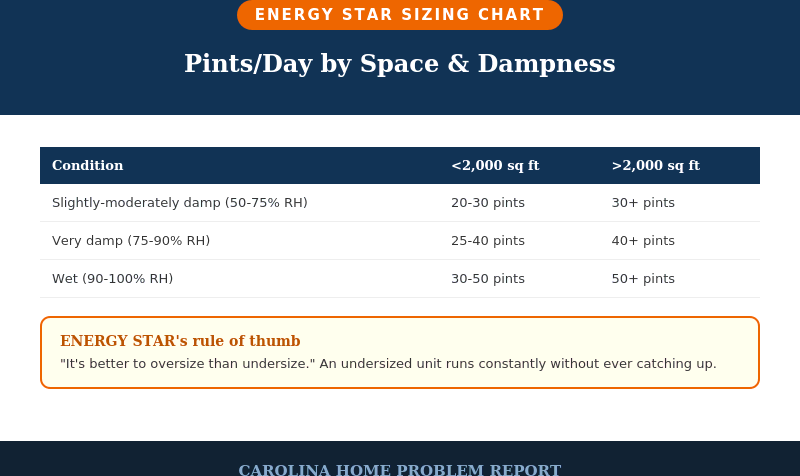
ENERGY STAR publishes a capacity chart based on both square footage and how damp the space already is, and the numbers matter more than most buying guides suggest. For a space under 2,000 sq ft, ENERGY STAR recommends 20-30 pints/day for slightly-to-moderately damp conditions (50-75% RH), 25-40 pints/day for very damp conditions (75-90% RH), and 30-50 pints/day for wet conditions (90-100% RH) — with the equivalent tiers scaling up to 30+, 40+, and 50+ pints/day for spaces over 2,000 sq ft.
Their general rule of thumb: "it's better to oversize than undersize." An undersized unit runs constantly without ever catching up to the moisture load; a correctly or slightly oversized one cycles normally and actually reaches its target humidity. A dedicated deep-dive on sizing math — including how to account for crawl space air leakage and occupancy load — is covered in our upcoming dehumidifier sizing guide.
What Installing a Whole Home Dehumidifier Actually Involves
This is the part most buying guides skip past with a single line about "professional installation" — and it's worth understanding before you get a quote. A whole home unit connects into your existing air distribution network: a return air grille is installed in a central location, with flexible ductwork running from the dehumidifier to that grille, and the output then ties into your existing supply ductwork.
As one HVAC description of the process puts it, "the humid air from the house goes back through that grille to the dehumidifier, then into the duct system."
The unit also needs a dedicated condensate drain line — a PVC line run from the unit to the outdoors, installed "with a slight downward slope for proper drainage," terminating away from the foundation so the water it pulls out of the air doesn't just end up back in your crawl space or basement.
This is genuinely a licensed-HVAC-contractor job, not a weekend DIY project: it requires cutting into and sealing an existing duct system correctly (a poor tie-in can reduce airflow or introduce leaks elsewhere), sizing and sloping a permanent drain line, and tying into your home's electrical system.
Knowing this upfront changes how you should evaluate quotes: a contractor who wants to skip the drain line, tie into your ductwork without inspecting it first, or install the unit without confirming your existing HVAC system can actually accommodate the added airflow is cutting a corner that will show up as a problem later.
The Efficiency Number (IEF) Most Buyers Skip
Beyond pint capacity, ENERGY STAR rates dehumidifiers by their integrated energy factor (IEF) — "liters of water removed per kilowatt-hour (kWh) of energy consumed." A higher IEF number means the unit removes the same amount of moisture using less electricity.
Two units with identical pint ratings can have meaningfully different running costs over a Carolina cooling season, and the ENERGY STAR label specifically requires "more efficient refrigeration coils, compressors, and fans"
— the same core vapor-compression refrigeration cycle a home AC uses, just tuned to pull moisture rather than cool air — delivering roughly 20% less energy use than a comparable conventional unit for the same moisture removal. A full breakdown of what that translates to in real monthly running costs is covered in our upcoming dehumidifier cost-to-run guide.
What to Look For When Choosing a Whole Home Dehumidifier
Once you've confirmed ENERGY STAR's trigger applies to your home and worked out the right capacity tier, these are the features worth comparing between specific units before you buy — regardless of brand:
- ENERGY STAR certification and IEF rating — confirm the specific IEF number rather than just the ENERGY STAR badge; certified units still vary in efficiency within the category.
- Gravity drain vs. built-in condensate pump. A gravity drain only works if the install location is above the drain termination point; a built-in pump adds flexibility but is one more component that can fail and needs periodic checking.
- Automatic humidistat control. A unit that cycles based on an actual measured RH setpoint, rather than running continuously or on a timer, avoids both under- and over-drying the space.
- Noise rating, especially for units installed near living spaces. A unit tucked in a basement or crawl space matters less here than one sharing attic or closet space with a bedroom below.
- MERV-rated filter compatibility. Since the unit processes your home's circulating air, a washable or replaceable filter stage protects the coil and can offer a secondary air-quality benefit.
- Auto-defrost function for cooler climates. Relevant for shoulder-season operation when a refrigerant-based unit can otherwise ice over in cooler ambient temperatures.
We're not linking specific product picks in this guide yet — once our Amazon Associates application is approved, this section will be updated with a comparison table of specific models that meet the criteria above.
The Bottom Line on a Whole Home Dehumidifier
A whole home dehumidifier is the right category to consider specifically when ENERGY STAR's trigger is actually met — humidity consistently above 55% throughout the house, measured, not guessed — and central air conditioning is already in place to share ductwork with.
Sizing by ENERGY STAR's pint-capacity chart, understanding what a real installation involves before you get quotes, and paying attention to IEF rather than pint rating alone are the details that separate a dehumidifier that actually keeps up with your home's moisture load from one that runs constantly without ever catching up.
A whole home system isn't the right fit for every situation. If your specific moisture problem is isolated to a crawl space rather than the living space above it, our crawl space dehumidifier guide covers that standalone-unit category in detail, including Argendon's crawl-space-specific product line.
And if you're still weighing a whole-home system against a portable unit for your specific situation, that head-to-head purchase decision is covered in our upcoming portable-vs-whole-home dehumidifier guide. If you're not yet sure your humidity problem calls for a dedicated product purchase at all, our how to reduce home humidity guide covers the full range of options first.
Frequently Asked Questions
How do I know if I need a whole home dehumidifier vs. a portable one?
If a measured reading shows above 55% RH consistently throughout the house (not just one room) and you already have central air, a whole home unit addresses the whole living space in one pass. A portable unit is a reasonable fit for humidity isolated to one specific room. A full side-by-side comparison is covered in our upcoming portable-vs-whole-home dehumidifier guide.
Can I install a whole home dehumidifier myself?
Not realistically. It requires cutting into and sealing an existing duct system correctly, installing a properly sloped permanent condensate drain line, and an electrical tie-in — this is a licensed HVAC contractor job.
Does a whole home dehumidifier replace my air conditioner?
No. It works alongside your existing central AC, sharing its ductwork, and handles moisture removal specifically — a job AC does only as a side effect of cooling, not as its primary function.
What does IEF mean and why does it matter?
Integrated energy factor — ENERGY STAR's measure of liters of water removed per kWh consumed. Two units with the same pint capacity can have different IEF ratings, meaning meaningfully different electricity costs to remove the same amount of moisture.
Is it better to oversize a whole home dehumidifier?
Per ENERGY STAR, yes — slightly oversizing is preferable to undersizing. An undersized unit runs constantly without ever reaching its target humidity, while a correctly or slightly oversized unit cycles normally.
🏠 CAROLINA LOCAL SUMMARY
Key Facts on Whole Home Dehumidifiers:
- ENERGY STAR's real trigger: sustained readings above 55% RH throughout the house, measured with a hygrometer, plus existing central air.
- Size by both square footage AND dampness tier — ENERGY STAR's own chart, not a single number.
- Installation is a licensed-HVAC-contractor job: duct tie-in, sloped condensate drain line, electrical connection.
- IEF (liters/kWh), not pint capacity alone, determines real running cost between similarly-sized units.
Carolina's humid subtropical climate makes the 55% RH trigger a common one to hit — if your moisture problem is specifically in the crawl space rather than the living space above it, our crawl space dehumidifier guide covers that separately.
About the Author
This guide was researched using ENERGY STAR's official dehumidifier sizing and efficiency guidance and This Old House's documented professional installation process, cross-referenced against Carolina Home Problem Report's own crawl space dehumidifier documentation, to give homeowners an accurate, government-sourced starting point before comparing specific whole-home products. This article opens our 10-cluster Dehumidifiers & Ventilation pillar.