What Is a Crawl Space [Complete Carolina Homeowner Guide — Anatomy, Components, Why NC and SC Homes Have Them, and What Proper Management Looks Like]
A crawl space is the enclosed area between the ground and the first floor of a home — typically 18 inches to 4 feet high, just tall enough to crawl through for maintenance. It houses the structural floor framing, plumbing, electrical wiring, and HVAC ductwork of the home. In NC and SC, crawl spaces are the dominant foundation type in older homes because clay soil, a shallow frost line, and high water tables make basements expensive and problematic. Understanding what a crawl space is — and what it does — is the foundation for understanding why the conditions inside it matter so much to the health of the home above it.
⭐ Key Takeaways
- ✓In NC and SC, crawl spaces are far more common than basements — only 20–30% of Carolina homes have basements because clay soils, shallow frost lines, and high water tables make them expensive and flood-prone
- ✓A crawl space does five things for your home: elevates the structure off the ground, provides access to mechanical systems, allows air circulation under the floor (in vented systems), carries structural loads, and houses utilities
- ✓There are two types: vented (traditional — open foundation vents allow outdoor air in) and sealed/encapsulated (modern — closed system with vapour barrier and dehumidifier). NC building code supports both but the evidence strongly favours sealed in Carolina's climate
- ✓Up to 40–50% of the air you breathe on the first floor of a crawl space home originates from the crawl space — making what happens below the floor directly relevant to health and indoor air quality
- ✓A crawl space costs approximately $10 per square foot to build versus $50 per square foot for a full basement — the economics explain why Carolina builders have historically preferred them
Most homeowners who purchase a crawl space home have never actually been under it. They know it exists — they have seen it listed in the home inspection report, they have heard the term in conversations about moisture or pests — but they have no clear picture of what the space actually looks like, what it contains, or why it matters. That lack of clarity makes every subsequent conversation about crawl space problems abstract and confusing.
Understanding what a crawl space is — its anatomy, its components, its purpose, and its particular challenges in the NC and SC environment — converts that abstraction into clarity. According to Advanced Energy's crawl space research in North Carolina, the crawl space is the single most consequential maintenance area in a Carolina home — both for the problems it generates when neglected and for the improvements it delivers when properly managed.
This article covers what a crawl space is from the ground up — the definition, the anatomy of every component, why Carolina homes have them instead of basements, the two types of crawl spaces, what the space is used for, what its specific challenges are in the Carolina climate, and what proper management looks like.
In This Article
Crawl Space Definition — What It Is and What It Does
A crawl space is the enclosed area between the ground surface and the underside of the first floor of a home. It is called a crawl space because its height — typically 18 inches to 4 feet — allows a person to enter and move through it by crawling rather than standing. The name is descriptive rather than technical.
A crawl space serves five functions in a home:
1. Elevation
Raises the first floor off the ground — reducing moisture intrusion from soil, improving drainage, and in coastal and flood-prone areas meeting elevation requirements
2. Utility access
Provides a route for plumbing, electrical wiring, HVAC ducts, and gas lines without running them through finished walls — and provides access for repairs and upgrades
3. Structural support
Houses the floor framing system — sill plates, rim joists, girders, floor joists — that carries all loads from the home above and transfers them to the foundation walls and piers
4. Thermal buffer
Creates a transitional zone between the cold/hot ground and the conditioned living space — insulation in the floor assembly moderates the temperature difference
5. Ventilation route
In vented systems, provides a channel for air movement under the floor. In sealed systems, this function is replaced by mechanical dehumidification — a significantly more effective moisture control strategy in Carolina's climate
Why NC and SC Homes Have Crawl Spaces Instead of Basements
Only 20–30% of homes in NC and SC have basements. The majority are built on crawl spaces or, increasingly in new construction, on concrete slabs. Understanding why illuminates the specific environmental context that makes crawl space management a priority in this region.
Clay soil — expensive and structurally challenging to excavate
NC's dominant soil type in the Piedmont is Cecil clay — the official state soil of North Carolina. Cecil clay is expansive — it swells when wet and shrinks when dry — and is extremely difficult to excavate with standard equipment. The hydrostatic pressure that clay-saturated soil exerts against below-grade basement walls is what causes the wall cracking and water intrusion that plagues Carolina basements. A crawl space foundation requires far less excavation and far less structural reinforcement against soil pressure.
Shallow frost line — no engineering requirement for deep foundations
In northern states, the frost line — the depth at which soil freezes in winter — extends several feet underground, requiring foundations to be built below it to prevent frost heave. In Carolina, the frost line is less than 10 inches deep. Foundations can be shallow. A crawl space with a 12–18 inch foundation depth satisfies building code requirements — a full basement would add cost with no engineering necessity.
High water table — particularly in Eastern NC and coastal SC
In Eastern NC and along the SC coast, the water table is often within 2–4 feet of the surface. A below-grade basement in these areas is essentially a below-water-table hole that requires continuous waterproofing maintenance to stay dry. Even with sump pumps, basements in high-water-table areas flood regularly. A crawl space — elevated above the soil rather than below it — is inherently more appropriate for these conditions.
Economics — crawl space is dramatically cheaper to build
A crawl space costs approximately $10 per square foot to build. A full basement costs approximately $50 per square foot — five times more. On a 1,500 square foot footprint, the difference is $15,000 versus $75,000 just for the foundation. In a market where builders standardise to reduce costs, the economics of crawl spaces have driven their prevalence across the Carolinas for generations.
Crawl Space Anatomy — Every Component Explained
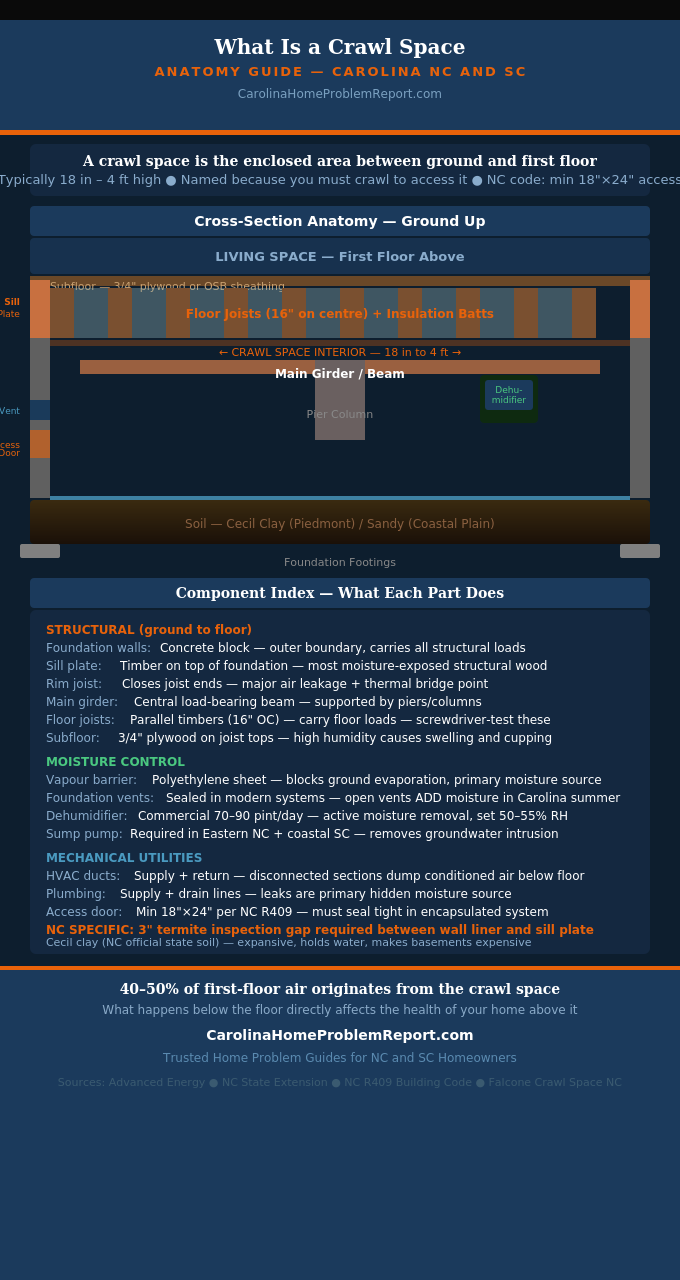
A crawl space is not empty space — it is an organised assembly of structural, mechanical, and moisture-control components. Here is every element from the ground up:
🔨 Structural Components — From Ground to Floor
🌐 Moisture Control Components
⚙ Mechanical and Utility Components
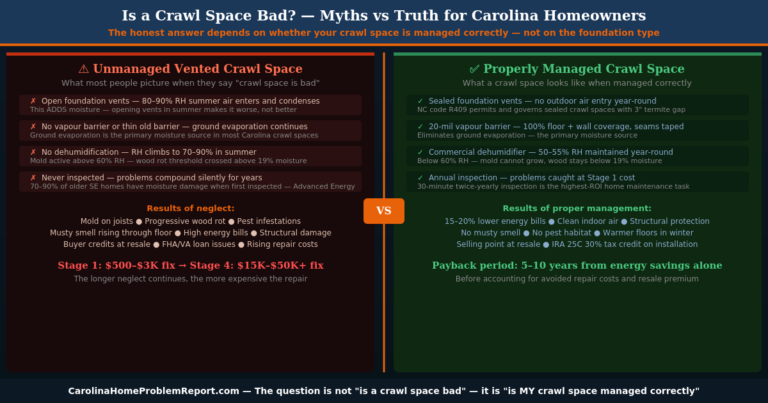
Two Types of Crawl Spaces — Vented vs Sealed
Crawl Space Challenges Specific to Carolina
The same environmental factors that made crawl spaces the dominant foundation type in Carolina also create the specific challenges that make crawl space management a priority:
High ambient humidity: Carolina summers regularly produce 80–90% outdoor RH. This air entering through foundation vents creates the condensation trap that makes vented systems counterproductive. NC and SC homes need sealed systems — not vented ones — to maintain safe crawl space humidity.
Piedmont clay soils: Cecil clay in the NC Piedmont expands when saturated and shrinks in drought — repeatedly stressing the foundation. Standing water against the foundation walls raises crawl space humidity even without rain. Proper perimeter drainage is essential in clay-soil areas.
Eastern NC and coastal SC water table: Water tables within 2–4 feet of the surface mean crawl space floors are close to standing groundwater. After rainfall, water table rise can push moisture through the soil into the crawl space floor regardless of surface drainage. Sump pumps are frequently necessary.
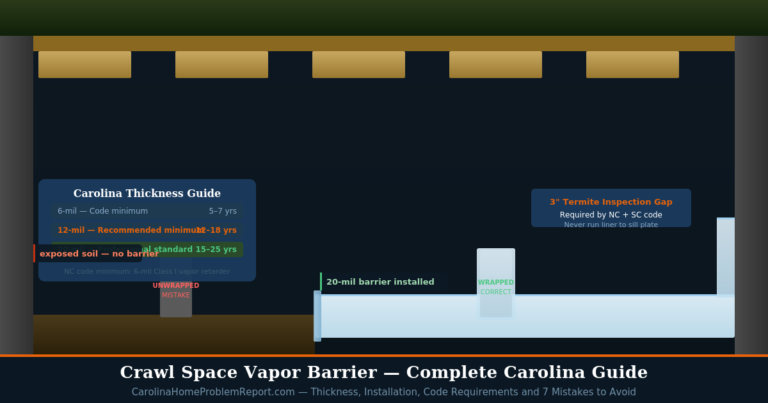
Eastern subterranean termites: NC and SC are in the highest termite pressure zones in the US. Termites enter crawl spaces through soil contact with wood — a moisture-softened sill plate in direct contact with humid soil is the preferred entry point. This is why the NC termite inspection gap (3 inches between wall liner top and sill plate) is mandatory in sealed systems.
Stack effect amplification: Carolina's temperature differential between crawl space and living space — larger in both summer and winter than in moderate climates — drives a stronger stack effect, pulling more crawl space air into the living space than in northern states. The air quality under a Carolina home matters more to indoor air quality precisely because more of it ends up being breathed.
Frequently Asked Questions
What is a crawl space and why do houses have them?
A crawl space is the enclosed area between the ground and the first floor, typically 18 inches to 4 feet high. Houses have them because they elevate the structure off the ground, provide access to plumbing, electrical, and HVAC systems, and in Carolina specifically are far cheaper to build than full basements ($10/sqft vs $50/sqft) while being far less prone to flooding in clay-soil, high-water-table terrain. In NC and SC, crawl spaces dominate older housing stock for exactly these reasons.
What is inside a crawl space?
A crawl space contains structural components (sill plate, rim joist, girder, floor joists, subfloor, piers), moisture control components (vapour barrier, foundation vents, and in sealed systems a dehumidifier and possibly a sump pump), and mechanical/utility runs (HVAC ductwork, plumbing supply and drain lines, electrical wiring). In an unencapsulated space, you also typically find insulation batts in the floor joist bays. In an encapsulated space, insulation is on the foundation walls rather than in the joist bays.
Why do NC and SC homes have crawl spaces instead of basements?
Four reasons specific to the Carolina environment: clay soil that makes excavation expensive and creates hydrostatic pressure against basement walls; a shallow frost line (under 10 inches) that makes deep foundations unnecessary; a high water table in many areas that makes below-grade spaces flood-prone; and economics — crawl spaces cost about one-fifth as much to build as full basements. These same factors that make crawl spaces practical also create specific moisture challenges that require careful management.
What is the difference between a vented and sealed crawl space?
A vented crawl space has open foundation vents in the walls that allow outdoor air in — the traditional approach based on the theory that airflow dries the space. A sealed (encapsulated) crawl space has all vents closed, a heavy vapour barrier on floor and walls, and a permanently installed dehumidifier maintaining target humidity. Building science research, including NC State Extension's guidance, consistently shows that sealed crawl spaces outperform vented ones in the Southeast because summer outdoor air is more humid than crawl space air, and introducing it through vents creates condensation rather than drying.
How tall is a crawl space?
Most crawl spaces in Carolina homes range from 18 inches to 4 feet. The NC building code requires a minimum access opening of 18 × 24 inches. Spaces below 18 inches are extremely difficult to work in and present challenges for both inspection and encapsulation. Some older homes have very shallow crawl spaces of 12–16 inches which may require professional assessment rather than DIY inspection. Spaces of 3–4 feet are relatively comfortable to work in and allow full inspection without specialised access equipment.
A crawl space is not just an inconvenient gap under your home — it is the structural and mechanical core of the building, the source of 40–50% of the first-floor air you breathe, and the single area where early problems are cheapest to catch and most expensive to ignore. In NC and SC specifically, the combination of clay soils, high humidity, high termite pressure, and a shallow frost line makes crawl spaces both prevalent and particularly susceptible to the conditions that drive moisture damage.
Understanding what is in a crawl space — and why each component matters — is the foundation for understanding every other crawl space article on this site. If you want to know the current condition of the space under your home, a professional assessment is the starting point.
Get a Free Crawl Space Assessment →The Carolina Home Problem Report editorial team researches and writes guides for homeowners across North and South Carolina. Research for this article draws on Advanced Energy, NC State Extension, Falcone Crawl Space Raleigh, Carolina Foundation Solutions, Mount Valley Foundation Services SC, Dry Pro Foundation NC, and NC R409 closed crawl space building code.
Carolina Home Problem Report is an informational resource for homeowners. We are not licensed contractors. See our Disclaimer.