Sagging Floors Over Crawl Space: The 4 Causes, When It Is an Emergency, and Repair Costs for NC and SC Homeowners
⚡ QUICK ANSWERSagging floors over a crawl space in NC and SC are almost always caused by one of four things — moisture-driven wood rot, termite damage, settling support piers, or inadequate original construction. All four are fixable. The urgent question is which one applies and how far the damage has progressed. A floor that is visibly sagging more than an inch, springy in multiple rooms, or accompanied by interior wall cracks needs professional assessment within days, not weeks. A soft spot in a single room that has not changed in months is less urgent but still needs investigation.
Noticing sagging floors over your crawl space is unsettling — but the feeling underfoot is telling you something important about the structural condition of your home. In NC and SC, where crawl space moisture, subterranean termites, and Piedmont clay soil movement all work against floor structure simultaneously, sagging floors are one of the most common structural complaints homeowners raise. The good news is that most cases are repairable — and the earlier the intervention, the less expensive the repair. This guide gives you the diagnostic framework to understand what you are dealing with and what it will cost to fix.
Is a Sagging Floor Over a Crawl Space an Emergency?
The honest answer is: it depends on the degree and progression. Use this as your initial assessment:
🚨 CALL WITHIN 24–48 HOURS if you see any of these: Floor deflection visibly more than 1 inch over a 10-foot span ● Springy or bouncy floors across multiple rooms not just one spot ● Interior wall cracks that have appeared recently or are widening ● Doors or windows that have stuck suddenly and were previously fine ● Visible separation at baseboards or between floor and walls ● Any floor area that gives significantly when you jump lightly on it
✅ MONITOR AND SCHEDULE AN INSPECTION within 30 days if: A single soft or slightly springy area that has been the same for months ● Minor floor slope that is not worsening ● Floors feel different in humidity vs dry seasons only — this may be normal wood expansion rather than structural movement
The 4 Causes of Sagging Floors Over Crawl Spaces in NC and SC
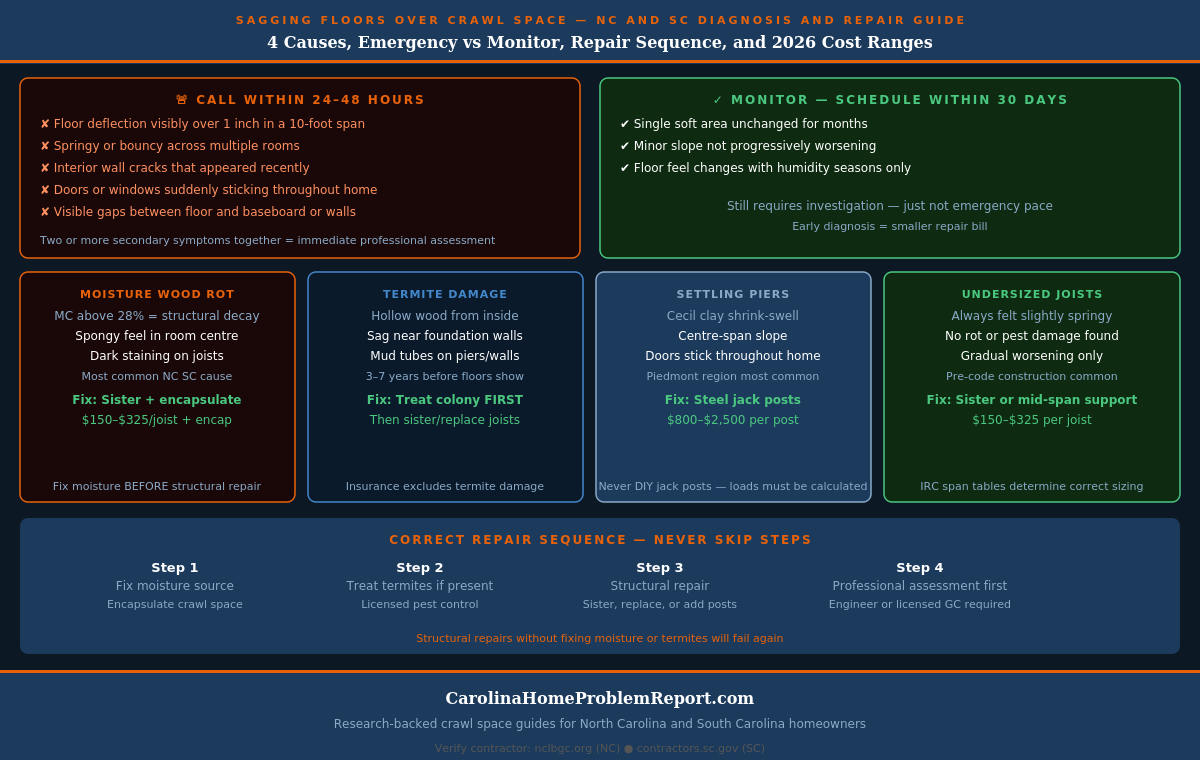
Cause 1 — Moisture-driven wood rot. This is the most common cause of sagging floors in NC and SC crawl spaces. When relative humidity in the crawl space exceeds 60% consistently — which it does in virtually every unencapsulated crawl space across the Carolinas from April through October — floor joists, girders, subfloor sheathing, and sill plates absorb moisture continuously. Wood moisture content above 28% creates conditions for active structural decay. The fungus responsible for brown rot and white rot digests the lignin and cellulose that give wood its strength. What looks structurally intact from below may have lost 50–70% of its load-bearing capacity while appearing only slightly discoloured.
Diagnostic signature: soft or spongy floor feel, often worst in the centre of the home away from the perimeter walls, associated with visible dark staining or powdery texture on joist surfaces, worse in rooms with bathrooms or kitchens above due to additional moisture sources. This is A16's territory for repair methods — see our Crawl Space Floor Joist Repair guide for sistering costs and methods.
Cause 2 — Subterranean termite damage. NC and SC sit in the highest subterranean termite pressure zone in the continental US east of the Mississippi. Subterranean termites establish colonies within 18 inches of a moisture source and access the structural wood of a crawl space through mud tubes built along foundation walls and piers. They consume wood from the inside out — a floor joist can be largely hollow while appearing intact from the outside. By the time floors begin to sag from termite damage, the infestation has typically been active for 3–7 years.
Diagnostic signature: sagging concentrated near foundation walls rather than in the centre of the span, mud tubes visible on foundation walls or piers when inspected, wood that sounds hollow when tapped, wood that crumbles or splits easily when probed. Termite damage must be treated by a licensed pest control operator before any structural repair — repairing the wood without eliminating the colony is a temporary fix.
Cause 3 — Settling or failed support piers and posts. The floor system of a crawl space home is supported by a post-and-beam system — wooden or steel posts bearing on concrete footings or directly on the soil, supporting girder beams, which in turn carry the floor joists. When support piers settle — either because the footing is inadequate, the soil beneath it has shifted (particularly common with NC Piedmont clay's shrink-swell behaviour), or the post itself has rotted — the girder above drops and the floor sags in the mid-span between exterior walls.
Diagnostic signature: sagging concentrated in the centre of the room or along the central beam line of the home, less associated with a spongy feel and more with a visible slope toward the middle, doors and windows throughout the home sticking simultaneously rather than in one area only. This is typically the most straightforward structural repair — adjustable steel jack posts installed beneath the sagging girder restore level and can be adjusted as needed over time.
Cause 4 — Inadequate original construction. Many NC and SC homes built before modern code requirements — and even some built after — have floor joist spans, sizes, or spacing that do not meet current IRC standards. Floor joists that are undersized for their span, incorrectly spaced, or notched by later contractors installing plumbing or HVAC will deflect progressively over years as the wood ages and load is applied. This cause produces gradual worsening rather than sudden change.
Diagnostic signature: floors that have always felt slightly springy since the home was built, deflection distributed evenly across a room rather than at specific points, no visible rot or termite damage on inspection. The fix is sistering — adding new full-depth joists alongside undersized originals — or installing mid-span support to reduce the effective span length.
Secondary Symptoms That Confirm Structural Movement
Sagging floors over a crawl space rarely occur in isolation. When floor structure is compromised, the entire building frame responds. These secondary symptoms confirm that structural movement is occurring and that the problem is not limited to the floor surface:
- Interior drywall cracks — particularly diagonal cracks at corners of door and window openings
- Doors or windows that suddenly stick, fail to latch, or no longer close squarely
- Visible gaps between the floor surface and baseboard trim
- Gaps between interior walls and the ceiling
- Hardwood floor boards separating at joints or cupping
- Tiles cracking in kitchens or bathrooms without obvious cause
Any combination of floor sagging with two or more of these secondary symptoms warrants immediate professional assessment — not next month, this week.
The Repair Sequence — What Must Happen First
The most important point about repairing sagging floors over a crawl space is the sequence. Structural repairs to floor joists, girders, or support piers made without first addressing the underlying moisture or pest cause will fail again. The sequence is always:
Step 1 — Fix the moisture condition. If moisture-driven wood rot is confirmed or suspected, encapsulation must be part of the solution — not an optional add-on. Sistering rotted joists in an actively humid crawl space delays the problem by years, not decades. See our Is Crawl Space Encapsulation Worth It guide for the ROI case.
Step 2 — Treat active termite infestation. If termites are present, a licensed pest control operator must treat the colony and establish a perimeter treatment before any structural wood repair. Repairing eaten wood while an active colony remains produces repairs that are re-eaten.
Step 3 — Structural repair. Once the cause is controlled, the structural repair proceeds — sistering compromised joists, installing or adjusting jack posts under sagging girders, replacing failed sill plates, or sistering undersized members.
Step 4 — Professional structural assessment. For anything beyond a single minor joist repair, a structural engineer or licensed general contractor should assess the scope before work begins. DIY jack post installation is a common and dangerous mistake — loads on support posts must be calculated against the span and load above, not estimated. An incorrectly placed or loaded jack post can concentrate force in a way that worsens the structural problem rather than correcting it.
Sagging Floor Repair Cost — NC and SC 2026
| Repair Type | Cost Range NC SC 2026 | Notes |
|---|---|---|
| Structural inspection | $300–$750 | Always first — defines scope of repair needed |
| Joist sistering | $150–$325 per joist | New joist bolted alongside damaged member |
| Joist replacement | $350–$1,000 per joist | Full removal and replacement — more invasive |
| Jack post installation | $800–$2,500 per post | Includes footing, installed by licensed contractor |
| Sill plate replacement | $100–$120 per linear foot | Requires temporary jacking of floor above |
| Subfloor replacement | $2,000–$7,000 | Water-damaged sheathing, moderate scope |
| Full structural repair + encapsulation | $8,000–$20,000+ | Comprehensive repair — extensive moisture damage |
💡 INSURANCE NOTE: Homeowners insurance typically does not cover sagging floors caused by gradual moisture damage, wood rot, or termite damage. These are considered maintenance failures, not sudden accidental events. Termite damage is specifically excluded from standard NC and SC homeowners policies. The repair cost comes entirely out of pocket in most cases — another reason early intervention matters.
Verifying Your Contractor in NC and SC
Structural repairs to floor systems in NC require a licensed General Contractor for projects exceeding $30,000, and a Residential Contractor licence for smaller residential projects. Any project involving foundation work — including jack post installation — typically requires a building permit and structural inspection. Before signing any contract for sagging floor repair in NC, verify the contractor's licence at nclbgc.org. In SC, verify at contractors.sc.gov — required for all residential projects over $5,000.
Related Guides
- Crawl Space Floor Joist Repair — Sistering vs Replacement Costs
- Crawl Space Structural Damage Signs — 4-Stage Cost Model
- Crawl Space Wood Rot — NC and SC Guide
- Crawl Space Moisture Attracts Termites
- Is Crawl Space Encapsulation Worth It in NC and SC?
- Crawl Space Encapsulation Cost Guide
- Complete Crawl Space Guide — NC and SC
Carolina Home Problem Report provides general educational information for NC and SC homeowners. We are not licensed structural engineers or contractors. For sagging floor assessment consult a licensed structural engineer or General Contractor. Verify contractor licences at nclbgc.org (NC) or contractors.sc.gov (SC). See our Disclaimer.