The Hidden Danger of Crawl Space Condensation [3 Deadly Types + Proven Fixes for Carolina Homes]
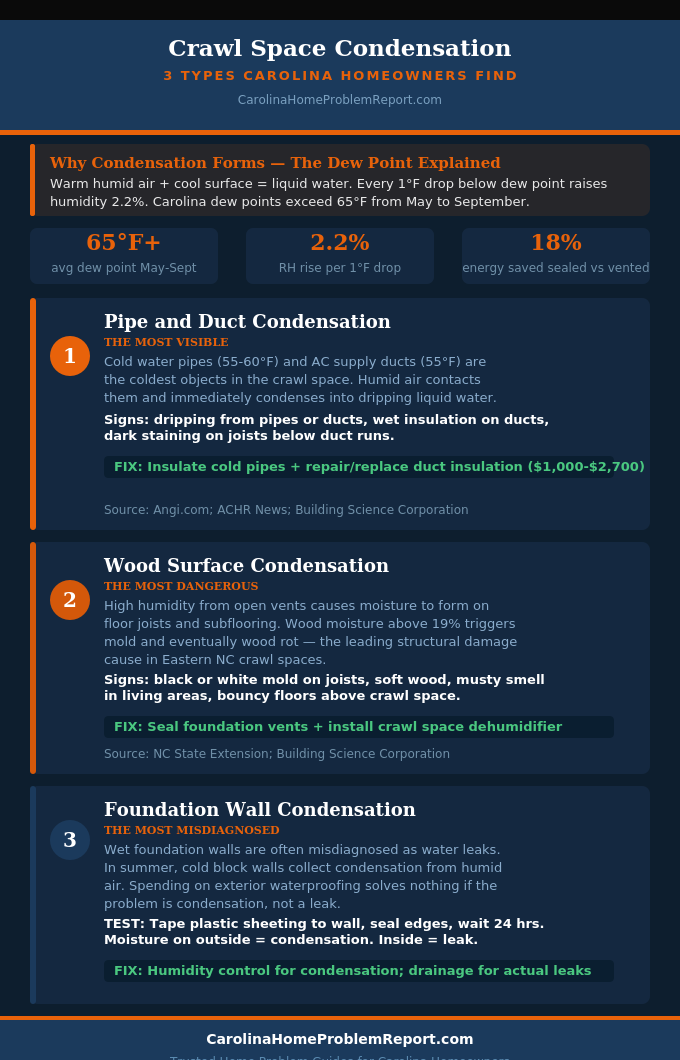
Crawl space condensation forms when warm humid air contacts cooler surfaces — pipes, ducts, floor joists, and foundation walls — and the surface temperature drops below the dew point. In the Carolinas, this happens most aggressively from May through September when outdoor dew points regularly exceed 65°F. Condensation is not a leak and it is not standing water — but left unaddressed it causes the same damage: mold, wood rot, and structural deterioration that can cost thousands to repair.
⭐ Key Takeaways
- ✓Crawl space condensation is caused by dew point physics — not leaks, not flooding, and not bad luck
- ✓For every 1°F the crawl space air cools below the outdoor dew point, relative humidity rises 2.2% — condensation follows automatically
- ✓Open foundation vents make condensation dramatically worse in Carolina summers by continuously pumping humid outdoor air onto cooler surfaces
- ✓Sealed crawl spaces in NC use 18% less energy for heating and cooling than identical homes with vented crawl spaces
- ✓The fix requires two steps working together — eliminate the source of humid air and insulate the cold surfaces condensation forms on
Crawl space condensation is one of the most misunderstood moisture problems Carolina homeowners encounter. Unlike standing water or a plumbing leak, condensation leaves no obvious source. You go into your crawl space and find water dripping from pipes, soaked insulation hanging from between the joists, or dark staining spreading across floor joists — and there is no rain, no leak, no flood to explain it. The water seems to be coming from nowhere.
It is not coming from nowhere. It is coming from the air itself — and once you understand the physics behind it, the solution becomes clear. Crawl space condensation is entirely predictable and entirely preventable. It is also one of the leading causes of mold growth, wood rot, and structural damage in Carolina homes precisely because homeowners mistake it for a minor inconvenience rather than the active moisture threat it actually is.
This guide explains exactly what causes crawl space condensation, why Carolina homes are especially vulnerable, where it forms and why, and what a complete fix looks like — including which steps must be done in which order to actually solve the problem rather than just treat the symptoms.
In This Article
- What Is Dew Point and Why Does It Matter for Crawl Spaces?
- Why Carolina Crawl Spaces Are So Vulnerable to Condensation
- The 3 Types of Crawl Space Condensation Carolina Homeowners Find
- Seasonal Condensation Calendar for Carolina Homes
- Warning Signs of Harmful Condensation Levels
- How to Stop Crawl Space Condensation — The Complete Fix
- Frequently Asked Questions
What Is Dew Point and Why Does It Matter for Crawl Spaces?
Crawl space condensation is a physics problem before it is a home maintenance problem. Understanding dew point is the key to understanding why condensation forms and why the solutions that seem logical — like opening more vents — actually make things dramatically worse in the Carolinas.
The dew point is the temperature at which air becomes so saturated with water vapor that it can no longer hold it — at which point that vapor turns into liquid water on whatever surface it contacts. According to the National Weather Service, a dew point above 60°F is enough to cause condensation indoors, especially in cooler, shaded areas like crawl spaces. The Carolinas regularly see outdoor dew points between 65°F and 75°F from May through September.
The Physics in Plain English
Think of a cold glass of iced tea sitting on a table on a humid Carolina summer afternoon. Water droplets form on the outside of the glass within minutes. The glass has not sprung a leak. The water is coming from the air itself — condensing on the cold glass surface because the glass surface is below the air’s dew point.
Your crawl space pipes, HVAC ducts, and floor joists are that glass. The warm humid Carolina summer air is the atmosphere around it. When that warm humid air enters the crawl space and contacts cooler surfaces, condensation forms — every time, automatically, by the laws of physics. Building Science Corporation research shows that for every 1°F the crawl space temperature drops below the outdoor dew point, relative humidity rises 2.2%. In a crawl space that is 10°F cooler than the outdoor dew point, that is a 22% jump in relative humidity — often pushing conditions from manageable to mold-ready in minutes.
This is why crawl space condensation in the Carolinas is not a sign that something has gone wrong with your home — it is a predictable consequence of the region’s climate interacting with standard crawl space construction. What determines whether that condensation damages your home is whether you have the right systems in place to prevent it.
Why Carolina Crawl Spaces Are So Vulnerable to Condensation
Crawl space condensation happens everywhere humid air contacts cooler surfaces. But Carolina homes experience it at a higher intensity and for a longer season than most of the country for several compounding reasons.
The dew point is extremely high for extremely long. The Carolina climate is classified as humid subtropical — meaning summer conditions with dew points above 65°F are not occasional weather events but the normal baseline from late spring through early fall. This extended high-dew-point season means crawl space condensation is not a summer week problem but a summer-long chronic condition in most vented crawl spaces.
Most older Carolina homes have vented crawl spaces. The North Carolina Building Code adopted the new closed crawl space standard in September 2004. Every home built before that — the majority of homes in both states — was built with open foundation vents. Those vents were designed on the theory that outdoor air would dry the crawl space. In a humid subtropical climate, the opposite is true. The vents continuously pump high-dew-point outdoor air directly onto the cooler surfaces inside the crawl space, generating condensation that would not exist if the vents were sealed.
The crawl space is significantly cooler than outdoor summer air. Because the crawl space is shaded, partially below grade, and in contact with the cooler soil, it stays meaningfully cooler than outdoor summer temperatures. This temperature differential is exactly what drives condensation — and in a Carolina summer where outdoor temperatures regularly hit 90°F+ while the crawl space stays at 70°F, the conditions for heavy condensation are reliably present for months at a time.
The AC system creates additional cold surfaces. Most Carolina homes have their HVAC ductwork running through the crawl space. When the air conditioning is running, supply ducts carrying 55°F conditioned air become intensely cold surfaces in a 70°F, high-humidity environment — exactly the conditions for maximum condensation. The ductwork becomes a continuous condensation machine throughout cooling season.
The 3 Types of Crawl Space Condensation Carolina Homeowners Find
Seasonal Condensation Calendar for Carolina Homes
Crawl space condensation in the Carolinas follows a predictable seasonal pattern. Understanding this calendar helps homeowners know when to inspect, when to intervene, and when conditions are most dangerous.
Condensation season begins. Outdoor dew points rise above 60°F. Crawl space condensation starts forming on pipes, ducts, and walls in vented crawl spaces. Best time to inspect before peak season.
Peak condensation season. Outdoor dew points regularly exceed 70°F. AC ducts are coldest relative to outdoor air. Maximum condensation on all surfaces. Highest mold risk of the year.
Tapering but still active. Dew points begin falling but remain above 60°F most days. Good inspection month to assess what July–August produced.
Condensation risk falls. Dew points drop below 55°F. Crawl space and outdoor temperatures converge. Good season for remediation and encapsulation work.
Reverse condensation risk. Cold outdoor air entering vented crawl spaces can condense on warmer heating ducts and plumbing — a different mechanism but still a concern in older vented foundations.
Transition season — watch carefully. Temperature swings between warm afternoons and cool nights create rapid dew point changes. Spring condensation can be particularly heavy. Good month for pre-season inspection.
Warning Signs of Harmful Condensation Levels
Some condensation on cold surfaces on a humid summer day is normal physics and does not necessarily indicate a damaging problem. These signs indicate condensation has reached levels that are causing or will soon cause structural damage:
- Visible mold growth on floor joists, rim joists, or subflooring — any color, any amount
- Insulation that is wet, sagging, or has fallen from between the floor joists
- Hygrometer reading above 60% consistently inside the crawl space
- Wood that feels soft or spongy when pressed firmly with a screwdriver or finger
- Musty smell inside the living space that worsens in summer or after humid weather
- Floors that feel bouncy or soft above the crawl space, especially near exterior walls
- Visible drip patterns on the soil floor beneath pipes or duct runs without any rain event
- Metal components showing rust — duct fasteners, pipe brackets, or support hardware
How to Stop Crawl Space Condensation — The Complete Fix
Crawl space condensation requires a two-part solution: eliminate the source of humid air entering the crawl space, and insulate the cold surfaces that condensation forms on. Doing only one without the other produces incomplete results. Here is the correct sequence:
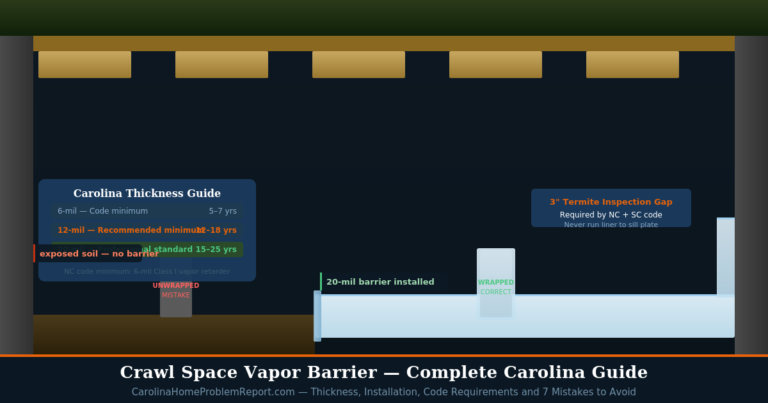
Install a vapor barrier across the entire crawl space floor. A 20-mil polyethylene liner covering 100% of the soil floor stops ground moisture from evaporating into the crawl space air. NC Building Code requires a minimum 6-mil vapor retarder covering 100% of exposed earth in closed crawl spaces — but professional grade 20-mil is significantly more durable.
Seal foundation vents. This is the most impactful single step for summer condensation control. Sealing vents stops the continuous entry of high-dew-point outdoor air that drives condensation on every surface in the crawl space. Vent sealing plugs or rigid foam insulation boards cut to fit are both effective.
Install a properly sized crawl space dehumidifier. After sealing vents, a crawl space dehumidifier actively removes moisture from the air and maintains relative humidity below 60% year-round. Standard room dehumidifiers are not rated for crawl space conditions — use a unit specifically designed for crawl space environments with automatic drainage or a pump. Target: 50–55% RH.

Insulate cold water pipes and inspect ductwork. Even in a well-controlled crawl space, cold water pipes and supply ducts can still attract condensation during peak Carolina humidity. Foam pipe insulation sleeves on all cold water lines and intact duct insulation on all supply runs stops surface condensation on these components specifically.
Consider full encapsulation for chronic or severe cases. Full crawl space encapsulation — vapor barrier on floor and walls, sealed vents, conditioned air or dehumidification — is the most comprehensive solution for homes with chronic condensation problems or significant mold and wood damage. A study published through Advanced Energy and referenced by NC State Extension found that sealed crawl spaces in NC use 18% less energy than vented crawl spaces with subfloor insulation.
Frequently Asked Questions
Is crawl space condensation the same as a leak?
No. Condensation forms when humid air contacts cooler surfaces — it is a physics phenomenon driven by dew point, not a structural failure. However, the damage condensation causes over time — mold, wood rot, deteriorating insulation — is just as serious as damage from a leak. The distinction matters for diagnosing the cause correctly and choosing the right fix.
Why is my crawl space dripping but there has been no rain?
If your crawl space is dripping during dry weather, the source is almost certainly condensation on cold pipes or HVAC ducts. Warm humid outdoor air entering through foundation vents is contacting the cold duct or pipe surfaces and condensing into liquid water. This is extremely common in Carolina crawl spaces from May through September and requires insulating pipes and ducts plus controlling crawl space humidity. Learn more at our guide to crawl space sweating.
Will opening more crawl space vents fix condensation?
No — in the Carolina climate, opening more vents makes condensation significantly worse. More vents means more high-dew-point outdoor air entering the cooler crawl space and contacting surfaces. This is why the NC Building Code moved to closed crawl spaces in 2004. The correct approach in the Southeast is to seal vents and actively control humidity.
How do I know if my crawl space has a condensation problem versus a groundwater problem?
Condensation problems are typically worst in summer during humid weather and improve in winter. Water intrusion from groundwater is triggered by rain events. Condensation produces general dampness across many surfaces; water intrusion enters at specific points. Use the plastic tape test described in the foundation wall section to distinguish between the two. Many Carolina crawl spaces have both problems occurring simultaneously.
What humidity level should a crawl space maintain to prevent condensation?
The target for a healthy Carolina crawl space is 50–55% relative humidity year-round. Below 60% consistently prevents mold growth on wood surfaces. A properly sized crawl space dehumidifier in a sealed crawl space can maintain this level automatically. A hygrometer placed in the crawl space gives you a continuous reading so you can monitor conditions without inspecting the space physically.
💡 Ready to Install the Dehumidifier for Step 3?
Once your vents are sealed and vapor barrier is in place, a properly sized crawl space dehumidifier is what holds humidity at 50–55% year-round and stops wood surface condensation permanently. Argendon’s range covers every crawl space size. Use code CHPR3 for 3% off.
Shop Argendon Dehumidifiers → Code CHPR3 saves 3% at checkout- Crawl space condensation in the Carolinas is not a structural failure — it is dew point physics operating predictably in a humid subtropical climate across a 5-month high-risk season from May through September.
- For every 1°F a crawl space temperature drops below the outdoor dew point, relative humidity rises 2.2% — in a typical Carolina summer a 10°F differential alone pushes crawl space humidity 22% above baseline.
- Opening more foundation vents makes summer condensation dramatically worse by pumping more high-dew-point outdoor air onto cooler crawl space surfaces — the correct fix is sealing vents, not adding more.
- The fix requires two steps working together: eliminate the humid air source (seal vents + vapor barrier) and actively control remaining humidity (crawl space dehumidifier) — neither works fully without the other.
- Sealed crawl spaces in NC use 18% less energy for heating and cooling than vented crawl spaces, according to Advanced Energy field research — encapsulation pays back in energy savings in addition to eliminating condensation.
The Carolina Home Problem Report editorial team researches and writes guides for homeowners across North and South Carolina. Our research draws on NC State Extension Service publications, Clemson Extension resources, EPA guidelines, Building Science Corporation data, and insights from licensed Carolina contractors.
📚 Key Concepts — Reference Sources
- Condensation (Wikipedia) — The physics process by which water vapor in humid air converts to liquid water when it contacts surfaces below the dew point temperature
- Dew Point (Wikipedia) — The temperature at which air becomes saturated and condensation begins to form on cooler surfaces — the core concept behind crawl space condensation
- Wood-Decay Fungus (Wikipedia) — The fungi that colonise floor joists and subfloor when sustained moisture above 19% wood moisture content creates suitable conditions
Carolina Home Problem Report is an informational resource for homeowners. We are not licensed contractors or mold assessors. Always consult a qualified professional before making home repair decisions. See our Disclaimer and Affiliate Disclosure.