HVAC Dehumidification: Why Your AC Can’t Close the Gap
HVAC dehumidification is real, but it has a documented structural ceiling of only 50-70% of a humid climate's actual dehumidification need. This isn't a sign your AC is broken, undersized, or poorly maintained — it's driven by the sensible heat ratio (the fixed split between how much of your AC's capacity goes to cooling versus drying) and a timing mismatch, since your home's peak heat load hits in the evening while its peak moisture load hits around 5am. A more efficient, higher-SEER system often makes this ceiling worse, not better. Below is exactly why this happens and what actually closes the gap.
⭐ Key Takeaways
- ✓Your AC dehumidifies as a side effect of cooling, not as its primary job — the two happen off the same coil
- ✓The sensible heat ratio (SHR) is the fixed split between cooling and drying — an SHR of 0.8 means 80% of capacity goes to temperature, only 20% to moisture
- ✓Counter-intuitively, higher-SEER equipment often dehumidifies less — some higher-end systems have latent capacity under 10% of total cooling capacity
- ✓Peak heat load hits in the evening; peak moisture load hits around 5am — a timing mismatch your AC was never designed around
- ✓Lowering the thermostat mostly makes the room colder, not drier — closing the gap needs a supplemental dehumidifier, not more AC
This is the mechanism behind a problem many Carolina homeowners already recognize from our guide on humidity even with the AC running — if you've already worked through that checklist (fan setting, filter, vents, duct leaks) and humidity is still an issue, this article explains the deeper structural reason why.
If you're ready to close this gap directly, our guide to sizing a whole home dehumidifier covers the supplemental system built specifically to do what a standard AC structurally cannot.
In This Article
How an AC Actually Removes Moisture
Air conditioning dehumidifies as a side effect of cooling, not as its primary job. Building-science guidance explains the mechanism through latent heat — "the energy hidden in all those water vapor molecules that make up this thing we call humidity." As air passes over your AC's cold evaporator coil, water vapor condenses out of it the same way condensation forms on a cold glass — that condensed water is what runs down your condensate drain. The cooling (sensible heat removal) and the dehumidifying (latent heat removal) happen simultaneously, but they're two different physical processes sharing the same piece of equipment.
The Sensible Heat Ratio: Why More Efficient Isn't Always Drier
The split between these two jobs is measured by the sensible heat ratio (SHR) — a worked example from the guidance shows a system removing "12,000 BTU per hour" of sensible heat against a total of "12,000 + 3,000 BTU/hr = 15,000 BTU/hr," giving an SHR of "12,000 ÷ 15,000 = 0.8." An SHR of 0.8 means 80% of the system's cooling capacity goes to temperature, and only 20% to moisture removal.
The Counter-Intuitive Part
Chasing higher cooling efficiency tends to push the SHR further toward sensible heat, not latent. The guidance notes that "higher-end equipment often has latent capacities less than 10 percent of the total cooling capacity." A more efficient, higher-SEER system optimized to cool your home using less energy often does proportionally less dehumidifying than an older, less efficient one — efficiency and dehumidification capacity pull in different directions rather than improving together.
The Timing Mismatch Nobody Designs Around
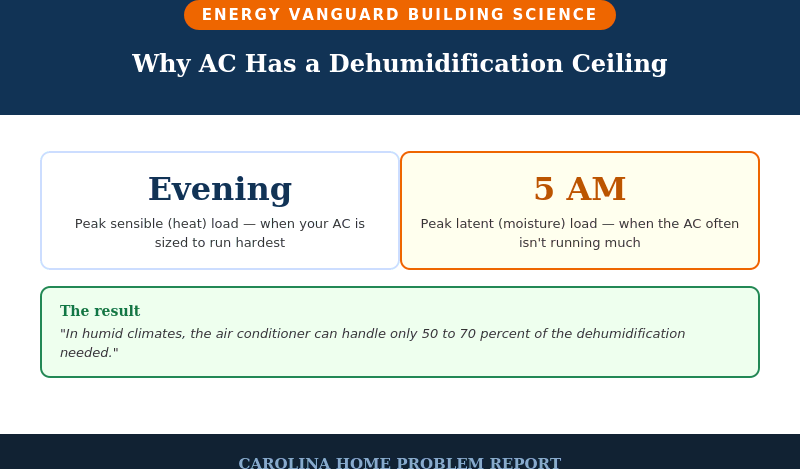
The deeper structural problem is when moisture and heat loads actually peak, and they don't peak together. The guidance identifies this directly: "the peak sensible load happens in the evening. The peak latent load occurs at about 5 am." Your AC is sized and controlled to handle the evening heat load — the time of day people are home, cooking, and the sun has spent all day heating the house. But the highest moisture load hits hours later, overnight into early morning, when the thermostat isn't calling for nearly as much cooling and the system simply isn't running enough to remove that moisture.
The consequence of this mismatch, stated plainly: "in humid climates, the air conditioner can handle only 50 to 70 percent of the dehumidification needed." That's not a sign of a broken or undersized system — it's the structural ceiling of using a temperature-controlled cooling system as your only dehumidification method in a genuinely humid climate like Carolina's.
Why "Just Lower the Thermostat" Doesn't Really Fix It
A common instinct when a home feels humid despite the AC running is to set the thermostat a few degrees lower, on the theory that more cooling means more dehumidification. Because sensible and latent cooling happen together off the same coil at a ratio largely fixed by the equipment's design, this mostly just makes the room colder rather than meaningfully drier — you end up with the classic "cold and clammy" complaint rather than a genuinely comfortable, lower-humidity space. The SHR doesn't shift dramatically just because the thermostat setpoint changes; the system still cools and dehumidifies in roughly the same proportion, just more of both.
What This Means for Your Home
If your AC is running normally, cooling your home to the set temperature, and you're still experiencing the humidity symptoms covered in our humidity even with AC guide, this 50-70% ceiling is very likely why — the system is doing its designed job of managing temperature, and the remaining 30-50% of your dehumidification need simply isn't something a standard AC was ever built to close. This is the structural gap a supplemental whole home dehumidifier is specifically designed to fill, working alongside your existing AC rather than replacing it.
Frequently Asked Questions
Why doesn't my AC remove all the humidity even when it's running constantly?
Because dehumidification is a byproduct of cooling, not a separately controlled function. The sensible heat ratio fixes roughly how much of the system's capacity goes to temperature versus moisture, and a timing mismatch between evening heat loads and overnight moisture loads means even a perfectly running AC can only handle about 50-70% of a humid climate's actual dehumidification need.
Does a higher-SEER AC dehumidify better than an older unit?
Often the opposite. Higher-efficiency equipment is optimized to cool using less energy, which tends to push the sensible heat ratio further toward temperature and away from moisture removal — some higher-end systems have latent capacity under 10% of total cooling capacity.
Will lowering the thermostat a few degrees fix the humidity?
Not reliably. Sensible and latent cooling happen together off the same coil at a largely fixed ratio, so lowering the setpoint mostly makes the room colder rather than meaningfully drier — the "cold and clammy" complaint.
What actually closes the remaining 30-50% gap?
A supplemental whole-home or standalone dehumidifier, sized to work alongside your existing AC rather than replace it. It handles the moisture removal your AC was structurally never designed to complete on its own.
Key Facts About HVAC Dehumidification:
- A standard AC removes only 50-70% of a humid climate's actual dehumidification need — a structural ceiling, not a malfunction.
- The sensible heat ratio (SHR) fixes the split between cooling and drying — a typical 0.8 SHR means 80% of capacity goes to temperature.
- Higher-SEER, more efficient equipment often dehumidifies less, not more — some units have under 10% latent capacity.
- Peak heat load (evening) and peak moisture load (around 5am) don't align — the AC isn't running enough when moisture peaks.
- Lowering the thermostat doesn't meaningfully fix it — a supplemental dehumidifier is what closes the gap.
If your AC is running normally but humidity persists, an HVAC professional can confirm your system's SHR and help you size a supplemental dehumidifier correctly.
Find an HVAC Professional Near You →This guide was researched using Energy Vanguard's published building-science guidance on dehumidification loads and sensible heat ratio, cross-referenced against our own AC and humidity documentation, to explain a structural HVAC limitation most homeowners assume is a repair issue rather than a design one. We are not contractors or HVAC technicians — we are a research team dedicated to giving Carolina homeowners clear, locally specific, unbiased answers.
Carolina Home Problem Report is an informational resource for homeowners. We are not licensed contractors or HVAC technicians. Always consult a qualified professional before making home repair decisions. See our Disclaimer and Affiliate Disclosure.