Slab vs Crawl Space NC SC [The Complete Carolina Comparison — Construction Cost, Utility Access, Moisture, Flood Zones, and Which Is Better by Region]
In NC and SC the answer depends on where in the state you are and what matters most to you. Slabs are cheaper to build and easier to maintain day-to-day but make plumbing and electrical repairs expensive and disruptive. Crawl spaces cost more to build and require moisture management but provide full utility access and flood elevation. In coastal NC and SC — particularly flood zone areas — crawl spaces are often preferred or required. In the Piedmont, both work well with proper management. The long-term utility access advantage of the crawl space is significant in a state where clay soils shift and plumbing eventually needs attention.
⭐ Key Takeaways
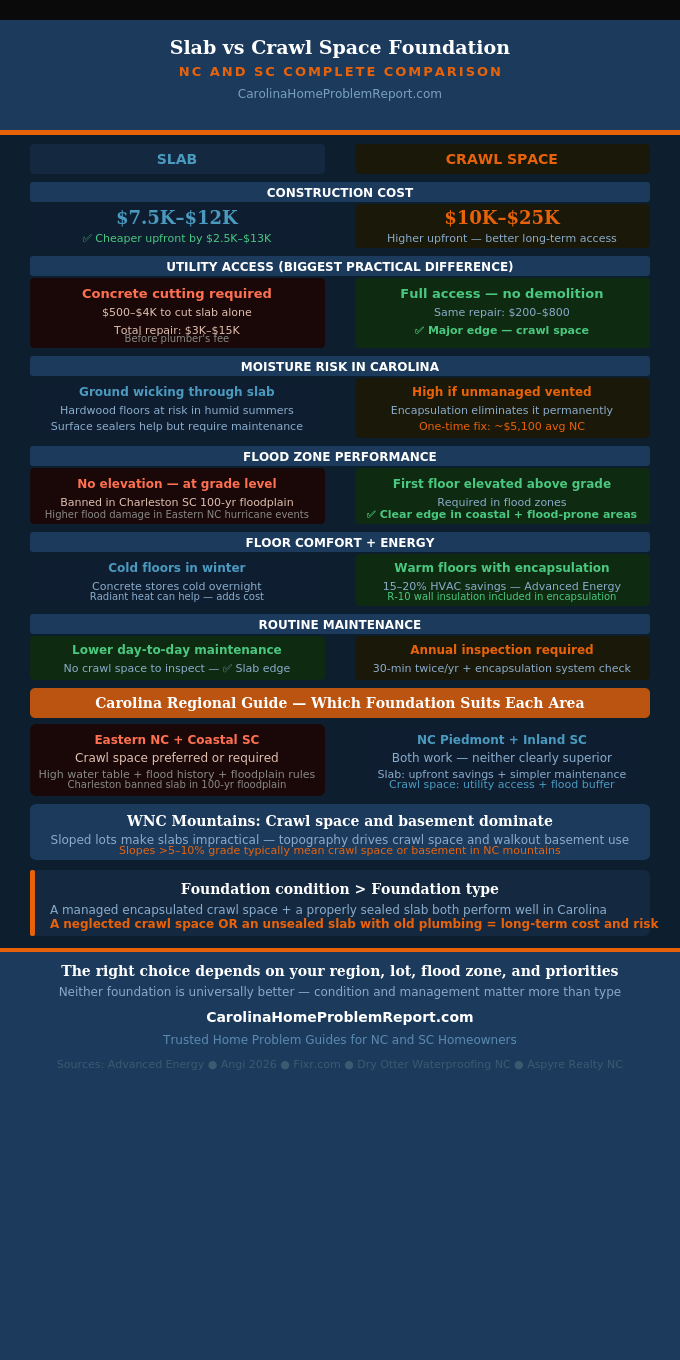
- ✓Slab construction costs $7,500–$12,000 for an average NC home vs $10,000–$25,000 for a crawl space — slabs are cheaper upfront but that gap narrows quickly if slab plumbing ever needs repair
- ✓Repairing a plumbing leak in a slab home requires cutting concrete — costs $500–$4,000 just for the cut and patch, before the plumbing repair itself. The same repair in a crawl space home takes a plumber an hour.
- ✓In coastal SC — including Charleston — slab-on-grade foundations have been banned for new home development in the 100-year floodplain since the city mandated elevated construction standards
- ✓Hardwood floors over a slab in humid Carolina summers are vulnerable to moisture wicking through the concrete causing cupping, warping, and staining — a problem that does not affect crawl space homes with properly managed spaces below
- ✓Neither foundation is universally better — the right answer depends on your region, your soil, your flood zone, and your priorities between upfront cost and long-term maintenance access
The slab vs crawl space NC SC comparison comes up in two situations for Carolina homeowners — when buying an existing home and evaluating foundation type, and when building new and making the construction decision. The stakes are different in each scenario. When buying, you are evaluating what you are taking on in terms of maintenance complexity and future repair costs. When building, you are making a structural and financial decision that will affect the home for its entire lifespan.
The generic "slab vs crawl space" articles available nationally give you a broad comparison that applies to Minnesota and Florida equally. What Carolina homeowners actually need is the comparison made in the context of the specific climate, soil, and flood zone conditions of NC and SC — conditions that shift the comparison meaningfully relative to national averages.
This article gives Carolina homeowners the specific comparison they need — construction costs, long-term maintenance costs, utility access, moisture behaviour, flood zone implications, termite risk, energy performance, and real estate considerations — with regional specifics for the Piedmont, Eastern NC, the NC mountains, and coastal SC where the answers genuinely differ.
In This Article
- Head-to-Head Overview — 10 Categories Compared
- Construction Cost — Slab Is Cheaper Upfront
- Utility Access — The Biggest Practical Difference
- Moisture Behaviour in Carolina
- Flood Zone and Termite Considerations
- Energy Performance and Floor Comfort
- Which Is Better — By Carolina Region
- Frequently Asked Questions
Head-to-Head Overview — 10 Categories Compared
| Category | Slab Foundation | Crawl Space Foundation | Edge |
|---|---|---|---|
| Construction cost | $7,500–$12,000 | $10,000–$25,000 | Slab |
| Build time | Faster — single pour | Longer — excavation + framing | Slab |
| Utility access | Requires concrete cutting for plumbing / electrical repairs | Full access — plumber/electrician can reach everything | Crawl space |
| Routine maintenance | Lower — no crawl space to inspect or manage | Annual inspection + moisture management required | Slab |
| Moisture risk (NC/SC) | Ground moisture wicks through unsealed slab — hardwood floors at risk in humid seasons | High if unmanaged; eliminated by encapsulation | Draw |
| Flood zone performance | Vulnerable — no elevation above grade | First floor elevated — required in Charleston 100-yr floodplain | Crawl space (coastal) |
| Termite risk | Requires pre-treatment before pour; hidden entry through expansion joints | Entry through soil-wood contact; manageable with encapsulation and inspections | Draw |
| Floor comfort (winter) | Cold floors — concrete stores cold overnight | Warmer with encapsulation + R-10 wall insulation | Crawl space (sealed) |
| Energy performance | Good thermal mass; less air leakage when properly sealed | 15–20% HVAC savings when encapsulated (Advanced Energy) | Draw (depends on system) |
| Pest control | Fewer entry points above grade but harder to inspect for termite activity | More entry routes but annual inspections catch activity early | Draw |
Construction Cost — Slab Is Cheaper Upfront
The slab's construction cost advantage is real and significant for new builds. It is important to understand what that advantage actually covers — and what it does not.
The slab cost advantage erodes over time
The $5,000–$13,000 upfront savings from choosing a slab can disappear with a single plumbing event. Replacing a polybutylene supply line or a cast iron drain section in a slab home requires core drilling or saw-cutting the concrete — $500–$4,000 just for the concrete work, before the plumber's fee. In a crawl space home, the same repair costs a plumber a few hours of access time. Over a 30-year ownership period, the likelihood of at least one slab penetration event for most NC homes is significant.
Utility Access — The Biggest Practical Difference
This is the single most consequential operational difference between slab and crawl space homes, and it is the one most often underweighted by homebuyers focused on upfront cost:
⚠ Slab home — utility repair scenario
A supply line springs a pinhole leak under the slab. Water migrates under the concrete before any surface evidence appears. By the time the homeowner notices damp floors or a water bill spike, the leak has been running for weeks. The repair requires:
- Leak detection service to locate the exact position under the slab
- Core drilling or saw-cutting the finished floor
- Excavating below the concrete to access the pipe
- Plumbing repair
- Concrete patching and floor finish repair
Total: $3,000–$15,000 depending on depth, pipe type, and floor finish
✅ Crawl space home — same scenario
The same pinhole leak in a crawl space home drips onto the vapour barrier below. The homeowner notices a musty smell or finds wet substrate during their annual inspection. The repair requires:
- Plumber enters through the access door
- Visually locates the leak source
- Repairs the pipe
Total: $200–$800 plumber's fee — no demolition, no patching, no floor refinishing
Moisture Behaviour in Carolina
Both foundation types have moisture challenges in Carolina — they are just different moisture challenges:
Flood Zone and Termite Considerations
Flood zones — crawl space elevation matters enormously in coastal NC and SC
Charleston, SC has banned slab-on-grade foundations for new home development in the 100-year floodplain. Homes must be elevated — and a crawl space on a higher foundation, or a pier-and-beam system, achieves that elevation. A slab home at grade in a flood zone has no buffer when surface water rises. The first floor is at ground level.
In Eastern NC — which has a high water table and experienced significant flooding from Hurricanes Floyd (1999), Matthew (2016), and Florence (2018) — homes with crawl space foundations built at adequate elevation consistently fared better than slab homes at grade. This is not a theoretical difference. It is documented in FEMA damage assessments from each event.
Termites — both foundation types are at risk in NC and SC
Both foundation types require active termite management in the Carolinas. Slab foundations require pre-pour chemical soil treatment and regular perimeter treatments — but termite entry through expansion joints and around pipe penetrations is difficult to detect. Crawl space foundations allow direct visual inspection of mud tubes and wood condition during annual inspections — making early detection more reliable. Neither type is categorically safer from termites in NC and SC; the inspection and treatment frequency is more important than the foundation type.
Energy Performance and Floor Comfort
Which Is Better — By Carolina Region
The right answer genuinely differs by region within NC and SC:
Both work — older homes predominantly have crawl spaces, new construction often uses slabs. The clay soil makes both manageable with proper drainage. Crawl space has the edge for homes with older plumbing systems that will need future access. Slabs are attractive for new construction where the upfront savings are significant and the build will use modern piping systems that rarely fail.
Crawl space has a significant advantage due to the high water table and flood history. The elevation buffer matters. Homes in FEMA AE or VE flood zones need to be elevated — a slab at grade does not achieve this. Many Eastern NC slab homes experienced significant flood damage in recent hurricane events that elevated crawl space homes avoided.
Crawl space or elevated construction is required in flood zones — slabs have been banned from the 100-year floodplain in Charleston. Even outside regulated flood zones, the high water table and storm surge risk make elevation a priority. Pier-and-beam and crawl space construction dominate the Lowcountry for good reason.
Crawl space and basement construction dominate due to topography — sloped lots make slabs impractical in many areas. Where the grade falls away steeply, a crawl space or walkout basement is the only practical option. Slabs are used on flat lots in mountain towns but are less common than in the Piedmont.
Similar to NC Piedmont — both work. Conditions in Greenville and Columbia are more similar to Charlotte than to coastal SC. New construction often uses slabs for cost efficiency. Existing housing stock is dominated by crawl spaces in older neighbourhoods. Both require moisture management in the humid Upstate summers.
Frequently Asked Questions
Is a slab or crawl space better in NC or SC?
Neither is universally better — the right answer depends on your region, lot conditions, flood zone, and priorities. In flood-prone areas of Eastern NC and coastal SC, a crawl space with proper elevation is strongly preferred over a slab at grade. In the Piedmont, both work well — slabs offer upfront savings, crawl spaces offer long-term utility access advantages. For new construction, a slab with modern piping is often cost-effective. For older homes with existing plumbing, the crawl space utility access advantage becomes more valuable over time.
Is a slab foundation cheaper than a crawl space in NC?
Yes, upfront — a slab foundation costs $7,500–$12,000 for an average NC home versus $10,000–$25,000 for a crawl space. The gap is $2,500–$13,000 at time of construction. However, this advantage erodes with any plumbing or electrical repair that requires concrete cutting — which costs $500–$4,000 just for the concrete work, before the trade repairs. Over a 30-year ownership period, the total cost of ownership is more comparable between the two foundation types than the construction cost difference suggests.
Do slab homes have moisture problems in NC?
Yes — ground moisture wicks upward through concrete via capillary action, particularly in Carolina's humid summers. Hardwood floors installed directly over a slab are vulnerable to moisture-related cupping and warping. This is less visible than crawl space moisture problems but can be equally expensive. A properly sealed slab with a vapour retarder below the concrete, combined with appropriate flooring choices and maintained HVAC dehumidification, manages this risk — but it requires attention, not just a one-time fix.
Should I buy a slab home or crawl space home in Carolina?
Either can be a good purchase — the foundation type is less important than the condition of the foundation. Before buying any Carolina home, have the crawl space specifically inspected (if applicable), and for slab homes ask about the age and material of the supply lines and any history of concrete repairs. A slab home with old polybutylene or copper supply pipes carries more future repair risk than one with modern PEX. A crawl space home with a well-maintained encapsulated space is a better purchase than a slab home with a problematic moisture history.
Why do some NC/SC areas have slabs instead of crawl spaces?
The shift toward slabs in new Carolina construction is primarily economic — slabs are cheaper and faster to build. As building costs increased and production builders sought to standardise construction, slabs became more common for new developments on flat lots. According to NC State Extension's guidance, the regional transition from crawl space to slab construction in newer NC subdivisions is well established, though crawl spaces continue to dominate the existing housing stock and in areas where topography, soil, or flood zone requirements make slabs impractical.
The slab vs crawl space decision in Carolina comes down to: where you are in the state, what the lot conditions are, and what matters more to you between upfront cost and long-term utility access. In coastal and flood-prone areas, crawl space elevation is not optional. In the Piedmont, slabs win on construction economics but crawl spaces win on maintenance access. Neither type is inherently superior — the condition and management of the foundation you have matters far more than which type it is.
If you are evaluating a specific property and want to know what you are taking on, a professional crawl space assessment or foundation inspection is the most reliable starting point.
Get a Free Foundation Assessment →Research draws on Advanced Energy field studies, Angi foundation cost data 2026, Fixr.com foundation comparison, Dry Otter Waterproofing NC foundation guide, Aspyre Realty Group coastal NC comparison, Lemon Lane Living coastal SC guide, and NC State Extension Publications.
Carolina Home Problem Report is an informational resource for homeowners. We are not licensed contractors or engineers. Foundation decisions for new construction should involve a licensed structural engineer. See our Disclaimer.