NC and SC Crawl Space Building Code [The Hidden Requirements That Affect Your Home’s Value — Complete R409 Guide for Carolina Homeowners]
North Carolina and South Carolina both permit closed crawl spaces under their residential building codes — but with specific requirements. NC code under Section R409 of the 2024 NC Residential Code (mandatory July 1, 2025) requires a Class I vapor retarder, sealed foundation vents, mechanical drying, and a 3-inch termite inspection gap. SC follows IRC Section R408.3 for unvented crawl spaces with similar requirements. A permit is required in NC for any vented-to-closed conversion. Code compliance matters not just for the inspection — it matters at resale, where unpermitted crawl space work is one of the most common and expensive deal-killers in the Carolina real estate market.
⭐ Key Takeaways
- ✓NC was one of the first states in the country to codify closed crawl spaces — adopting Section R409 in 2009, significantly updated in 2018 and 2024
- ✓A permit is required in NC for converting any vented crawl space to a closed crawl space — confirmed by NC Office of State Fire Marshal December 2025
- ✓The 3-inch termite inspection gap (3-inch minimum, 4-inch maximum per 2024 code) is NC-specific — liner must NOT run to the sill plate
- ✓SC requirements vary more by jurisdiction than NC — always confirm with your local county or municipal building department before any work begins
- ✓Unpermitted crawl space work is one of the most common deal-killers in Carolina home sales — buyers and inspectors flag it, and retroactive permitting or rework can cost $2,000–$8,000
NC and SC crawl space building code matters to every homeowner who is planning, has completed, or is purchasing a home with a crawl space encapsulation or moisture control system. It matters during the project — because non-compliant work fails inspection and may need to be redone. It matters after the project — because unpermitted work creates liability at resale. And it matters when evaluating a contractor's quote — because a quote that does not mention permits for a vented-to-closed conversion in NC is a red flag.
North Carolina has one of the most developed and specific crawl space code frameworks in the country. According to the NC Office of State Fire Marshal's December 2025 guidance, a permit is required for converting a conventional vented crawl space to a closed crawl space under Section R409 of the 2018 NC Residential Code (extended to the 2024 code) regardless of project cost. NC has 250+ specialty crawl space contractors and 15+ years of code experience under R409 — meaning NC building inspectors are well-versed in what compliant work looks like and will flag non-compliant installation.
This guide gives Carolina homeowners the complete plain-English breakdown of what the NC and SC building codes actually require for crawl spaces — both vented and sealed — including the history of how the code evolved, every specific requirement from the current code text, what triggers a permit, and why code compliance is the difference between an encapsulation that adds value to your home and one that creates problems at the worst possible moment.
In This Article
- How NC Crawl Space Code Evolved — 2004 to 2024
- NC Section R408 — Vented Crawl Space Requirements
- NC Section R409 — Closed Crawl Space Requirements (Complete)
- NC Permit Requirements — What Triggers a Permit
- SC Building Code Requirements for Crawl Spaces
- Key Differences — NC vs SC
- Code Compliance at Resale — Why It Matters More Than You Think
- Frequently Asked Questions
How NC Crawl Space Code Evolved — 2004 to 2024
Understanding the history of NC's crawl space code helps explain why the requirements are structured the way they are, and why contractors with years of experience in NC often install better than contractors from states where closed crawl space code is newer.
NC becomes one of the first states in the country to adopt closed crawl space provisions in its residential code. The framework allows sealed crawl spaces as an alternative to vented — the concept is established but requirements are relatively basic at this stage.
NC Residential Code is significantly updated. Section R408.3 for sealed crawl spaces establishes the core requirements that the industry now builds to: continuous vapor retarder, sealed vents, conditioned air supply or dehumidifier, and insulation per climate zone. NC contractors begin building under this framework, developing 15+ years of experience that makes NC one of the best-quality crawl space markets in the country.
The 2018 NC Residential Code refines Section R409. Key changes include the explicit 3-inch termite inspection gap requirement for wall liners and wall insulation, clarification of the combustion air requirements for fuel-burning appliances, and the requirement that drains terminate outdoors or to a sump pump rather than into the crawl space floor. The permit requirement for vented-to-closed conversions is also clarified.
The 2024 NC Residential Code for One- and Two-Family Dwellings becomes mandatory July 1, 2025. Section R409 continues as the closed crawl space framework. The 3-inch minimum, 4-inch maximum termite inspection gap is codified explicitly. Vapor retarder requirements, mechanical drying requirements, and permit obligations all continue from the 2018 framework with refinements. NC OSFM issues formal guidance in December 2025 confirming permit requirement for all vented-to-closed conversions.
NC Section R408 — Vented Crawl Space Requirements
Section R408 governs the traditional vented crawl space approach. Existing NC homes with vented crawl spaces are not required to convert to sealed — but if they maintain the vented approach, R408 sets the minimum requirements.
🏭 NC Section R408 — Key Requirements for Vented Crawl Spaces
- Foundation vent openings: Minimum net area of 1 sq ft per 150 sq ft of crawl space floor area. Reduced to 1 sq ft per 1,500 sq ft where an approved vapor retarder covers the ground.
- Vent placement: At least one vent within 3 feet of each corner of the building. Vents must be arranged to provide cross-ventilation.
- Ground vapor retarder: A minimum 6-mil vapor retarder is still required on the ground in a vented space — exposed dirt without any liner is not code-compliant even with open vents.
- Ground clearance: A minimum 18 inches clearance between the bottom of floor joists and grade, 12 inches between grade and the bottom of girders.
- Insulation placement: Insulation in a vented crawl space must be placed in the floor system — wall insulation is not permitted as the only insulation in a vented crawl space.
- Access opening: Minimum 18 inches by 24 inches access to the crawl space.
- Flood resistance: In flood-prone areas per Table R301.2(1), foundation walls must be provided with flood openings per Section R323.2.2 — standard vent sealing is not permitted in FEMA-designated flood zones without flood vent compliance.
NC Section R409 — Closed Crawl Space Requirements (Complete)
Section R409 is the complete framework for closed crawl spaces in North Carolina. Every sub-section is listed below in plain English — this is the most complete plain-language summary of NC Section R409 available for homeowners.
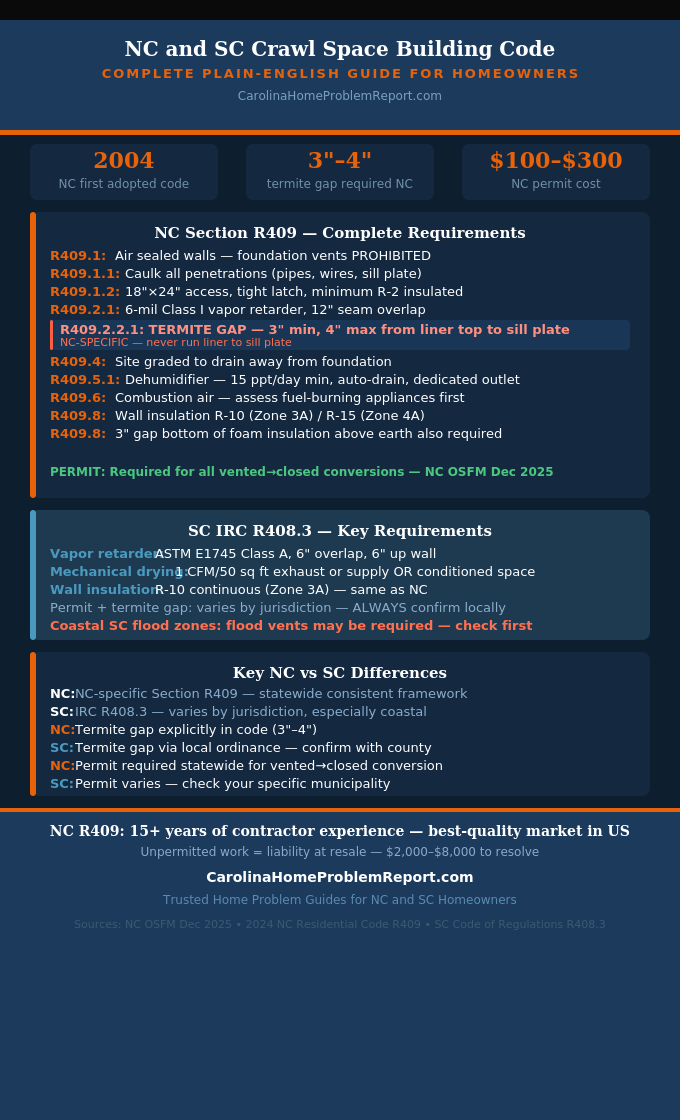
R409.1 — Air Sealed Walls
Closed crawl spaces shall be built to minimise entry of outdoor air. Foundation wall vents are specifically prohibited. All gaps at the foundation wall and floor assembly must be sealed with caulk, gaskets, or sealant — including around the access door frame, between the foundation and sill plate, and at all plumbing, mechanical, electrical, and gas penetrations.
R409.1.2 — Access Panel/Door
Minimum access opening of 18 inches by 24 inches required. Access door must be tight-fitting with a latch mechanism. Access panels or doors must be insulated to a minimum of R-2.
R409.2.1 — Ground Vapor Retarder
A minimum 6-mil polyethylene vapor retarder (Class I) or equivalent shall be installed covering all exposed earth in the crawl space. Joints lapped not less than 12 inches. The floor shall be graded to drain to low spots. A drain to daylight or sump pump is required at each low spot. Drains must be separate from gutter systems.
R409.2.2.1 — Wall Liner Termite Inspection Gap ⚠
The most NC-specific requirement. A clear, unobstructed 3-inch minimum, 4-inch maximum inspection gap must be maintained between the top of the wall liner and the bottom of the wood sill plate. This gap is required to allow visual inspection for termite mud tubes. The liner must NOT run to the sill plate. This gap does not create an energy penalty under NC code.
R409.2.4 — Drains and Vent Terminations
All drains including water heater pressure relief, drain pans, and condensate drain pipes shall terminate outdoors, to crawl space floor drains, or to interior pumps. They shall NOT discharge water into the crawl space floor. Dryer vents shall terminate outdoors.
R409.4 — Site Grading
The building site must be graded to drain water away from the crawl space foundation per Section R401.3 requirements. This is an exterior work requirement that must be satisfied before encapsulation is considered complete.
R409.5 — Space Moisture Vapor Control (Mechanical Drying)
Closed crawl spaces shall be provided with a mechanical drying capability. At least one of the following five methods is required:
- R409.5.1 — Dehumidifier: A permanently installed dehumidifier with minimum rated capacity of 15 pints per day. Condensate must drain to daylight or interior condensate pump. A dedicated electrical outlet is required.
- R409.5.2 — Supply air from HVAC: Supply air from the dwelling's air conditioning system ducted into the crawl space at 1 CFM per 30 sq ft of floor area. No return air duct from crawl space to HVAC is permitted. Must include a backflow damper.
- R409.5.3 — House air fan: House air blown into the crawl space by a continuously-rated fan at 1 CFM per 50 sq ft of floor area. An air relief vent to outdoors is permitted.
- R409.5.4 — Exhaust fan: Crawl space air exhausted outdoors by a continuously-rated fan at 1 CFM per 50 sq ft. No make-up air requirement.
- R409.5.5 — Conditioned space: Crawl space designed as a conditioned space with wall insulation per energy code requirements.
Most contractors use R409.5.1 (dehumidifier) as it is the most practical and reliable method for Carolina conditions.
R409.6 — Combustion Air Warning
The code notes explicitly: "The air sealing requirements of a closed crawl space may result in a foundation which cannot provide adequate combustion air for fuel-burning appliances." Any fuel-burning appliances in or near the crawl space that draw combustion air from the crawl space must have a dedicated combustion air supply installed as part of the conversion — this is professional work.
R409.8 — Wall Insulation
Where the floor above the closed crawl space is not insulated, the foundation walls shall be insulated per Table N1102.1 — R-10 continuous minimum for Climate Zone 3A (most of NC and SC), R-15 for Climate Zone 4A (NC mountains). When foam plastic insulation is used on foundation walls, it must maintain the 3-inch minimum termite inspection gap at the top AND a 3-inch minimum clearance gap at the bottom from the earth floor surface. Ignition barrier requirements apply if the space is used as a plenum.
NC Permit Requirements — What Triggers a Permit
The NC Office of State Fire Marshal issued formal guidance in December 2025 confirming the permit requirement. Here is exactly what triggers a permit and what does not:
⚠️ Verify your contractor pulls the permit
A contractor who does not mention pulling a permit for a vented-to-closed conversion is either unaware of the requirement or is intentionally skipping it. Either situation creates liability for you as the homeowner. Ask before signing any contract: "Will you pull the required building permit for this conversion?" If the answer is no or uncertain, that is a significant red flag. The permit is not a bureaucratic formality — it triggers an inspection that confirms the work meets code.
SC Building Code Requirements for Crawl Spaces
South Carolina adopts the International Residential Code (IRC) as its base residential code, with state and local amendments. SC Code of Regulations Section 8-1221 governs unvented crawl spaces under IRC R408.3. Here is the plain-English breakdown:
🏭 SC IRC R408.3 — Unvented Crawl Space Requirements
- Vapor retarder: Exposed earth must be covered with a continuous vapor retarder meeting ASTM E1745 Class A. Joints must overlap by 6 inches and be sealed or taped. Edges must extend at least 6 inches up the stem wall and be attached and sealed.
- Mechanical drying: One of the following must be provided — continuously operated mechanical exhaust at 1 CFM per 50 sq ft, supply air from conditioned space at 1 CFM per 50 sq ft, or the crawl space designed as a conditioned space with insulation per the energy code.
- Insulation: Climate Zone 3A (most of SC) — R-10 continuous on foundation walls if the floor above is not insulated. Climate Zone 3 coastal (Myrtle Beach area and Grand Strand) — same Zone 3A requirements.
- Termite inspection gap: Not explicitly specified in the IRC as it is in NC code — but required by local ordinance in most SC counties due to SC's high termite pressure. Always confirm with your local building department.
- Flood zones: Coastal SC homes in FEMA Special Flood Hazard Areas may require flood vents that remain operational — check with your local building department before sealing any vents.
🏭 SC Permit Requirements
- SC permit requirements for crawl space work vary more by jurisdiction than NC — there is no statewide requirement as clear as NC's OSFM guidance
- Vapor barrier installation alone typically does not require a permit in SC municipalities
- Electrical work (dehumidifier circuit), plumbing modifications, and structural changes trigger permits in essentially all SC jurisdictions
- Inland SC (Columbia, Greenville, Spartanburg) — requirements track closest to NC's framework
- Coastal SC (Charleston, Myrtle Beach, Beaufort) — stricter requirements due to flood zone considerations; confirm locally
- Always contact your specific county or municipal building department before beginning any crawl space conversion work in SC
Key Differences — NC vs SC
| Requirement | North Carolina | South Carolina |
|---|---|---|
| Code basis | NC-specific Section R409 (2024 NC Residential Code) | IRC R408.3 with SC state amendments |
| Vapor retarder minimum | 6-mil Class I polyethylene, 12-inch seam overlap | ASTM E1745 Class A, 6-inch seam overlap |
| Termite inspection gap | 3-inch minimum, 4-inch maximum — explicitly in code | Not explicitly in IRC — required by local ordinance in most SC counties |
| Mechanical drying minimum | 15 pints per day dehumidifier OR HVAC supply OR exhaust fan | 1 CFM per 50 sq ft exhaust or supply OR conditioned space |
| Wall insulation (Zone 3A) | R-10 continuous minimum | R-10 continuous minimum (same) |
| Permit for conversion | Required statewide — confirmed OSFM Dec 2025 | Varies by jurisdiction — check locally |
| Code consistency | High — single statewide framework, 15+ years of contractor experience | Variable — IRC base with municipal variations, especially coastal |
Code Compliance at Resale — Why It Matters More Than You Think
This is the aspect of crawl space code that homeowners most commonly overlook until they are under contract for a home sale and a buyer's inspector finds a problem. Here is the real-world impact of code compliance — and non-compliance — at resale in the Carolina market:
A permitted, code-compliant sealed crawl space is a value-positive feature. Carolina real estate agents increasingly flag encapsulated crawl spaces as a selling point. Buyers pay more for homes with documented moisture control. Home inspectors give positive reports. Appraisers note the improvement. The investment returns positively at sale.
Unpermitted crawl space work is flagged during buyer due diligence. When a buyer's inspector finds a sealed crawl space with no permit on record, the buyer requests either retroactive permitting (which may require opening walls for inspection) or a price reduction to cover the cost of having a licensed contractor certify or redo the work. These credits typically run $2,000–$8,000 and can kill deals.
Non-compliant work — missing termite gap, no dehumidifier, liner to sill plate — is flagged specifically. NC inspectors are well-trained on R409 compliance. A home inspector who finds a sealed crawl space with liner running to the sill plate will note it as non-compliant. A sealed space without mechanical drying will be noted as non-compliant. These findings trigger buyer credits or requests to fix before closing.
Always request the permit and R409 compliance summary from your contractor. Reputable NC contractors routinely provide an R409 compliance summary as part of their project close-out documentation. This documentation adds value at resale by demonstrating that the work meets code — buyers and their agents can see exactly what was installed and confirmed by the building department.
Frequently Asked Questions
Do I need a permit for crawl space encapsulation in North Carolina?
Yes — if the project converts a vented crawl space to a closed crawl space by sealing the foundation vents. The NC OSFM confirmed in December 2025 that a permit is required for this conversion regardless of project cost. Simple vapor barrier installation on the floor only, without sealing vents or installing mechanical systems, is typically permit-exempt — but confirm with your local building department before starting any work. The permit cost is typically $100–$300 and includes a building department inspection to confirm R409 compliance.
What is the 3-inch termite inspection gap and why is it required in NC?
The 3-inch termite inspection gap is an NC-specific code requirement in Section R409.2.2.1 that mandates a clear, unobstructed gap of 3 inches minimum and 4 inches maximum between the top of wall liners and wall insulation and the underside of the wood sill plate. The gap exists specifically so that pest inspectors can visually check for Eastern subterranean termite mud tubes during annual termite inspections — the most common termite entry point in Carolina homes is at the foundation wall/sill plate junction. Running liner to the sill plate eliminates this inspection pathway and is not code-compliant in NC.
What does NC code require for crawl space dehumidifiers?
Section R409.5.1 requires a permanently installed dehumidifier with a minimum rated capacity of 15 pints per day for code compliance. Condensate must drain to daylight or an interior condensate pump — it cannot discharge into the crawl space floor. A dedicated electrical outlet is required. Note that 15 pints per day is the code minimum — most Carolina contractors install 70–90 pint per day commercial units to adequately manage the region's summer humidity load, which far exceeds what a 15-pint unit can handle effectively in most crawl space sizes.
Is SC crawl space code the same as NC?
Similar but not identical. Both states require vapor retarders, mechanical drying, and insulation for closed crawl spaces. The key differences are: NC has a more prescriptive and NC-specific code framework (Section R409) while SC follows IRC R408.3 with state amendments; NC explicitly requires the 3-inch termite gap in code while SC relies on local ordinance; NC has a clear statewide permit requirement while SC varies by jurisdiction. SC also has significant variation between inland and coastal markets due to flood zone considerations that NC coastal counties also face but which are more extensively regulated in low-elevation coastal SC.
What happens if crawl space work was done without a permit in NC?
Unpermitted work in NC is not automatically required to be corrected unless triggered — but it becomes visible and creates liability at two points: first, if a local building inspector discovers it during an unrelated inspection; second, and most commonly, during the buyer's due diligence when selling the home. Buyers and their inspectors flag unpermitted work, and lenders may refuse to finance homes with significant unpermitted improvements. Resolution requires either retroactive permitting (the building department may require opening walls and ceilings for inspection) or a contractor to certify or redo the work to current code. Costs typically run $2,000–$8,000 and deals sometimes fall through.
North Carolina's crawl space building code is one of the most developed and contractor-experienced in the country. Section R409 has been in place in various forms since 2004, giving NC's specialty contractor market 20+ years to learn how to install compliant systems correctly. The requirements — sealed walls, vapor retarder, mechanical drying, 3-inch termite gap, insulation per climate zone — exist because building scientists demonstrated that these specific components, together, produce a crawl space that stays dry, protects structural wood, and contributes to healthy indoor air quality over the long term. They are not bureaucratic formalities. They are a proven performance specification that decades of field research in NC specifically validated.
Every component in the code requirement corresponds to a specific failure mode that researchers documented in NC homes. The permit and inspection process is what confirms those components are actually present and correctly installed — protecting both the homeowner who paid for the work and every future buyer of the home.
Find a Licensed Crawl Space Contractor Near You →The Carolina Home Problem Report editorial team researches and writes guides for homeowners across North and South Carolina. Our research draws on the NC Office of State Fire Marshal publications, NC and SC residential building codes, Advanced Energy field studies, and insights from licensed Carolina contractors. We are not contractors or legal advisors — we are a research team dedicated to giving Carolina homeowners clear, locally specific, unbiased answers. Always confirm code requirements with your local building department before beginning work.
Carolina Home Problem Report is an informational resource for homeowners. We are not licensed contractors or building code officials. Building code requirements change and vary by jurisdiction — always confirm requirements with your local building department before beginning any work. See our Disclaimer.