AC Size Calculator
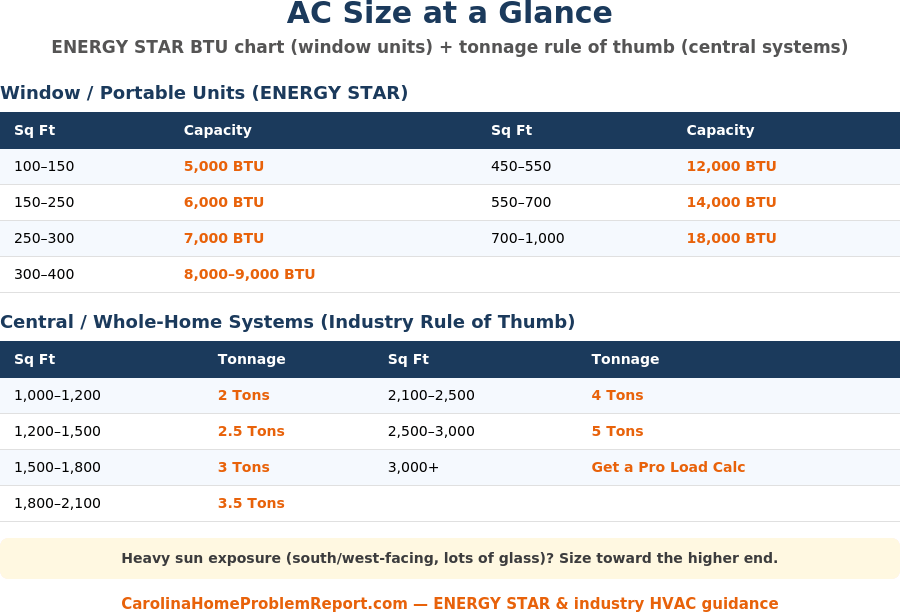
This free AC size calculator uses the official ENERGY STAR BTU sizing chart for window/portable units, plus an industry-standard tonnage rule of thumb for whole-home central systems, to recommend a starting capacity for your space.
Enter your square footage and whether the room gets heavy sun, and you'll get a recommended BTU or tonnage range plus a link to the right next step for your situation.
This calculator gives a starting estimate, not a professional load calculation. Ceiling height, insulation quality, number of occupants, and duct condition all affect real-world sizing.
How This Calculator Works
For spaces up to 1,000 sq ft, this tool uses ENERGY STAR's own published BTU sizing chart for room and portable air conditioners — the same chart manufacturers use on product packaging. For larger spaces, it switches to the standard HVAC industry tonnage rule of thumb (roughly one ton of cooling per 500-600 sq ft), since whole-home systems are sized in tons rather than BTUs. Checking "heavy sun" nudges the result upward, since a south or west-facing room with lots of glass takes meaningfully more cooling capacity than a shaded room of the same size.Why Correct AC Sizing Actually Matters
An undersized AC runs nearly nonstop on hot Carolina afternoons and still can't pull the temperature down, which wastes electricity and never actually solves the problem. An oversized unit cools the air quickly, shuts off, and starts again soon after — satisfying the thermostat without running long enough to properly remove humidity from the air. That's exactly the short-cycling pattern covered in our oversized AC humidity problems article, and it's one of the most common reasons a home still feels sticky even with a "powerful enough" system. Either mistake typically means buying equipment twice — once for the wrong size, and again for the right one. A few minutes with this calculator is cheaper than either mistake.What This Calculator Doesn't Account For
This tool gives a solid starting range, not a professional load calculation. It doesn't account for ceiling height significantly above 8 feet, insulation quality, the number of people regularly occupying the space, heat-generating appliances, or duct condition and leakage. For a whole-home system specifically, these factors can shift the real answer meaningfully — see our HVAC sizing problems article for the full picture of what actually goes into correct sizing beyond square footage alone. If your situation involves any of these factors, treat this calculator's result as a starting point for a conversation with a contractor, not a final answer.Frequently Asked Questions
For a single window or portable unit, yes — it uses ENERGY STAR's own chart directly. For a whole-home central system, it's a solid starting range, but a contractor should still run a proper Manual J load calculation before installation.
A sunny room absorbs significantly more heat through its windows and walls, so a unit sized only for square footage will struggle to keep up. Sizing up front for heavy sun avoids that.
They measure the same thing — cooling capacity. One ton equals 12,000 BTU/hr. Window and portable units are usually labeled in BTU; central systems are usually labeled in tons.
Rounding up feels safer but usually backfires — an oversized AC short-cycles and leaves the air cold but humid, which is exactly the sticky-house problem this site covers. Matching the real number is what actually keeps a home comfortable.
We research and verify home-problem solutions specific to Carolina homes and climate, so you can fix issues right the first time — or know exactly what to ask a pro before you hire one.
This calculator is for general informational purposes and provides an estimate, not a professional load calculation. Always confirm sizing for a whole-home system with a licensed HVAC contractor.