Poor Airflow Room Imbalance: When One Room Won’t Cooperate
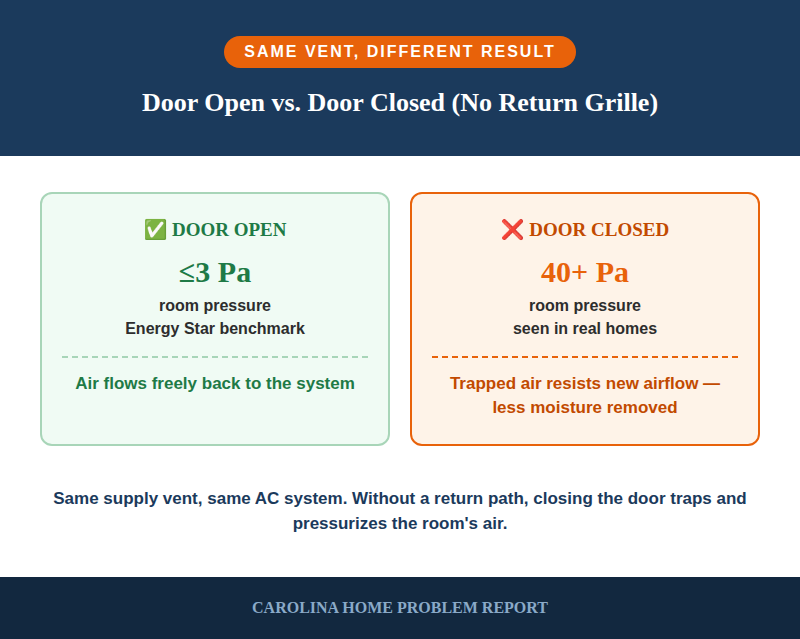
Poor airflow room imbalance usually starts with a closed door. Most homes have supply vents in every room but only one central return-air grille — so when a bedroom door is closed, that room has nowhere for the air to go back to the system, and pressure builds up inside it. Energy Star's benchmark is 3 Pascals or less with the air handler running, but some homes reach over 40 Pascals in a closed bedroom. That trapped, pressurized air fights the very airflow that's supposed to be removing its heat and moisture — which is why one room can run noticeably more humid than the rest of the house even though the same AC serves both.
⭐ Key Takeaways
- ✓Most homes have a supply vent in every room but only one central return-air grille — closing a door cuts that room off from the return path
- ✓Energy Star's comfort benchmark is 3 Pascals or less across a closed door; some homes measure over 40 Pascals
- ✓The pressure imbalance is directly linked to uneven room temperatures, higher energy costs, and moisture problems in walls and ceilings
- ✓A 1-inch door undercut passes roughly 60 CFM; a half-inch undercut is often enough in a well-sealed, efficiently designed home
- ✓This is a different mechanism from floor-to-floor imbalance — it's about individual rooms losing their return-air path, not upstairs vs. downstairs
If you've read our humidity upstairs guide, that article covers imbalance between entire floors. This one is about something narrower and often-missed: why a single room — any room, on any floor — can run more humid than the rest of the house because of how its air gets back to the system, distinct from the oversizing/short-cycling mechanism covered in our oversized AC guide.
In This Article
- What Causes a Poor Airflow Room Imbalance
- The Single-Return-Grille Problem
- How Much Pressure Is Too Much
- Why This Specifically Affects Humidity
- Signs You Have a Poor Airflow Room Imbalance
- How to Fix a Poor Airflow Room Imbalance
- The Safety Risk Nobody Mentions: Backdrafting
- Frequently Asked Questions
What Causes a Poor Airflow Room Imbalance
A central AC system is a loop: air is pushed into rooms through supply vents, and it's supposed to find its way back to the air handler through return grilles to be cooled and dehumidified again. Building-science publication GreenBuildingAdvisor puts it plainly: "the simple act of closing a door changes the dynamics of a house in ways that can have profound impacts on the people inside the home." A closed door with no other path back to the system breaks that loop for just that room — air keeps getting pushed in through the supply vent, but it has nowhere to leave.
The Single-Return-Grille Problem
This wouldn't matter if every room had its own return grille, but GreenBuildingAdvisor's article on return-air problems explains that's rarely how homes are actually built: "most rooms don't have a return-air grille; instead, there's often just a single large return-air grille in the living room or a central hallway to serve the whole house." That design works fine with doors open. Close a bedroom door, and that room's only way back to the central return is under, around, or through the door itself.
⚠️ This Isn't Just an Uneven-Temperature Issue
GreenBuildingAdvisor is specific about the downstream consequences: "room-to-room pressure imbalances that lead to uneven room temperatures, comfort complaints, higher energy costs, and even moisture problems in walls and ceilings." The correct design, per the same source, is "at least one return grille in every conditioned room" — something few existing homes actually have.
How Much Pressure Is Too Much
Pressure buildup in a closed room is measured in Pascals (Pa), and there's an actual industry benchmark for it: "Energy Star requires bedrooms to be pressurized to 3 Pascals or less with the air handler running." That's a low bar by design — but GreenBuildingAdvisor notes real-world conditions can run far worse,
citing a contractor who found "many homes with bedrooms that get pressurized to over 40 Pa when the bedroom door is closed." That's more than 13 times the Energy Star threshold, in a bedroom that's closed for hours every night — exactly when a body is also adding its own heat and moisture to that same trapped air.
Why This Specifically Affects Humidity
A pressurized room resists incoming supply air — the same way it's hard to blow more air into an already-full balloon — so the actual airflow reaching that room drops even though the vent itself is fully open. Less airflow means less contact time between the room's air and the AC's cold coil, and less time on that coil is exactly what caps moisture removal, covered in more depth in our HVAC dehumidification guide.
The room-imbalance version of this problem is different from an oversized system's short-cycling, covered in our oversized AC guide — here, the AC itself might be correctly sized and running full cycles, but one specific room simply isn't receiving its fair share of that airflow because its return path is blocked.
Signs You Have a Poor Airflow Room Imbalance
The most direct test: the room's condition improves noticeably within a few minutes of propping the door open. If that measurably helps, the room's airflow is fine; its return-air path is the problem. A few other tells, drawn from what home-performance inspectors actually look for, tend to show up together rather than alone:
- The door is harder to open or close while the AC is running, or it whistles, slams, or makes an "ear pressure" sensation as it's opened — a direct symptom of the pressure difference equalizing suddenly.
- A noticeable temperature gap — commonly 3 to 4 degrees or more — between that room and the rest of the house, even though its supply vent is open and unobstructed.
- The room feels stuffy or stale, with dust settling faster than in rooms that have a working return path, because the air isn't actually cycling through — it's trapped.
- Higher humidity specifically in that room, and an AC that seems to run longer overall without ever quite catching up on comfort.
- A central return grille that whistles or a filter that looks slightly collapsed inward — a sign the system as a whole is starved for return air, which makes every closed-door room's version of this problem worse.
None of these alone proves a return-air problem — a dirty filter or a failing capacitor can mimic some of them — but several showing up together in one specific room, especially the door-closed/door-open comparison, point squarely at this mechanism.
How to Fix a Poor Airflow Room Imbalance
The most common retrofit fix is a larger gap under the door — a door undercut — sized to the room's actual supply airflow. Research from the Florida Solar Energy Center, cited by GreenBuildingAdvisor, found a 1-inch undercut passes roughly 60 CFM, but the same source cautions that "door undercuts typically won't allow enough air to get out of the bedroom unless you leave a gap bigger than most people want under their doors."
In a tighter, more efficient home, a half-inch undercut can be enough: testing showed that "for supply air up to about 80 CFM, the pressure stays below the Energy Star threshold of 3 Pascals" with only a half-inch gap. Beyond the door itself, air also moves around its sides and top — GreenBuildingAdvisor notes "air flow through the sides and top of the door is equal to the air flow through the undercut," so the true return path is usually a bit better than the undercut alone suggests.
A cleaner, more deliberate fix is a jump duct or transfer grille — a short duct or louvered opening connecting the room to a hallway near the central return, installed specifically to give that room's air a real path out without relying on the gap under the door at all. Building scientist Allison Bailes of Energy Vanguard documented measuring a real guest bedroom at 6.7 Pascals with the door closed,
dropping to about 1.7 Pascals — well under the Energy Star 3 Pa threshold — after installing a retrofit in-door transfer grille, a roughly 30-minute job across three bedrooms with no drywall work involved. His rule of thumb: an undercut plus a modest transfer path can comfortably handle 75 to 100 CFM of supply air before pressure becomes a problem again, which covers most bedrooms. As he puts it, "your bedroom really doesn't aspire to be a balloon" — but without a return path, that's effectively what it becomes.
For a room with higher supply airflow or a tighter building envelope, this is a job for an HVAC contractor who can measure the room's actual supply CFM and size the fix — including a duct damper adjustment if the room is also getting more supply air than it needs — rather than guessing at an undercut size or grille placement.
The Safety Risk Nobody Mentions: Backdrafting
⚠️ Why This Is More Than a Comfort Issue
A pressurized bedroom doesn't just trap air in that one room — it has to pull makeup air from somewhere else in the house, which puts the rest of the home under slight negative pressure. Energy Vanguard flags the real consequence: a home with a negatively pressurized main area can pull
exhaust gases back down the flue of a natural-draft gas water heater or furnace instead of letting them vent outside — a phenomenon called backdrafting, which can introduce carbon monoxide into the living space. This is why return-air design isn't purely a cosmetic humidity-and-comfort issue in homes with natural-draft gas appliances; it's a reason to take the fix seriously rather than just living with a slightly muggy guest room.
If your home has a natural-draft (not sealed-combustion or power-vented) gas water heater or furnace, a working carbon monoxide detector on every level is a baseline safety measure regardless of airflow design — and fixing a severe room pressure imbalance is one more reason to prioritize it, not a substitute for one.
Frequently Asked Questions
Why is just one bedroom in my house more humid than the rest?
Most likely a return-air problem: the room has a supply vent but no dedicated return grille, and closing the door traps and pressurizes the air inside, cutting the effective airflow — and moisture removal — that room actually receives.
Is this the same as the upstairs-vs-downstairs humidity problem?
No — that's a floor-to-floor imbalance, usually from a single system serving two stories without dampers. This is a room-level problem caused by a missing return-air path, and it can happen on any floor.
Will just leaving the door open fix it?
Yes, functionally — but it isn't always practical for a bedroom. A door undercut sized to the room's supply airflow, or a proper jump duct/transfer grille, fixes the same problem while letting you keep the door closed.
How do I know how big to make a door undercut?
It depends on the room's actual supply airflow — a half-inch gap can be enough in a tight, efficient home with modest airflow, while a leakier home or a higher-airflow room may need more than most people want under a door. An HVAC contractor can measure the room's CFM and size it correctly, or recommend a transfer grille instead.
Is a closed-door airflow imbalance actually dangerous, or just uncomfortable?
Usually it's a comfort and humidity issue. But in a home with a natural-draft gas water heater or furnace, pressurizing bedrooms forces the rest of the house slightly negative, which can pull combustion exhaust back down the flue instead of venting it outside. That's a real reason to fix a severe imbalance, and a reason to have a working carbon monoxide detector regardless.
Key Facts About Poor Airflow Room Imbalance:
- Most homes have a supply vent in every room but only one central return-air grille.
- Energy Star's benchmark is 3 Pascals or less across a closed door; some real homes reach over 40 Pascals.
- Pressure buildup is linked to uneven temperatures, higher energy costs, and moisture problems in walls and ceilings.
- A 1-inch door undercut passes about 60 CFM; a half-inch can suffice in a tighter, efficient home.
- A jump duct or transfer grille is a more deliberate fix than relying on the gap under the door alone — one documented retrofit dropped a bedroom from 6.7 Pa to 1.7 Pa in about 30 minutes.
- In homes with natural-draft gas water heaters or furnaces, severe pressure imbalances can contribute to backdrafting — a working carbon monoxide detector is a baseline safety step either way.
If a specific room runs consistently more humid despite an open supply vent, an HVAC professional can measure its actual airflow and pressure and recommend the right fix.
Find an HVAC Professional Near You →This guide was researched using GreenBuildingAdvisor's published guidance on return-air problems and door undercuts, including Energy Star pressure standards and Florida Solar Energy Center airflow research, plus Energy Vanguard's documented real-world retrofit measurements and backdrafting safety notes, cross-referenced against Carolina Home Problem Report's existing HVAC and humidity documentation, to explain room-level airflow imbalance as a distinct mechanism from floor-to-floor imbalance and AC oversizing. We are not contractors or HVAC technicians — we are a research team dedicated to giving Carolina homeowners clear, locally specific, unbiased answers.
Carolina Home Problem Report is an informational resource for homeowners. We are not licensed contractors or HVAC technicians. Always consult a qualified professional before making home repair decisions. See our Disclaimer and Affiliate Disclosure.