Oversized AC Humidity Problems: Why Bigger Isn’t Better
Oversized AC humidity problems happen because a too-large system cools your home to the thermostat's set point too quickly and shuts off before it has run long enough to remove much moisture — a pattern called short cycling. Even a correctly done Manual J load calculation builds in about a 15% sizing margin, but a system sized by rough "square feet per ton" rules of thumb, or one deliberately oversized to avoid comfort complaints, can run far past that margin. The result is a home that feels "cool but clammy" — at temperature, but still above 60% humidity. The fix is a proper load calculation, better-suited equipment, or a supplemental dehumidifier.
⭐ Key Takeaways
- ✓A properly run Manual J load calculation already has about a 15% sizing margin built into the protocol — "bigger just in case" adds on top of that
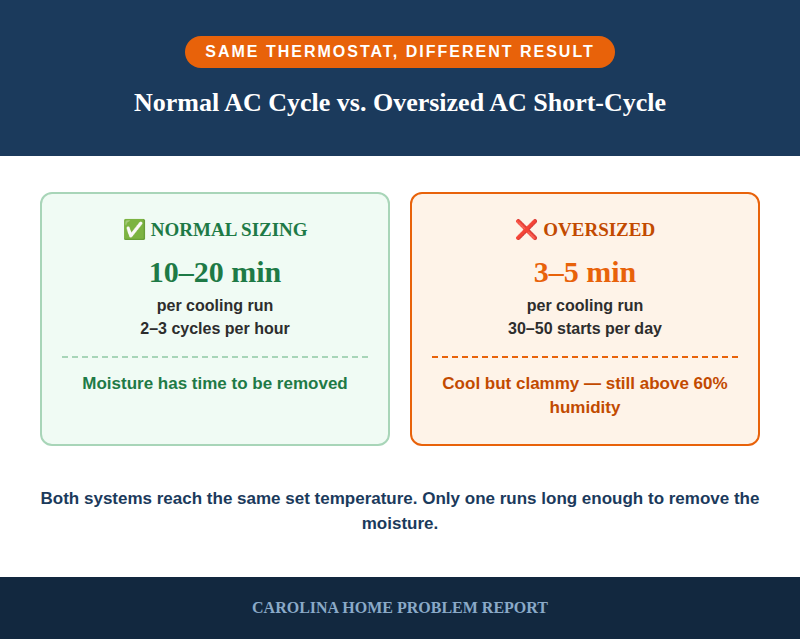
- ✓Short cycling — runs under 10 minutes, 30-50 starts a day instead of 6-8 — is the direct mechanical signature of an oversized system
- ✓A home that's "cool but clammy" — at temperature but still above 60% humidity — is the classic oversizing symptom
- ✓Excess short-cycling can also cut a system's lifespan roughly in half — 8-10 years instead of 15-20
- ✓The fix is a proper load calculation, humid-climate-suited equipment (lower SHR, inverter-driven), or a whole-house dehumidifier — not simply lowering the thermostat
If you've read our humidity even with AC guide, you already know oversizing is listed as one of several possible causes there. This article goes deep on that one specific cause: why it happens, how to actually recognize it in your own home, and what a real fix looks like — distinct from the structural 50-70% dehumidification ceiling every AC has, covered in our HVAC dehumidification guide.
In This Article
Why Bigger Isn't Better
It feels intuitive that a more powerful air conditioner should do a better job of controlling humidity — more capacity, more moisture removed, right? The opposite is usually true. Building-science publication GreenBuildingAdvisor's FAQ on air conditioning and high humidity is direct about the trade-off: "equipment that is too big costs more to buy, uses more energy, and encourages short cycling." The article also notes that contractors "routinely install equipment that is oversized" — often because an undersized system that struggles on the hottest day of the year generates far more complaints than an oversized one that simply runs less.
The Rule-of-Thumb Sizing Problem
The correct way to size an AC is a Manual J load calculation — a standardized procedure from the Air Conditioning Contractors of America (ACCA), built on ASHRAE design temperatures, that works out the actual heating and cooling capacity a specific home needs. In practice, a lot of residential sizing still happens by rough "square feet per ton" rules of thumb instead, a shortcut that skips the variables that actually matter — window area and orientation, insulation levels, air leakage, duct location — and tends to land on the larger side. Even a correctly run Manual J calculation isn't razor-precise: GreenBuildingAdvisor notes "there's about 15% of oversizing built into the protocol" as a safety margin. A rule-of-thumb estimate, or a calculation run with the wrong inputs, can push well past that.
⚠️ A Small Input Error Can Mean a Big Oversizing Jump
GreenBuildingAdvisor gives a concrete example: using the wrong outdoor design temperature — say 97°F instead of the correct 91°F for a given climate zone — "will result in an oversized air conditioner," even when every other step of the Manual J process is followed correctly. Sizing is only as accurate as its weakest input.
Why Oversized Equipment Short-Cycles
An oversized system has more cooling capacity than the space actually needs, so it reaches the thermostat's set point fast — then shuts off, because the thermostat has no way to know the run was too short to do much else. GreenBuildingAdvisor's article on oversized HVAC equipment states it plainly: "the oversized equipment will short cycle." Every start and stop also has a cost: the same article notes that occupants alone add roughly "230 BTU per hour of sensible load and another 200 BTU per hour of latent load" per person to a home's cooling needs — a reminder that a system's BTU capacity is supposed to be matched closely to real, specific loads like this, not padded generously "just in case." A system that's meaningfully larger than the sum of those real loads simply doesn't have to work long to satisfy the thermostat, which is exactly the problem.
Three Red Flags Your AC Might Be Oversized
HVAC load-calculation firm Procalcs lays out three concrete signs worth checking against your own system's behavior:
1. Run times that are too short. A normally sized system runs "2-3 cycles per hour, each lasting 10-20 minutes." An oversized one instead tends to "cycle every 3-5 minutes" — a duty cycle pattern of frequent, brief runs rather than fewer, longer ones. 2. "Cool but clammy." The air reaches your thermostat's target temperature, but the space still feels humid — Procalcs describes oversized systems as ones that "cool air quickly but shut off before removing moisture — leaving homes at target temperature but above 60% humidity." 3. Equipment wearing out early. Short cycling means far more starts and stops than the system was designed for — "30-50 times daily versus 6-8 for normal operation" — which Procalcs links to a shortened service life of roughly "8-10 years — a 50% reduction" from a normal 15-20 year lifespan.
How Short-Cycling Specifically Wrecks Dehumidification
Every AC divides its work between cooling the air (sensible heat) and pulling moisture out of it (latent heat), and GreenBuildingAdvisor's FAQ explains why the order of operations matters: "air temperature may go down faster than relative humidity, and once the air temperature has reached the set point, the air conditioner turns itself off." Temperature drops fast; moisture removal takes longer to catch up — so a run that's cut short by oversizing stops right around the point where a properly sized system would still be working on the humidity. This is a different problem from the one covered in our HVAC dehumidification guide: that article covers the 50-70% dehumidification ceiling every correctly sized AC has, structurally, because of the sensible/latent split and a timing mismatch in when heat and moisture loads peak. Oversizing doesn't create a new mechanism — it just cuts the available runtime down further, on top of that existing ceiling, which is why an oversized system's humidity performance is often noticeably worse than the ceiling alone would predict.
The Fix: Right-Sizing and Better-Suited Equipment
The most direct fix is a proper Manual J load calculation done with accurate inputs — correct design temperature, real window and insulation specs, actual duct condition — rather than a rule-of-thumb estimate, ideally at replacement time rather than after the fact. If replacement isn't imminent, GreenBuildingAdvisor points to equipment choice as a lever: systems "with a lower sensible heat ratio" spend proportionally more of each cycle on moisture removal, and it specifically calls out "high-performance minisplit heat pumps with SHRs of less than 70%" as a humid-climate-suited option. These often use an inverter compressor, which can modulate its output instead of running as a blunt on/off cycle — reducing the short-cycling problem directly rather than working around it.
One option to be cautious with: adjusting fan speed to keep the evaporator coil colder can pull out more moisture per cycle, but GreenBuildingAdvisor cautions that "over-cooling the AC's evaporator coil can create problems of its own, such as condensation inside ductwork or a frozen coil" — not a fix to attempt without a technician's input. If replacing or resizing equipment isn't practical right now, a whole-home dehumidifier running alongside the existing AC is the more direct standalone fix — it removes moisture independently of the thermostat's temperature-driven on/off cycle entirely.
Frequently Asked Questions
How do I know if my AC is actually oversized, not just working normally?
Watch the run times. A normal system runs 2-3 cycles an hour, 10-20 minutes each. If yours is cycling every 3-5 minutes, or the house feels "cool but clammy" — at temperature but still humid — those are the two clearest signs.
Isn't a bigger AC always safer, since it can handle the hottest days?
No — it trades one problem for another. An oversized system costs more upfront, uses more energy, short-cycles on all but the hottest days, and can wear out roughly twice as fast. A correctly sized system already has about a 15% margin built in.
Is this the same issue covered in your "humidity even with AC" article?
That guide lists oversizing as one of several possible causes alongside filters, fan settings, and duct leaks. This article goes deep specifically on oversized AC humidity problems — how to diagnose them, why they happen, and what a real fix involves.
Can I fix this myself without replacing the whole system?
Not by adjusting the equipment yourself — fan-speed changes meant to increase moisture removal can cause frozen coils or ductwork condensation if done wrong. A more practical near-term fix is running a whole-home dehumidifier alongside your existing AC.
Key Facts About Oversized AC and Humidity:
- A correctly run Manual J load calculation already builds in about a 15% sizing margin.
- Oversized equipment short-cycles: runs under 10 minutes instead of the normal 10-20 minutes.
- "Cool but clammy" — at temperature but still above 60% humidity — is the classic oversizing symptom.
- Excess short-cycling can cut equipment lifespan roughly in half, to 8-10 years from 15-20.
- The fix is a proper load calculation, lower-SHR/inverter-driven equipment, or a supplemental whole-home dehumidifier.
If your AC is short-cycling and your home still feels humid at temperature, an HVAC professional can run a proper load calculation and confirm whether your system is oversized.
Find an HVAC Professional Near You →This guide was researched using GreenBuildingAdvisor's published guidance on Manual J load calculations, oversized HVAC equipment, and air conditioning and high humidity, along with Procalcs' diagnostic red-flag data, cross-referenced against Carolina Home Problem Report's existing HVAC and humidity documentation, to explain oversizing as a diagnosable, fixable cause of humidity problems distinct from the structural ceiling every AC has. We are not contractors or HVAC technicians — we are a research team dedicated to giving Carolina homeowners clear, locally specific, unbiased answers.
Carolina Home Problem Report is an informational resource for homeowners. We are not licensed contractors or HVAC technicians. Always consult a qualified professional before making home repair decisions. See our Disclaimer and Affiliate Disclosure.