Snakes in Crawl Space North Carolina [Warning — How to Identify Venomous vs Non-Venomous + What to Do and What Never to Do]
Finding snakes in a crawl space in North Carolina is common — and usually not the emergency most homeowners assume it is. NC has 38 native snake species but only 6 are venomous, and the snake you find under your home is far more likely to be a harmless rat snake or corn snake than a copperhead. The correct response is to stay calm, do not attempt to handle or kill it, and call a licensed wildlife removal professional for identification and removal. The permanent solution is encapsulation — a sealed crawl space gives snakes no reason to enter and no way in.
⭐ Key Takeaways
- ✓NC leads the country in snakebite incidents per capita — and the vast majority of bites happen when someone tries to handle or kill the snake, not from accidental encounters
- ✓The copperhead accounts for over 90% of venomous snakebites in NC — it is the only venomous species most Piedmont and mountain homeowners will ever encounter
- ✓The rat snake is the most common snake found in NC crawl spaces — non-venomous, valuable as a rodent predator, and most shed skins found in crawl spaces belong to this species
- ✓10 of NC's 38 native snake species are legally protected — it is illegal to kill or possess them without a permit, regardless of where they are found
- ✓A snake in your crawl space is a symptom of underlying conditions — rodent prey, moisture, and accessible entry points. Fix those conditions and snakes have no reason to return
Snakes in a crawl space in North Carolina is a situation that causes immediate alarm for most homeowners — and immediate over-reaction in many cases. The alarm is understandable. The over-reaction is what creates real danger. North Carolina leads the country in snakebite incidents per capita, and the data on when those bites occur is instructive: the vast majority happen when someone attempts to handle, catch, or kill a snake they found. Not from accidental encounters. The snake found resting peacefully in a cool dark crawl space is not the threat. The homeowner who decides to pick it up is.
Understanding the NC snake situation clearly — which species you are likely to find, which are dangerous and which are harmless, what their presence tells you about your crawl space conditions, and what the correct response sequence is — converts a frightening discovery into a manageable problem with a permanent solution. According to the NC Wildlife Resources Commission, rat snakes enter buildings more frequently than any other NC snake and are the source of most shed skins found in crawl spaces and basements — and they are entirely non-venomous.
This guide gives NC homeowners the complete picture — the species most likely to enter crawl spaces, how to identify venomous versus non-venomous by the characteristics that actually work, what to do when you find one, the legal framework that applies to snake removal in NC, and the permanent encapsulation solution that eliminates the conditions that attract snakes in the first place.
In This Article
- Why Snakes Enter NC Crawl Spaces
- NC Snake Species Most Likely in Your Crawl Space
- Venomous vs Non-Venomous — How to Tell the Difference
- What to Do When You Find a Snake in Your Crawl Space
- NC Law — What You Can and Cannot Do With Snakes
- Snake Removal Costs in NC
- Permanent Prevention — Encapsulation as the Long-Term Solution
- Frequently Asked Questions
Why Snakes Enter NC Crawl Spaces
A snake entering a crawl space is responding to specific environmental conditions — not malice and not coincidence. Understanding what draws them makes it straightforward to remove those conditions.
Rodent prey
The single most reliable snake attractant is a rodent population. Mice and rats leave scent trails that snakes follow. A crawl space with active rodent activity is advertising itself as a food source to every snake within range. The rat snake — NC's most common crawl space snake — is specifically adapted to hunt rodents in confined spaces. Solving the rodent problem removes the reason snakes enter.
Temperature regulation
Snakes are ectothermic — they rely on external temperature sources to regulate body heat. A crawl space offers a stable cool-in-summer, warm-in-winter microclimate that is attractive as a refuge from temperature extremes. In late summer and early autumn when nights cool, crawl spaces become particularly attractive as pre-hibernation shelter. This explains the seasonal pattern of snake calls in September and October.
Moisture and habitat
Damp crawl spaces with exposed soil closely resemble the natural under-rock, under-log habitats that many NC snake species prefer. A moist, dark, undisturbed space with abundant small prey is essentially ideal snake habitat. This is one more reason why encapsulation — which eliminates the moisture — simultaneously makes the space less attractive to the snakes that prefer moist environments.
Accessible entry points
Open foundation vents are the primary snake entry point into NC crawl spaces. A standard foundation vent opening — even when covered with the screen that came with the house — provides adequate access for most snake species. Damaged vent screens, foundation cracks, gaps around pipes, and poorly sealed access doors are all entry routes. Every gap wider than 1/4 inch is a potential entry point for smaller species.
NC Snake Species Most Likely in Your Crawl Space
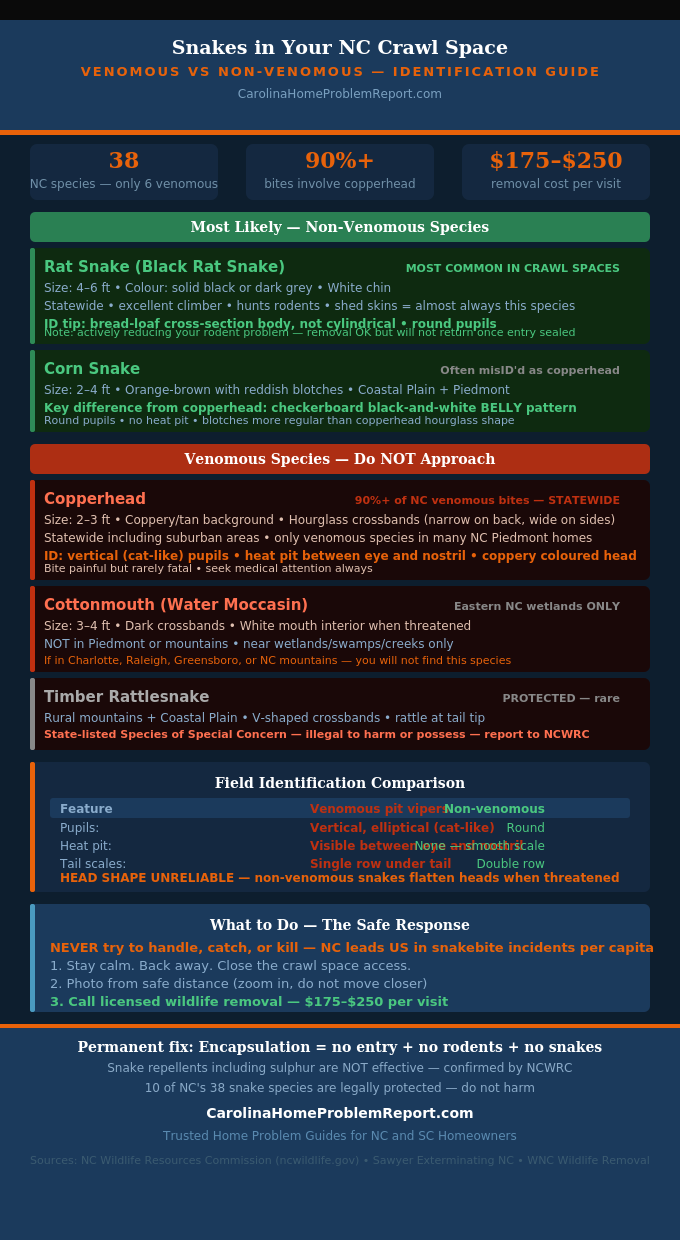
Of NC's 38 native snake species, a small number account for the vast majority of crawl space encounters. Here are the species you are most likely to find, where in NC they occur, and the key facts about each:
Venomous vs Non-Venomous — How to Tell the Difference
There is a significant amount of misinformation circulating about how to identify venomous snakes. The NCWRC specifically lists characteristics that should never be used for identification because they are unreliable. Here is what actually works — and what does not:
⚠️ Identification myths — NEVER rely on these
- Head shape — Most non-venomous snakes flatten and widen their heads when threatened to appear more dangerous. A non-venomous snake with a triangular head is not venomous. This test is unreliable.
- Colour or pattern alone — Corn snakes and juvenile rat snakes are frequently mistaken for copperheads. Colour identification without other features is insufficient.
- Aggression level — Both venomous and non-venomous snakes can display defensive aggression. Rattling, striking posture, and hissing occur in non-venomous species too.
What actually distinguishes venomous NC snakes — observed from a safe distance:
| Feature | Venomous (pit vipers) | Non-Venomous |
|---|---|---|
| Pupil shape | Vertical, elliptical (cat-like) | Round pupils |
| Heat pit | Visible indentation between eye and nostril | No pit — smooth scale between eye and nostril |
| Tail underscales | Single row under tail | Double row under tail (except coral snake) |
| Rattle (rattlesnakes only) | Segmented rattle at tail tip | No rattle — smooth tail tip |
Practical reality: Pupil shape and heat pits require close-range observation — too close for safety. The most reliable practical approach when you cannot identify a snake with certainty from a safe distance is to assume it may be venomous, maintain safe distance, and call a professional. This is what the NCWRC recommends.
What to Do When You Find a Snake in Your Crawl Space
⚠️ The most important rule — do not attempt to handle, catch, or kill the snake
NC leads the country in snakebite incidents per capita and most of those bites happen during handling or killing attempts — not from accidental encounters. A snake resting in a crawl space is not hunting you. It is sheltering. Attempting to remove it without professional training and equipment puts you at far greater risk of a bite than simply leaving it alone and calling for help.
Stay calm and back away
Do not approach the snake, attempt to identify it at close range, or attempt to shoo it out. Close the crawl space access and note where the snake was observed — your description helps the removal professional.
Photograph from a safe distance if possible
A photo from a safe distance — even a blurry one — helps the removal professional identify the species before they arrive and prepare accordingly. Use your phone's zoom, do not move closer for a better shot. If it is not safe to photograph, skip this step.
Call a licensed wildlife removal company
Licensed wildlife removal companies in NC have the training and equipment to safely remove and relocate both venomous and non-venomous snakes. Many offer same-day response for snakes. The NC Wildlife Resources Commission does NOT send staff to remove snakes from private property — you need a private licensed wildlife removal company.
After removal — identify and seal the entry points
Once the snake is removed, the professional should be able to identify where it entered. Seal foundation vents with rigid foam or proper vent covers with 1/4-inch hardware cloth, seal all gaps around pipes and penetrations, and address any foundation wall cracks. Then address the rodent population that attracted the snake in the first place — otherwise a new snake will find the same entry point.
NC Law — What You Can and Cannot Do With Snakes
Many NC homeowners are unaware that significant legal protections apply to snakes found on their property. Violating these protections — even unintentionally — can result in penalties.
What is protected under NC law:
- All 38 native NC snake species are classified as nongame animals — it is unlawful to take or possess more than 5 reptiles without a collection license
- 10 species are state-listed as endangered, threatened, or Species of Special Concern — these cannot be handled, harmed, or possessed under any circumstances without a special permit
- Specifically protected: Timber Rattlesnake (Species of Special Concern), Pigmy Rattlesnake (Species of Special Concern), Eastern Diamondback Rattlesnake (state listed), Eastern Coral Snake (state listed Endangered)
- Killing any of the four protected venomous species — even on your own property — is a wildlife violation
What you can legally do:
- Call a licensed wildlife removal company — they operate under appropriate permits
- Non-listed non-venomous species can be relocated on private property with landowner permission — but NCWRC notes most species die from stress if relocated more than two miles from their capture site
- Seal entry points on your property to prevent future access
- Report sightings of protected species: Timber or Pigmy Rattlesnakes to rattlesnake@ncwildlife.gov; Eastern Coral Snake sightings to NCWRC
Snake Removal Costs in NC
| Service | Cost Range | Notes |
|---|---|---|
| Single snake removal | $175–$250 | Standard charge for one removal visit in Charlotte market. Higher for venomous species or difficult access. |
| Crawl space inspection and removal | $250–$450 | Includes full crawl space inspection, species identification, removal, and inspection report. |
| Exclusion work (entry point sealing) | $300–$800 | Sealing identified entry points with hardware cloth and appropriate materials. Often combined with removal visit. |
| Annual monitoring contract | $200–$500/yr | Some NC wildlife companies offer annual inspection and removal contracts for homes with repeated snake activity. |
Permanent Prevention — Encapsulation as the Long-Term Solution
Individual snake removal is a solution to today's problem. The permanent solution addresses all three of the conditions that make a crawl space attractive to snakes in the first place:
💡 Additional exterior prevention — the yard matters too
Woodpiles, compost heaps, rock piles, and tall grass within 10 feet of the foundation provide shelter that encourages snakes to stay near the home. Keep the foundation perimeter clear — no mulch against the foundation walls, no stored materials, no wood stacks within 10 feet, and grass mowed short in the immediate perimeter zone. Trim trees and shrubs away from the roofline — rat snakes are strong climbers that will use overhanging branches as access routes to attic-level entry points.
Frequently Asked Questions
What kind of snake is in my crawl space in NC?
The most likely answer is a rat snake — large, black or dark grey, non-venomous, and the most common snake found in NC buildings and crawl spaces. Corn snakes are the second most common in Piedmont and Coastal Plain homes. If you are in the NC Piedmont or mountains and see a brown patterned snake, there is a possibility of a copperhead and you should not approach it. Call a licensed wildlife removal company for identification.
Is a snake in my crawl space dangerous?
It depends on the species. A rat snake or corn snake in your crawl space poses no danger and is actively reducing your rodent population. A copperhead poses a bite risk if someone enters the crawl space without checking first. The practical safety rule is: never enter a crawl space without scanning visible areas first, wear boots and long trousers when entering, and if you see a snake you cannot identify as non-venomous with certainty — leave and call a professional.
How do I get rid of snakes in my crawl space in NC?
The correct response sequence is: call a licensed wildlife removal company for identification and removal (cost $175–$450), then seal all entry points — foundation vents, pipe gaps, access door — to prevent return, then address the rodent population that attracted the snake. None of the commercially available snake repellents are proven effective — the NCWRC specifically states that chemical repellents including sulphur are ineffective. The only reliable prevention is removing the food source and sealing entry points.
Will encapsulation keep snakes out of my crawl space?
Yes — a properly encapsulated crawl space with sealed foundation vents and all penetrations sealed removes both the moisture habitat and the open entry points that snakes use. Combined with rodent exclusion — which removes the food source — encapsulation is the most effective long-term snake prevention available. Many NC homeowners report zero snake activity in crawl spaces after proper encapsulation.
Can I kill a snake in my NC crawl space?
Beyond the safety risk — NC leads the country in snakebite incidents and most bites happen during handling or killing attempts — there are also legal considerations. Four of NC's six venomous species are state-listed as protected and cannot be legally killed or possessed. All native snake species are classified as nongame animals with possession limits. The NCWRC strongly recommends relocation over lethal control and notes that education and coexistence is the preferred approach. Call a licensed wildlife removal professional rather than attempting to kill any snake.
A snake in your NC crawl space is almost certainly a harmless rat snake pursuing your rodent population — and it is telling you something useful about the conditions under your home. The permanent solution is not repeated snake removal calls. It is eliminating the three conditions that make your crawl space attractive: the rodent prey, the moisture habitat, and the open entry points. A properly encapsulated crawl space with sealed vents, a running dehumidifier, and an active rodent exclusion programme gives snakes no reason to enter and no way in.
If you need a snake removed today, call a licensed NC wildlife removal company. If you want to solve the underlying problem permanently, the crawl space encapsulation assessment is where to start.
Find a Crawl Space Professional Near You →The Carolina Home Problem Report editorial team researches and writes guides for homeowners across North and South Carolina. Snake species information draws directly from the NC Wildlife Resources Commission official species profiles. We are not wildlife removal professionals — always call a licensed company for snake removal. See our Disclaimer.
Carolina Home Problem Report is an informational resource for homeowners. We are not licensed wildlife removal professionals. Always call a licensed wildlife removal company for snake identification and removal. See our Disclaimer.