Crawl Space Structural Damage Signs [Dangerous to Ignore — The 4-Stage Warning System Every Carolina Homeowner Needs]
Crawl space structural damage shows itself in the living space above long before most homeowners look underneath. Soft or bouncy floors, sticking doors and windows, diagonal cracks above door frames, and stair-step cracks in exterior brick are the four most reliable above-floor signals that something structural is failing beneath your feet. In Carolina homes — where expansive clay soil, persistent humidity, and ageing wood framing combine — these signs progress through predictable stages. The earlier you catch the stage, the lower the repair cost.
⭐ Key Takeaways
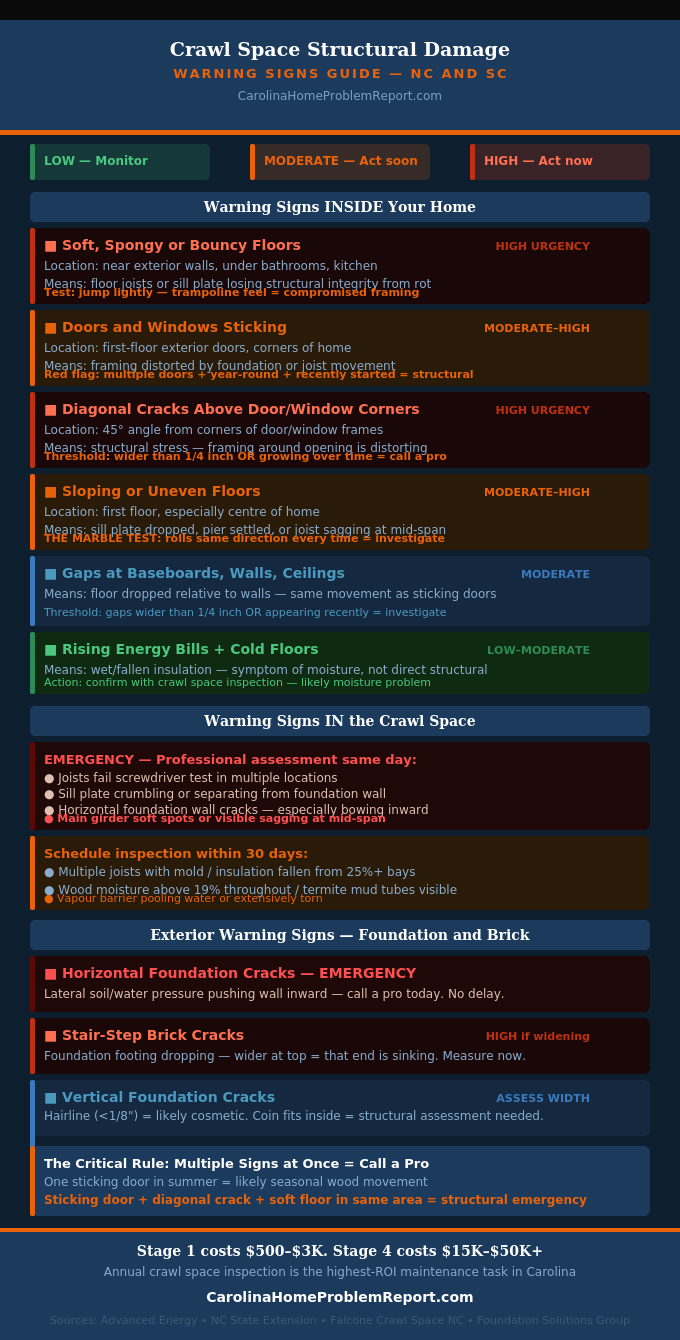
- ✓The marble test is the fastest above-floor structural check — place a marble on a hard floor in the suspect area. If it consistently rolls in one direction, the floor has measurable slope worth investigating.
- ✓Multiple signs appearing simultaneously is the critical escalation signal — one sticking door in summer humidity is not alarming; two sticking doors plus a floor crack plus a diagonal wall crack at the same time means call a professional today
- ✓Horizontal foundation wall cracks are the highest-urgency structural sign in any crawl space home — they indicate lateral soil or water pressure pushing the wall inward
- ✓Carolina's expansive clay soil is a specific regional factor — Piedmont clay expands when wet and shrinks when dry, creating seasonal structural stress that does not exist in sandier coastal soils
- ✓Structural damage caught at Early Stage costs $500–$3,000 to fix. Caught at Critical Stage it costs $15,000–$50,000+. The difference is knowing what to look for.
Crawl space structural damage signs are what your home displays when what is happening underneath has progressed far enough to affect what you see and feel above the floor. Understanding these signs — and knowing which are cosmetic and which are structural emergencies — is the practical skill that separates a $2,000 repair from a $20,000 one. Every structural repair professional in the Carolina market has the same story: homeowners who noticed the signs months earlier but did not know their significance, and who are now looking at a repair cost that would have been a fraction of the price if addressed when first observed.
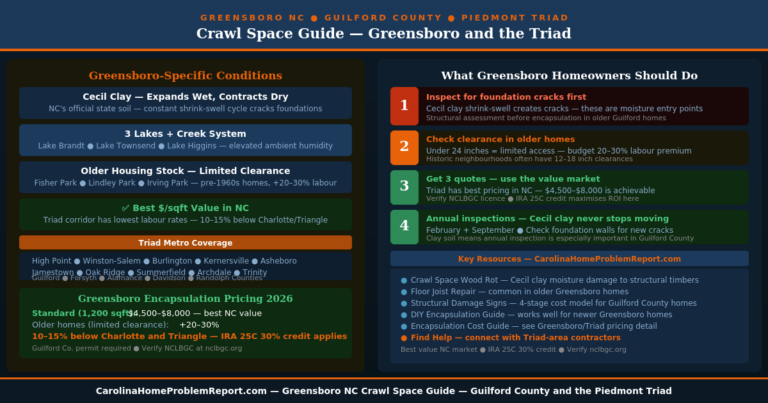
Carolina crawl space structural damage has a specific regional character that national guides miss. North and South Carolina's Piedmont region sits on expansive clay soil that swells when wet and contracts when dry — a cycle that exerts constant, seasonal stress on foundations that sandier coastal soils do not. The humid subtropical climate means that crawl space wood framing stays at elevated moisture content for much of the year. Combine aging sill plates and joists with clay soil movement and you get the specific warning sign pattern that Carolina structural contractors see consistently: soft floors over the perimeter, diagonal cracks above first-floor door frames, and stair-step cracking in brick exterior walls — all pointing to the same underlying cause in the crawl space below.
This guide walks through every significant crawl space structural damage sign — organised by where you find it, how urgent it is, and what stage of damage progression it represents. According to Advanced Energy's North Carolina crawl space research, the majority of structural damage in older Southeast homes is preventable or significantly reducible if moisture conditions are controlled before wood framing reaches the rot threshold. The warning signs in this guide are your early detection system.
In This Article
- The Four Stages of Crawl Space Structural Damage
- Signs Inside Your Home — What to Look For Room by Room
- Signs in the Crawl Space — What a Proper Inspection Finds
- Exterior Warning Signs — Foundation and Brick Cracks
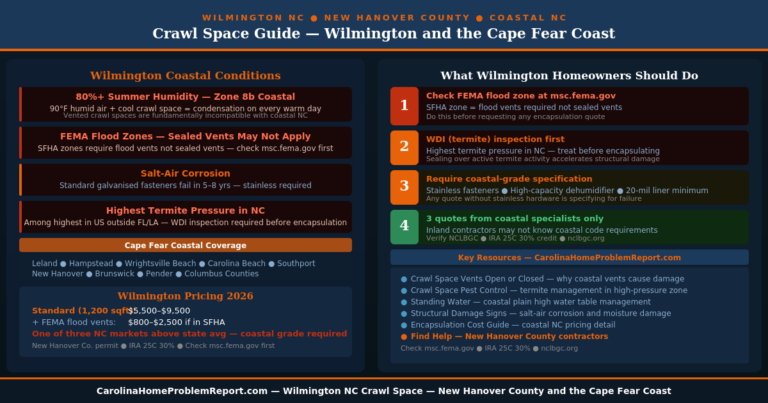
- The Carolina Context — Clay Soil and Coastal vs Piedmont Patterns
- Normal Aging vs Structural Problem — How to Tell the Difference
- Repair Cost by Stage — The Financial Case for Early Detection
- Frequently Asked Questions
The Four Stages of Crawl Space Structural Damage
Crawl space structural damage does not appear suddenly. It progresses through four distinct stages, each with different symptoms and repair costs. Knowing which stage you are in changes everything about how urgently you need to act.
Signs Inside Your Home — What to Look For Room by Room
Most crawl space structural problems announce themselves inside the living space first. Here are the specific signs by location and what each means:
Signs in the Crawl Space — What a Proper Inspection Finds
A crawl space inspection — even a basic homeowner inspection wearing PPE — should check for each of these conditions. The presence of multiple items from this list simultaneously is the clearest signal that professional structural assessment is needed.
⚠ Immediate professional assessment needed:
- Joists that fail the screwdriver penetration test in multiple locations
- Sill plate crumbling, separating from foundation wall, or compressing under pressure
- Main girder/beam showing soft spots, cracks running along the grain, or visible sagging at mid-span
- Pier posts tilting, settling unevenly, or wood shims at pier tops visibly compressed
- Horizontal cracks in the foundation wall — especially if bowing inward
- Standing water or saturated soil that persists after rain
⚠ Schedule inspection within 30 days:
- Multiple joists with visible mold, discolouration, or surface softening
- Insulation fallen or sagging from more than 25% of joist bays
- Wood moisture meter readings consistently above 19% throughout the space
- Visible termite mud tubes on foundation walls or piers
- Vapour barrier torn, missing, or with visible standing water pooling on top
🟢 Monitor and address moisture conditions:
- Light surface mold on a few joists — no screwdriver penetration
- High humidity readings — above 60% RH — but no visible mold or structural softening yet
- Small areas of old vapour barrier that need patching
- Isolated fallen insulation in one or two bays without moisture damage to the joist above
Exterior Warning Signs — Foundation and Brick Cracks
The exterior of the home provides important structural information that complements the interior and crawl space inspection. Carolina homes with brick or masonry veneers display characteristic crack patterns when the foundation beneath is moving.
Stair-step cracks in brick mortar
HIGH URGENCY if wideningCracks that follow the mortar joints in a diagonal stair-step pattern indicate that the foundation footing beneath that section is sinking or shifting. The brick is reflecting the movement of the foundation below. A stair-step crack that is wider at the top than the bottom confirms the bottom of that section is sinking. Measure the width when first noticed and again 60 days later — a crack that has not grown is monitoring territory; a crack that has widened is urgent.
Horizontal cracks in the foundation wall
EMERGENCYHorizontal cracks running across the foundation wall — particularly if the wall appears to bow inward above the crack — are the single most urgent structural sign in any crawl space home. They indicate that lateral soil or hydrostatic pressure is actively pushing the wall inward. Unlike vertical shrinkage cracks that are typically cosmetic, horizontal cracks indicate that the wall's capacity to carry vertical load is being compromised. Do not delay — call a licensed structural contractor same day.
Vertical foundation wall cracks
MODERATE — ASSESS WIDTH AND PROGRESSIONHairline vertical cracks in poured concrete foundation walls are common and are usually the result of concrete curing shrinkage — cosmetic rather than structural. A vertical crack that is wider than 1/8 inch, that has visible separation with one side displaced relative to the other, or that is actively growing warrants professional evaluation. The threshold for action is any crack you can insert a coin into — 1/8 inch or wider.
Brick pulling away from doors or windows
MODERATE URGENCYVisible gaps between the brick veneer and the door or window frame — particularly at the corners — indicate that the brick is moving relative to the framing. This reflects differential movement where the foundation beneath the brick is settling differently from the framing above. More common in homes with significant sections of brick on one side and vinyl or wood on another, where the different weight distribution creates differential settlement.
The Carolina Context — Clay Soil and Coastal vs Piedmont Patterns
The structural warning signs in Carolina homes follow geographic patterns that national guides miss. Your location within NC or SC changes which signs appear first and how urgently each should be treated.
Normal Aging vs Structural Problem — How to Tell the Difference
Not every crack, gap, or sticking door is a structural emergency. Carolina homes age in a humid climate that produces cosmetic issues independent of structural problems. Here is the distinction that matters:
| Sign | Normal / Monitor | Structural / Act Now |
|---|---|---|
| Floor creaking | Isolated, consistent sound at same spot for years | New creaking throughout a room, especially with floor flex |
| Sticking door | One door, summer only, same behaviour for years | Multiple doors, year-round or worsening, appeared recently |
| Wall crack | Hairline, stable for years, not at door/window corners | Diagonal at door frame corner, wider than 1/4 inch, or growing |
| Floor unevenness | Slight undulation, stable for years, older home character | Marble consistently rolls in one direction, worsening slope |
| Foundation crack | Hairline vertical crack, less than 1/8 inch, stable | Horizontal crack, wider than 1/8 inch, displaced, or growing |
| Brick crack | Tiny vertical hairline crack, stable, isolated | Stair-step pattern, wider at one end, growing over time |
The most reliable indicator: multiple signs appearing at the same time
A single sign is often explainable by normal aging or seasonal wood movement. Two or three signs appearing at the same time in the same area of the home almost always indicate a structural issue rather than normal aging. If you have a sticking door, a diagonal crack near that door frame, and a soft floor in that room simultaneously — that cluster of signs in one location is a strong structural signal requiring professional evaluation, not monitoring.
Repair Cost by Stage — The Financial Case for Early Detection
| Stage | Typical Cost | What the Money Covers |
|---|---|---|
| Stage 1 — Early | $500–$3,000 | Vapour barrier, mold treatment, minor borate application. No structural repair needed yet. |
| Stage 2 — Intermediate | $3,000–$8,000 | Joist sistering (5–10 joists), full encapsulation, insulation replacement, dehumidifier. |
| Stage 3 — Advanced | $8,000–$20,000 | Extensive joist work (15–30 joists), sill plate sections, encapsulation, drainage. May require structural engineer. |
| Stage 4 — Critical | $15,000–$50,000+ | Full sill plate replacement, girder replacement, foundation repair, drainage, encapsulation. PE required. |
Frequently Asked Questions
What are the signs of structural damage from a crawl space?
The four most reliable inside-the-home signs are: soft or bouncy floors (particularly near exterior walls), doors and windows that suddenly start sticking or won't close, diagonal cracks above door frame corners, and floors that slope measurably in one direction. In the crawl space itself, look for joists that fail the screwdriver penetration test, sill plates that crumble or compress, and standing water. Multiple signs appearing together in the same area of the home is the strongest indicator that professional assessment is needed.
How do I know if my crawl space has structural damage?
Do the marble test — place a marble on the first-floor hardwood or tile in a suspect area and see if it rolls consistently in one direction. Check all first-floor exterior doors for sticking, especially at the top corners. Look for diagonal cracks in drywall at door and window frame corners. Then put on PPE and do a visual scan of the crawl space — probe accessible joists with a screwdriver and look for sagging, discolouration, and mold. If you find two or more signs, schedule a professional inspection.
Are cracks in my foundation wall a sign of crawl space structural damage?
It depends on the crack type. Hairline vertical cracks in poured concrete walls — thinner than 1/8 inch, stable for years — are typically cosmetic. Horizontal cracks in foundation walls are a structural emergency and require same-day professional attention. Stair-step cracks in brick or block foundations indicate settling of the footing beneath and need assessment if they are wider than 1/4 inch or growing. In Carolina's Piedmont clay soil region, some crack opening and closing seasonally is normal — but any crack that is consistently growing wider over time is not.
How much does it cost to fix crawl space structural damage in NC or SC?
Cost depends almost entirely on the stage at which the damage is caught. Early-stage moisture damage with no structural failure costs $500–$3,000 for moisture control. Intermediate damage with joist sistering and full encapsulation runs $3,000–$8,000. Advanced damage requiring extensive joist work and sill plate repair runs $8,000–$20,000. Critical-stage damage requiring engineering and full structural replacement runs $15,000–$50,000+. The 10x cost difference between early and critical stage is the primary argument for annual crawl space inspection.
Why are there cracks above my door frames in NC?
Diagonal cracks above door frame corners in NC and SC homes most commonly result from foundation movement caused by expansive Piedmont clay soil, crawl space wood rot weakening the sill plate, or differential settling. The crack forms because the door frame is a structural opening — when the framing around it distorts due to movement below, the corner of the opening is the point of highest stress concentration and cracks first. A crack that appeared recently or is wider than 1/4 inch warrants professional assessment to determine whether it is soil movement, wood rot, or a combination.
The signs of crawl space structural damage in Carolina homes are reliable and readable once you know what you are looking at. Soft floors near exterior walls. Diagonal cracks above door frames. Sticking doors that never used to stick. A marble that always rolls the same way. These are not random occurrences — they are the structural consequences of moisture accumulating in a crawl space for years without active control, compounded in the Piedmont by expansive clay soil that never stops moving.
According to NC State Extension's Healthy Homes program, annual crawl space inspection and proactive moisture control is the single most effective structural preservation measure a Carolina homeowner can take. The cost of inspection is nothing. The cost of catching damage at Stage 1 versus Stage 4 is the difference between a manageable repair and a devastating one.
Get a Free Crawl Space Structural Assessment →The Carolina Home Problem Report editorial team researches and writes guides for homeowners across North and South Carolina. Our research draws on Advanced Energy field studies, NC State Extension Healthy Homes publications, Falcone Crawl Space and Structural Repair guidance, and insights from licensed Carolina structural contractors. We are not contractors or structural engineers — we are a research team dedicated to giving Carolina homeowners clear, locally specific, unbiased answers.
Carolina Home Problem Report is an informational resource for homeowners. We are not licensed contractors or structural engineers. Always consult a qualified structural professional before making repair decisions. See our Disclaimer.