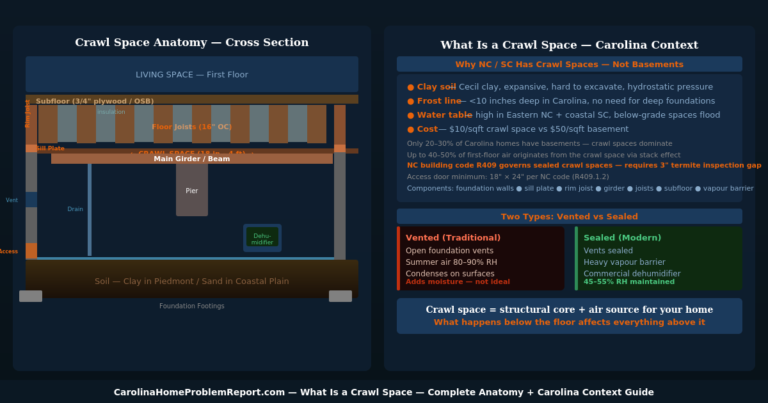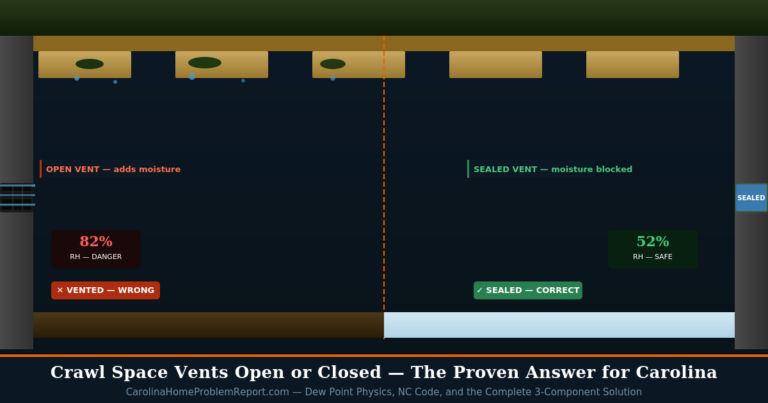
Crawl Space Vapor Barrier [Warning: 7 Installation Mistakes That Cause Failures + Complete NC and SC Guide]
A crawl space vapor barrier is a polyethylene liner installed across the soil floor of a crawl space to block ground moisture from evaporating into the space above. For Carolina homes, the minimum code-compliant thickness is 6-mil, but professional contractors in NC and SC now recommend 12-mil to 20-mil reinforced material for durability in the region's demanding humid conditions. A vapor barrier alone addresses ground evaporation — but in a Carolina summer, a complete moisture solution also requires sealed vents and a dehumidifier. Understanding the difference between a basic vapor barrier and a full encapsulation system is the most important thing a Carolina homeowner can know before spending a dollar on either.
⭐ Key Takeaways
- ✓A crawl space vapor barrier addresses one moisture source — ground evaporation. It does not address humid outdoor air entering through vents, condensation, or water intrusion.
- ✓NC code minimum is 6-mil (Class I vapor retarder) — but most Carolina professionals now install 12-mil to 20-mil for durability that lasts 15–25 years
- ✓Seam taping is not optional — untaped overlaps allow ground moisture to rise through the gaps, defeating the purpose of the barrier entirely
- ✓Basic vapor barrier installation is DIY-accessible — but full encapsulation including vent sealing and dehumidifier sizing benefits from professional expertise
- ✓A vapor barrier delivers 70–80% of the moisture control benefit of a complete encapsulation on its own — making it the highest-return first step in any crawl space improvement
A crawl space vapor barrier is the single most impactful improvement most Carolina homeowners can make to the space beneath their floor — and also one of the most misunderstood. Some homeowners think a vapor barrier and a full encapsulation are the same thing. Others think a vapor barrier alone is enough to solve any crawl space moisture problem. Both are wrong in ways that cost real money.
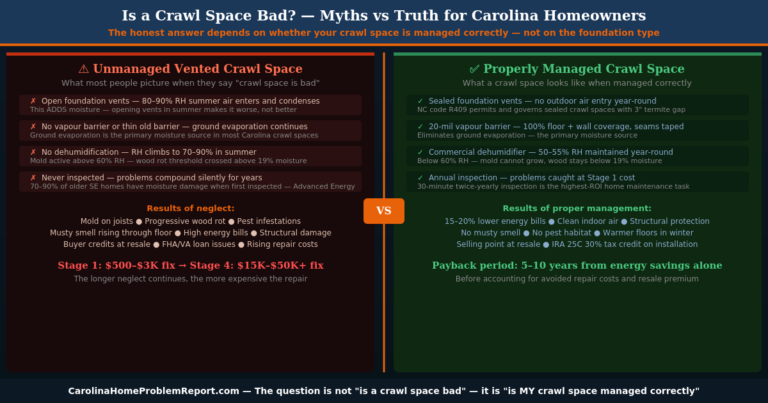
A vapor barrier is a specific component of a moisture management system — the ground liner that blocks soil evaporation from rising into the crawl space air. It is the most important single component in that system, accounting for roughly 70–80% of the moisture control benefit of a complete encapsulation on its own. But in a Carolina crawl space during summer, ground evaporation is not the only moisture source. Humid outdoor air entering through foundation vents and condensation on cold surfaces contribute significantly — and a vapor barrier alone does not address either.
This guide gives Carolina homeowners a complete understanding of what a crawl space vapor barrier is, how to choose the right one for NC and SC conditions, how to install it correctly whether DIY or professional, the most common installation mistakes that cause failures, and when a vapor barrier alone is enough versus when a full encapsulation is required.
In This Article
- What a Crawl Space Vapor Barrier Actually Does
- Vapor Barrier vs Full Encapsulation — Which Does Your Home Need?
- Thickness Guide — 6-Mil vs 12-Mil vs 20-Mil for Carolina Conditions
- Material Types and What the Perm Rating Means
- NC and SC Code Requirements
- How to Install a Crawl Space Vapor Barrier — Step by Step
- 7 Common Mistakes That Cause Vapor Barrier Failures
- Frequently Asked Questions
What a Crawl Space Vapor Barrier Actually Does
The soil beneath a Carolina home is never truly dry. Even in the middle of a summer drought, the ground below the surface contains moisture held in the soil matrix. That moisture continuously evaporates upward — moving from the higher moisture concentration of the soil toward the lower moisture concentration of the air above it. In an uncovered crawl space, that process runs unimpeded and continuously deposits water vapor into the air beneath your floor.
According to Advanced Energy's crawl space research program — which conducted the most rigorous field study of Carolina crawl spaces over five years — soil evaporation is the single largest ongoing moisture source in most older Carolina homes with exposed dirt floors. The vapor barrier's job is simple: lay an impermeable membrane across 100% of the soil surface and stop that evaporation pathway entirely.
When properly installed — 100% soil coverage, sealed seams, barrier running up foundation walls and secured — a quality vapor barrier reduces crawl space humidity measurably within days of installation. Homeowners often notice the difference within the first week: the musty smell diminishes, first-floor rooms feel less clammy, and hygrometer readings in the crawl space begin dropping.
What a vapor barrier does NOT do
A vapor barrier addresses one moisture source — ground evaporation. It does not:
- Stop humid outdoor air from entering through open foundation vents
- Prevent condensation on cold pipes, ducts, or floor joists
- Stop water intrusion through foundation cracks or surface drainage
- Replace the need for a dehumidifier in a vented crawl space
- Remediate existing mold or treat structurally compromised wood
Understanding these limitations is why a vapor barrier alone — without vent sealing and a dehumidifier — often produces improvement but not resolution in Carolina crawl spaces during the summer months.
Vapor Barrier vs Full Encapsulation — Which Does Your Home Need?
This is the most practically important question a Carolina homeowner faces when addressing crawl space moisture. The answer depends entirely on the specific conditions of your crawl space.
✅ A vapor barrier alone may be sufficient if:
- Your crawl space humidity stays consistently below 60% RH even in summer
- You have no history of standing water or active water intrusion
- You have no visible mold on wood surfaces
- Your goal is basic ground moisture reduction and odor control
- You are on a limited budget and want to phase improvements — vapor barrier first, dehumidifier later
- The home is being prepared for sale and needs to pass a moisture inspection
⚠ Full encapsulation is the right choice if:
- Humidity consistently exceeds 60% RH in summer despite having a vapor barrier
- You have open foundation vents — they will import humid air that the vapor barrier cannot stop
- You have had standing water or active water intrusion events
- You see or smell mold — must be remediated before encapsulation
- You want to maximise energy savings and home comfort improvement
- You live in Eastern NC or coastal SC where the water table is shallow and humidity pressure is highest
💡 The phased approach for budget-conscious homeowners
If budget requires choosing between a vapor barrier now and a complete encapsulation later, install a quality 20-mil vapor barrier first. This delivers 70–80% of the moisture control benefit immediately at a fraction of the full encapsulation cost. When budget allows, add vent sealing and a commercial dehumidifier to complete the system. The vapor barrier installation done now will become part of the complete encapsulation later — it is not wasted spending.
Thickness Guide — 6-Mil vs 12-Mil vs 20-Mil for Carolina Conditions
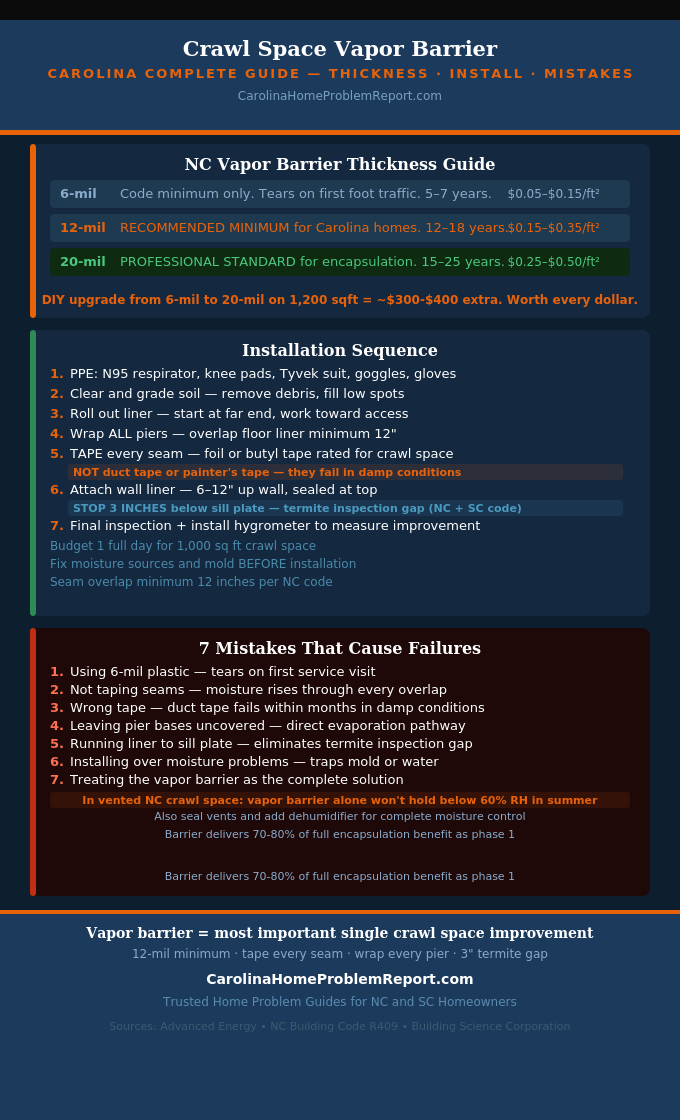
Vapor barrier thickness is measured in mils — thousandths of an inch. A 6-mil barrier is 0.006 inches thick. A 20-mil barrier is 0.020 inches thick — more than three times as thick. Here is what each thickness means in practice for a Carolina crawl space:
| Thickness | Cost per sq ft | Lifespan | Best For |
|---|---|---|---|
| 6-mil polyethylene | $0.05–$0.15 | 5–7 years with foot traffic | Code minimum. Pre-sale installations. Low-traffic spaces. Budget-limited phase 1 only. |
| 10-mil polyethylene | $0.10–$0.25 | 8–12 years | Budget upgrade from 6-mil. Moderate moisture environments. Available at big-box stores. |
| 12-mil reinforced polyethylene | $0.15–$0.35 | 12–18 years | Recommended minimum for Carolina homes. Resists tearing during inspections. Cost-effective sweet spot for long-term protection. |
| 20-mil reinforced polyethylene | $0.25–$0.50 | 15–25 years | Professional standard for full encapsulation. Superior puncture resistance. Best long-term value. Required for many contractor warranties. |
| HDPE reinforced 20-mil+ | $0.40–$0.75+ | 20–30 years | High-traffic spaces, commercial buildings, crawl spaces with rough terrain. Premium option. |
💡 Why Carolina professionals are moving from 6-mil to 12–20-mil
A 6-mil barrier installed today will be punctured by a plumber's knee or a pest inspector's boot within the first few service visits to the crawl space. Each puncture is a spot where ground evaporation resumes. A 20-mil reinforced liner survives that foot traffic without tearing — protecting the moisture control investment for the life of the system. The material cost difference between 6-mil and 20-mil across a 1,200 sq ft crawl space is roughly $300–$400. The labor to reinstall a failed 6-mil barrier in 5 years costs $1,000–$2,000. The math strongly favours the heavier material upfront.
Material Types and What the Perm Rating Means
Beyond thickness, two other specifications matter when selecting a vapor barrier for a Carolina crawl space:
Perm Rating — The Number That Actually Measures Moisture Resistance
Permeability (perms) measures how much water vapor passes through a material. Lower is better for a vapor barrier. NC building code requires a Class I vapor retarder with a perm rating of 0.1 perms or less for closed crawl spaces. In practice, quality polyethylene liners at 6-mil and above typically achieve 0.06 perms or lower — well within code. The perm rating should be listed in the product spec sheet. If a contractor or product listing does not provide the perm rating, ask for it.
Class I vapor retarder: 0.1 perms or less — required by NC code for closed crawl spaces Class II vapor retarder: 0.1 to 1.0 perms — not suitable for NC closed crawl space applications Class III vapor retarder: 1.0 to 10 perms — paint or building wrap — not suitable
White vs Black Liner — It Matters More Than You Think
White or light-coloured vapor barriers are now the professional standard for crawl space encapsulation for a practical reason that has nothing to do with aesthetics: a white surface significantly improves visibility during annual inspections. Pest inspectors looking for mud tubes, homeowners checking for moisture breakthrough, and HVAC technicians working in the space can all see problems against a white background that would be invisible against black. Many professional barriers are white on the surface and black or grey on the ground-contact side — combining visibility above with UV resistance below for the portions that extend up the walls.
LDPE vs HDPE — The Material Composition Difference
Most standard vapor barriers are made from low-density polyethylene (LDPE) — a flexible, cost-effective material that works well at higher mil thicknesses. High-density polyethylene (HDPE) is stiffer and offers better puncture resistance at the same thickness — it is used in premium products and commercial applications. For most Carolina homeowners installing 12–20-mil LDPE products, the LDPE vs HDPE distinction is less important than the mil thickness and installation quality.
NC and SC Code Requirements
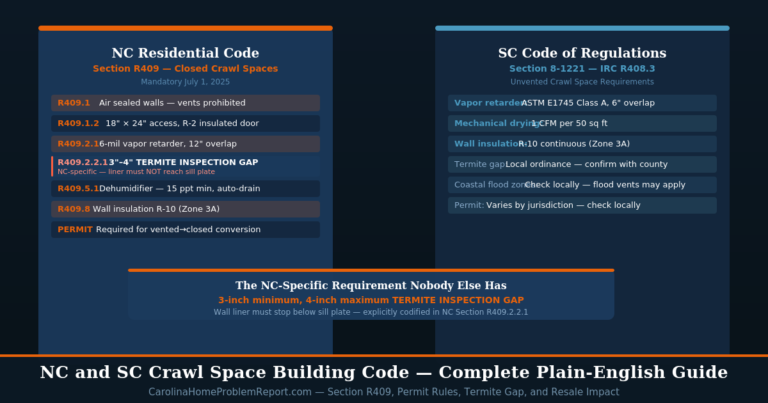
🏭 NORTH CAROLINA — Section R409 Closed Crawl Space Requirements
- Minimum barrier: Class I vapor retarder — 6-mil polyethylene minimum
- Coverage: 100% of exposed earth — no gaps, no uncovered areas
- Seams: Joints lapped not less than 12 inches (one foot overlap minimum)
- Wall attachment: Edges extended at least 6 inches up stem walls, attached and sealed
- Termite inspection gap: Liner must terminate 3 inches below the top of the foundation wall — never run to the sill plate
- Pier wrapping: All concrete or block piers must be wrapped — leaving pier bases uncovered leaves a direct evaporation pathway
- Tape: County codes may require seams to be taped — confirm with your local building department
🏭 SOUTH CAROLINA — Requirements
- SC requires vapor retarders meeting ASTM E1745 Class A for unvented crawl spaces
- Same 3-inch termite inspection gap requirement as NC — do not run liner to the sill plate
- Coastal SC building departments (Charleston, Myrtle Beach) may impose additional requirements — confirm locally
- Seam tape is standard practice in SC even where not explicitly mandated by code
How to Install a Crawl Space Vapor Barrier — Step by Step
Basic vapor barrier installation is within the capability of a careful DIY homeowner. It is physically demanding — you are working in a confined, dirty, often low-clearance space — but not technically complex. Here is the complete sequence.
⚠️ Before you start — check these first
Do NOT install a vapor barrier over: active standing water, wet soil from recent flooding, or visible mold on wood surfaces. Any active water intrusion source must be fixed before installation. Any existing mold must be professionally remediated before the barrier goes in. Installing a vapor barrier over these conditions traps the problem rather than solving it.
Gather PPE and tools
N95 respirator (minimum — P100 preferred), safety glasses or goggles, knee pads, disposable Tyvek crawl space suit, waterproof gloves. Tools needed: utility knife, heavy-duty scissors, tape measure, chalk line, hand stapler or masonry fasteners, seam tape rated for crawl space use (foil or butyl tape — not duct tape or masking tape which fail in damp environments), and a headlamp.
Clear and prepare the crawl space floor
Remove all debris, old insulation scraps, wood pieces, and any material that could puncture the barrier from below. Remove any old vapor barrier — install over an old 6-mil that has failed and you are trapping moisture between layers. Grade the soil surface as level as possible. Fill in any low spots where water could pool beneath the barrier. NC code requires grading toward drain points.
Roll out the barrier starting from one end
Start from the furthest point from the access and work toward the exit — you want to complete each section before knee-crawling over it. Roll the liner across the entire floor, extending up each foundation wall 6–12 inches. Where sheets meet, overlap seams by at least 12 inches (NC code minimum) — more overlap is better. Cut around piers and obstacles with your utility knife.
Wrap all piers completely
Every pier — concrete block, brick, or wood post — must be wrapped with a separate piece of barrier material that overlaps with the floor liner by at least 12 inches at the base. Piers that simply have the floor liner butted up against them leave a direct moisture pathway around the base. Tape all joints where pier wraps meet the floor liner.
Tape every seam and overlap
Use manufacturer-approved seam tape — foil-backed tape, butyl tape, or polypropylene tape rated for crawl space use. Run a continuous strip of tape along every seam where barrier sheets overlap. Press firmly and ensure full adhesion. Do NOT use standard duct tape (fails within months in damp conditions), painter's tape, or any household tape product. This step is where most DIY vapor barrier installations fail.
Attach wall liner — stopping 3 inches below the sill plate
Run the wall portion of the liner up each foundation wall and fasten it using masonry fasteners or construction adhesive rated for the foundation wall material. The liner must terminate 3 inches below the top of the foundation wall — this is the termite inspection gap required by NC and SC code. Never run the liner all the way to the sill plate. At the top edge, tape the liner flat against the wall and seal with butyl tape to prevent air bypass.
Inspect before exiting
Before leaving the crawl space, do a complete visual inspection of the installed barrier. Check: 100% soil coverage with no gaps, all seams taped and adhered, all piers wrapped and taped, wall liner fastened and terminated at the correct height. Install a hygrometer and check the reading again in 7 days to confirm the humidity improvement the barrier produces.
7 Common Mistakes That Cause Vapor Barrier Failures
These are the failures that professionals fix most often when called to re-do a previous installation:
Using 6-mil plastic for a permanent installation
6-mil tears on first contact with a kneeling plumber or pest inspector. Within 2–3 service visits the barrier is riddled with holes. Choose 12-mil minimum for any installation meant to last more than a few years.
Not taping the seams
Overlapping without taping allows ground moisture to rise through the overlaps. All the soil evaporation you blocked by covering the rest of the floor escapes through untaped seams. Tape every overlap — it takes 30 minutes and costs $20 in tape.
Using the wrong tape
Standard duct tape, masking tape, or painter's tape lose adhesion in humid conditions within weeks to months. Use foil-backed tape, butyl tape, or polypropylene seam tape rated for moisture applications. Spend $15–$25 on the right tape — it is the cheapest insurance in the entire installation.
Leaving pier bases uncovered
Butting the floor liner against the base of piers without wrapping them leaves every pier base as an unprotected soil evaporation point. Wrap every pier completely and tape the junction between the pier wrap and floor liner.
Running the liner to the sill plate
Taking the wall liner all the way to the sill plate conceals the junction between the foundation and the floor framing — exactly where termite inspectors look for mud tubes. NC and SC code require a 3-inch inspection gap. Eliminate it and you blind yourself to termite activity at the most critical entry point.
Installing over existing moisture problems
Installing a vapor barrier over active mold on the soil, over wet soil from uncorrected water intrusion, or over a failing old barrier creates a sealed moisture trap. Fix all moisture sources and remediate any mold before the liner goes in.
Thinking the vapor barrier is the complete solution
In a vented Carolina crawl space during summer, a vapor barrier installed without sealed vents and a dehumidifier will improve conditions but will not maintain humidity below 60% RH on its own. The open vents continue importing high-dew-point outdoor air. Plan the complete system — vapor barrier is the most critical first step, not the entire solution.
Frequently Asked Questions
What thickness vapor barrier do I need in North Carolina?
NC code requires a minimum 6-mil Class I vapor retarder. For any installation intended to last, professionals in NC now recommend 12-mil minimum and 20-mil for complete encapsulation systems. The extra material cost across a typical crawl space is $300–$500 — worth it for the durability difference. 6-mil is adequate only for a pre-sale installation or a temporary measure.
Can I install a crawl space vapor barrier myself?
Yes — basic vapor barrier installation is DIY-accessible for a motivated homeowner with appropriate PPE. Budget a full day for a 1,000 sq ft crawl space. The work is physically uncomfortable but not technically complex. Purchase appropriate seam tape, a quality 12–20-mil liner, and follow the installation steps in this guide. Full encapsulation including vent sealing and dehumidifier sizing benefits from professional involvement, particularly for sizing the dehumidifier correctly for your specific crawl space volume.
How long does a crawl space vapor barrier last?
A properly installed 20-mil reinforced barrier in a Carolina crawl space lasts 15–25 years with normal maintenance traffic. A 6-mil barrier under similar conditions lasts 5–7 years before foot traffic damage requires replacement. The single largest factor in liner longevity is mil thickness — heavier material simply withstands crawl space conditions longer.
Is a vapor barrier the same as encapsulation?
No. A vapor barrier is the ground and wall liner component of a crawl space moisture management system. Full encapsulation includes the vapor barrier plus sealed foundation vents, rim joist air sealing, and a commercial dehumidifier — creating a sealed, actively managed environment. The vapor barrier alone is a significant improvement over an exposed dirt floor but does not constitute a complete encapsulation.
Does a crawl space vapor barrier help with mold?
It helps prevent new mold growth by reducing the humidity that allows mold to establish on wood surfaces — but only if combined with vent sealing and a dehumidifier in a vented Carolina crawl space. A vapor barrier alone in a space with open foundation vents may reduce humidity from 80% to 70% in summer — still above the 60% mold growth threshold. For active mold already on wood surfaces, professional mold remediation must happen before the vapor barrier is installed.
A crawl space vapor barrier is the most important single moisture control improvement a Carolina homeowner can make beneath their floor. In a region where exposed crawl space soil evaporates significant moisture daily regardless of weather, a properly installed 12–20-mil liner produces measurable improvement quickly and cost-effectively. It is the right first step in a phased approach, the most critical component in a complete encapsulation, and the one upgrade that delivers the most moisture control benefit per dollar spent anywhere in the crawl space system.
Use the right thickness, tape every seam with the right tape, wrap every pier, stop the liner 3 inches below the sill plate, and fix any moisture sources before installation. Get those fundamentals right and the vapor barrier will perform for decades.
Find a Crawl Space Professional Near You →The Carolina Home Problem Report editorial team researches and writes guides for homeowners across North and South Carolina. Our research draws on NC State Extension Service publications, Advanced Energy field studies, EPA guidelines, NC Building Code research, and insights from licensed Carolina contractors. We are not contractors — we are a research team dedicated to giving Carolina homeowners clear, locally specific, unbiased answers.
Carolina Home Problem Report is an informational resource for homeowners. We are not licensed contractors. Always consult a qualified professional before making home repair decisions. See our Disclaimer and Affiliate Disclosure.