Crawl Space Encapsulation Cost [Complete NC and SC Price Guide for 2026 — What’s Hidden in Every Quote]
Crawl space encapsulation cost in North and South Carolina runs $5,000 to $12,000 for most homes, with the NC average at $5,100 and the SC average at $5,000 — both slightly below the national average of $5,500. Basic vapor barrier installation alone costs $1,500–$4,000. A complete encapsulation with vapor barrier, sealed vents, insulation, and a commercial dehumidifier typically runs $3–$7 per square foot, rising to $3–$10 per square foot when mold remediation, structural repairs, or sump pump installation is needed first.
⭐ Key Takeaways
- ✓Crawl space encapsulation cost in NC averages $5,100 and in SC averages $5,000 — both below the $5,500 national average
- ✓Skipping the dehumidifier is the single most common and most expensive mistake — without it, moisture rebuilds under the vapor barrier within one season
- ✓Converting from vented to closed crawl space requires a permit in North Carolina as of December 2025 — confirm your contractor pulls it
- ✓Advanced Energy's 5-year NC field study found sealed crawl spaces use 15–18% less energy for heating and cooling — most projects pay back in 7–10 years
- ✓Always get at least 3 quotes from licensed contractors — encapsulation pricing varies significantly and scope differences between quotes are often where homeowners get misled
Crawl space encapsulation cost is one of the most searched questions Carolina homeowners ask after a crawl space inspection reveals moisture problems — and it is one of the most difficult to get a straight answer on. Every contractor gives a different number. Online estimates range from $1,500 to $15,000. A neighbour paid $4,000. Your quote came back at $9,000. Which is right?
The answer is that all of these numbers can be right depending on what is actually being quoted. A $1,500 price covers a basic 6-mil vapor barrier on the soil floor alone. A $9,000 price covers a complete system — heavy-duty barrier, sealed vents, wall insulation, commercial dehumidifier with auto-drain, rim joist air sealing, and a termite inspection gap. These are not the same job. The biggest source of confusion and dissatisfaction in the crawl space encapsulation market is homeowners comparing quotes that are scoping entirely different work.
This guide breaks down exactly what crawl space encapsulation costs in North and South Carolina in 2026, what drives the price up and down, what should and should not be included in any complete encapsulation quote, and how to evaluate three competing quotes intelligently so you get the right job done at a fair price.
In This Article
- NC and SC Crawl Space Encapsulation Cost — 2026 Numbers
- What a Complete Encapsulation Should Include
- 7 Factors That Drive the Final Cost Up or Down
- Add-On Costs — What Gets Discovered During the Job
- NC and SC Building Code — What You Need to Know
- Is Crawl Space Encapsulation Worth the Cost in Carolina?
- How to Get and Compare 3 Quotes — Red Flags and Green Flags
- Frequently Asked Questions
NC and SC Crawl Space Encapsulation Cost — 2026 Numbers
Here are the current market cost ranges for crawl space encapsulation in North and South Carolina, broken down by project type. These figures reflect 2026 contractor pricing in the NC and SC market, which runs slightly below national averages due to regional competition and lower labor costs than major metro markets.
| Project Type | NC Cost Range | SC Cost Range | What's Included |
|---|---|---|---|
| Basic vapor barrier only | $1,500–$4,000 | $1,200–$3,800 | 6-mil ground liner only. Meets minimum code. Does NOT address wall moisture, air sealing, or humidity control. |
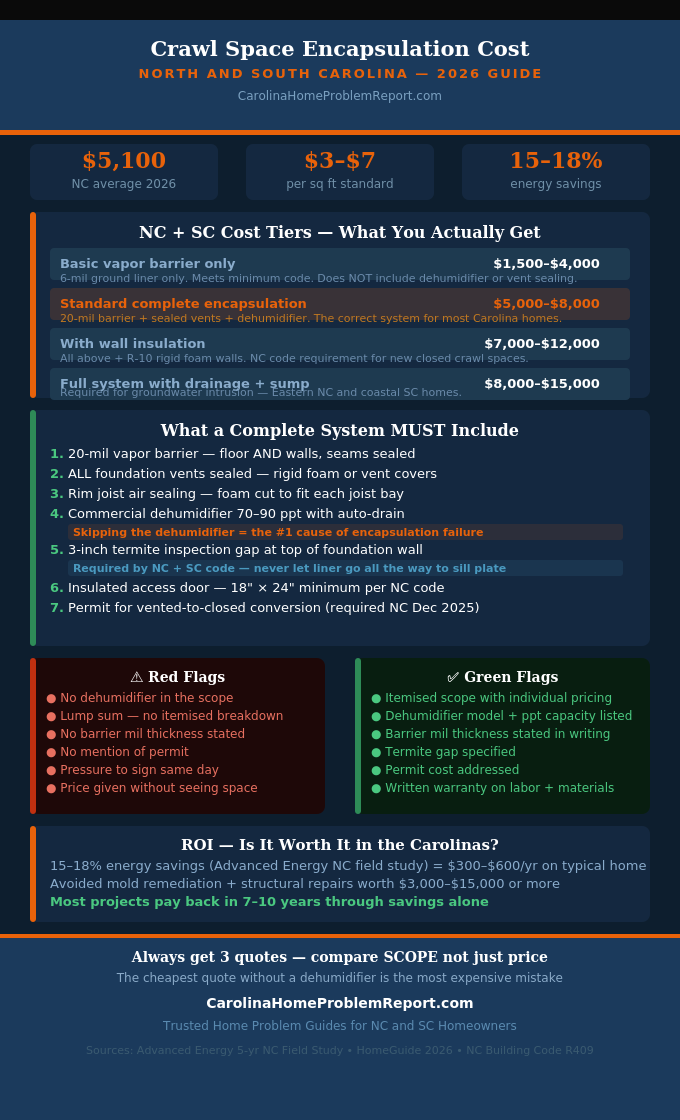
| Standard complete encapsulation | $5,000–$8,000 | $4,800–$7,500 | 20-mil floor barrier, wall liner, sealed vents, rim joist air sealing, commercial dehumidifier with auto-drain. The correct system for most Carolina homes. |
| Premium encapsulation with insulation | $7,000–$12,000 | $6,500–$11,000 | All of above plus rigid foam or spray foam wall insulation (R-10 minimum for NC code), upgraded barrier material, and in some cases a drainage matting layer. |
| Full system with drainage/sump | $8,000–$15,000 | $7,500–$14,000 | Everything above plus interior perimeter drainage channel and sump pump. Required for groundwater intrusion problems common in Eastern NC and coastal SC. |
| With mold remediation added | Add $1,500–$4,000 | Add $1,500–$3,800 | Professional mold treatment must precede encapsulation when active mold is found on wood surfaces. Billed separately from encapsulation scope. |
Regional cost variation within the Carolinas
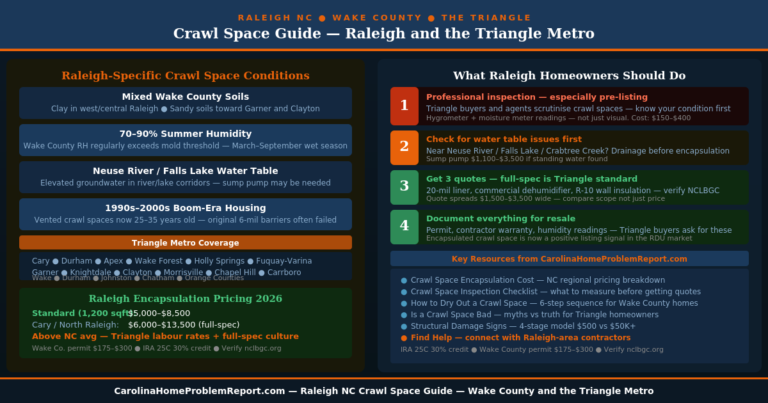
Charlotte and the Raleigh-Durham market tend to run at or slightly above the NC state average due to higher labor demand and more contractors operating at scale. Eastern NC markets (Greenville, Jacksonville, Kinston, Wilmington) often price slightly lower. The SC Lowcountry (Charleston, Beaufort, Hilton Head) may price higher due to coastal access difficulty and stricter local code requirements. Inland SC markets (Columbia, Greenville-Spartanburg) generally track with the state average.
What a Complete Crawl Space Encapsulation Should Include
The most important thing to understand about crawl space encapsulation cost is that a complete system has specific non-negotiable components. A quote that omits any of these is not a quote for a complete encapsulation regardless of what it says on the contract.
20-mil polyethylene vapor barrier — floor AND walls
A minimum 20-mil reinforced liner covering 100% of the crawl space floor with seams overlapped and taped, extended up foundation walls 6–12 inches and sealed. NC code requires a minimum 6-mil Class I vapor retarder — but 20-mil is the professional standard for durability. A barrier that only covers the floor and not the walls is incomplete. Wall coverage stops moisture wicking in from the foundation.
Sealed foundation vents — all of them
Every foundation vent must be sealed with rigid foam insulation and/or purpose-made vent covers. A single open vent continuously imports humid outdoor air into an otherwise sealed space, undoing the encapsulation's humidity control. In NC, this vent sealing is a code requirement for a compliant closed crawl space.
Rim joist air sealing
The rim joist — where the floor framing meets the foundation wall — is one of the most significant air and moisture infiltration points in a crawl space. Rigid foam cut to fit and sealed in each joist bay around the perimeter stops both air infiltration and the cold that makes rim joists condensation targets in winter.
Commercial-grade crawl space dehumidifier with auto-drain
This is the step most often omitted from budget encapsulation quotes — and its omission is what causes failures. A sealed crawl space without a dehumidifier accumulates moisture from residual ground evaporation and infiltration through minor penetrations. NC code under Section R409 requires mechanical drying with a unit capable of removing at least 15 pints per day. Professional contractors use 70–90 pint-per-day units ($1,000–$3,500 installed). The auto-drain connection to a condensate line or sump is non-negotiable — a dehumidifier that requires manual bucket emptying will eventually overflow unattended.
3-inch termite inspection gap
In NC and SC, wall liner must terminate 3 inches below the top of the foundation wall — leaving a visible gap between the liner and the sill plate. This gap is required specifically so that pest inspectors can visually check for mud tubes during annual inspections without disturbing the encapsulation. A contractor who takes the liner all the way to the sill plate may be cheaper, but they are also eliminating your ability to detect termite activity that begins at the foundation wall — the most common entry point in Carolina homes.
Access door upgrade (if needed)
NC code requires a minimum 18-inch by 24-inch access opening for crawl space entry. If the existing hatch is smaller, or is a simple wooden cover with no insulation or seal, replacing it with a properly sized, insulated, airtight access door is part of a complete encapsulation. A leaky access hatch undermines the sealed environment the rest of the system creates.
7 Factors That Drive the Final Cost Up or Down
Knowing what drives price variation helps you evaluate quotes and understand why your number may be higher or lower than a neighbour's.
Crawl space square footage
The baseline cost driver. Encapsulation is priced partly by square footage. A 1,000 sq ft crawl space will cost roughly 60% of a 1,600 sq ft crawl space for the same scope of work. Measure your crawl space footprint before requesting quotes so you can compare per-sq-ft pricing accurately.
Crawl space height and access difficulty
Labor costs increase significantly in crawl spaces under 24 inches of clearance. Installers working in tight spaces take longer and work harder. Difficult or distant access points — a hatch in a closet versus exterior access — also add labor time. If your crawl space has low clearance throughout, expect quotes 15–25% higher than comparable higher-clearance spaces.
Existing condition — mold, rot, wet insulation
Any mold present must be professionally remediated before encapsulation proceeds — adding $1,500–$4,000. Wet or fallen insulation must be removed and disposed of before installation. Any of these conditions found during the assessment adds to the total cost but also means the job would be incomplete without them.
Vapor barrier mil thickness
The code minimum is 6-mil. Professional standard is 12–20-mil reinforced liner. A 20-mil barrier costs more upfront but resists punctures from foot traffic during inspections and has a service life of 15–25 years. A 6-mil barrier may need replacement in as little as 5–7 years in an active crawl space. The difference in material cost across a 1,000 sq ft space is roughly $300–$600 — worth it for the longevity difference.
Whether drainage or a sump pump is needed
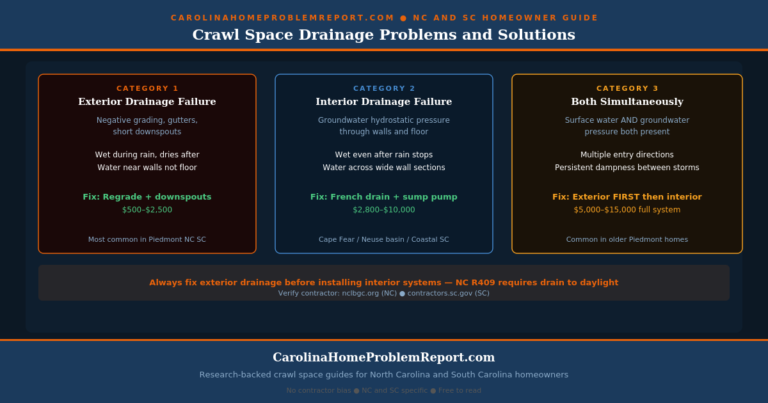
Homes with groundwater intrusion — common in Eastern NC and coastal SC — need a sump pump and possibly interior drainage installed before or during encapsulation. This adds $800–$3,000+ to the project cost but is not optional for these sites. An encapsulation installed without drainage on a groundwater-affected site will fail — the liner will float.
Wall insulation scope
Insulating foundation walls with rigid foam board (R-10 minimum per 2025 NC code) or spray foam adds $500–$3,700 to the project but significantly improves thermal performance. Without wall insulation in a closed crawl space, the space remains cold in winter, increasing condensation risk on pipes and creating cold floors above. Wall insulation is worth including for NC homes where winter heating costs are a concern.
Location within the Carolinas
Charlotte metro and the Triangle (Raleigh-Durham-Chapel Hill) have the most competition and the highest labor demand — prices tend to land at or slightly above the NC state average. Rural and smaller market areas typically price 10–20% lower. Coastal markets — Wilmington, Jacksonville, Outer Banks, Charleston SC — often price at or above average due to access difficulty and stricter local code requirements.
Add-On Costs — What Gets Discovered During the Job
Honest contractors will note these in the quote as conditional costs. Contractors who give very low initial estimates and then surprise you with these during the job are red flags. Know what might come up:
| Add-On Item | Typical Cost | When Required |
|---|---|---|
| Mold remediation | $1,500–$4,000 | Active mold on joists or walls. Must precede encapsulation. |
| Wet insulation removal | $500–$2,000 | Sagging, fallen, or moisture-saturated insulation batts. |
| Sump pump installation | $800–$3,000 | Groundwater intrusion, Eastern NC, low-lying sites. |
NC and SC Building Code — What You Need to Know
North Carolina's building code has evolved significantly on crawl space standards. Understanding the current requirements protects you from contractors who cut corners on code compliance and leaves you with a crawl space that fails inspection or creates problems at resale.
🏭 NORTH CAROLINA — Current Requirements (2025)
- Section R409 of the NC Residential Code (updated July 1, 2025) governs closed crawl spaces explicitly
- Class I vapor retarder required — minimum 6-mil liner on ground floor, seams overlapped 6 inches, sealed and taped, edges extending 6 inches up stem walls
- Mechanical drying required — a permanently installed dehumidifier capable of removing minimum 15 pints per day OR a conditioned air supply from the HVAC system
- Foundation vents must be blocked and sealed — all existing vents closed and insulated
- Wall insulation required — R-10 continuous rigid foam on foundation walls minimum (Climate Zone 3A)
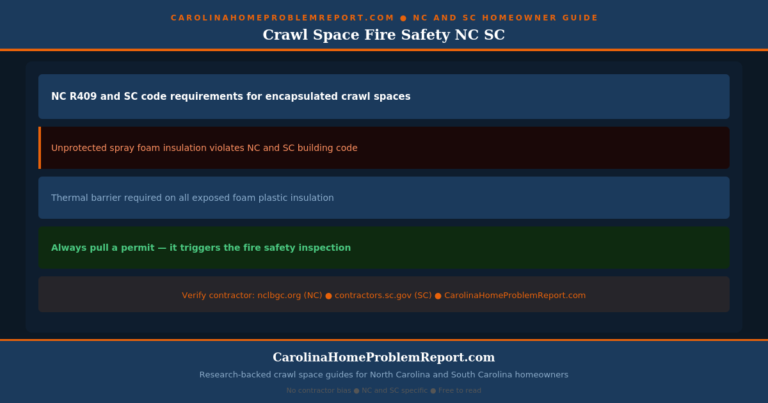
- Permit required — converting from vented to closed crawl space requires a permit pull from the local building department as of December 2025 guidance from the NC Department of Insurance
- 3-inch termite inspection gap — liner must terminate 3 inches below the top of the foundation wall
- Access opening minimum — 18 inches by 24 inches required for crawl space access
🏭 SOUTH CAROLINA — Current Requirements
- SC permits closed crawl spaces under similar provisions to NC with the same termite inspection gap requirement
- Coastal SC building departments (Charleston, Myrtle Beach, Beaufort) may impose additional flood-resistant material requirements in FEMA flood zones
- Inland SC (Greenville, Columbia, Spartanburg) requirements track closely with NC provisions
- Always confirm local permit requirements with the county building department before work begins — SC requirements vary more by jurisdiction than NC
⚠️ The permit question matters at resale
A crawl space encapsulation done without a required permit in NC is unpermitted work. When you sell your home, buyers and their inspectors may flag unpermitted work during due diligence, potentially requiring retroactive permitting or the work being redone to current code. Confirm with your contractor that they pull the permit before work begins.
Is Crawl Space Encapsulation Worth the Cost in Carolina?
For most older Carolina homes with vented crawl spaces, yes — and the evidence is specific and measurable. According to Advanced Energy's 5-year field study of North Carolina homes, sealed crawl spaces use 15–18% less energy for heating and cooling than comparable vented crawl spaces with subfloor insulation. This finding, gathered from 12 central NC homes over five years, is the most rigorous data available on Carolina crawl space encapsulation ROI.
ROI Framework for a Typical Carolina Home
Energy savings: A home spending $2,000 per year on heating and cooling saves $300–$360 per year at 15–18% reduction. Over a 15-year encapsulation lifespan, that is $4,500–$5,400 in cumulative energy savings on a $6,000 project.
Avoided structural repairs: A single avoided mold remediation and joist sistering event saves $3,000–$8,000. A full subfloor replacement that encapsulation prevents costs $5,000–$15,000. Encapsulation is far cheaper than the damage it prevents.
HVAC lifespan extension: A sealed crawl space reduces the humidity load on your air conditioning system, allowing it to cycle off sooner. Research suggests this can add 2–3 seasons of useful life to HVAC equipment worth $7,000–$12,000 to replace.
Home value and resale: A clean, dry, encapsulated crawl space is increasingly flagged by real estate agents and inspectors in both NC and SC as a value-positive feature. A vented crawl space with mold is consistently cited as a deal-killer that triggers buyer credits of $5,000–$15,000. Encapsulation removes that liability.
Federal tax credits (note: status as of 2025): The 25C Energy Efficient Home Improvement Credit — this credit expired December 31, 2025 under the One Big Beautiful Bill. Check IRS.gov for current home improvement incentive programs before filing. Crawl space encapsulation that includes insulation and air sealing often qualifies. Consult a tax professional to confirm eligibility for your specific project.
How to Get and Compare 3 Quotes — Red Flags and Green Flags
Getting three quotes is the minimum standard for a project of this size. Here is how to do it effectively:
Frequently Asked Questions
How much does crawl space encapsulation cost in North Carolina?
The NC average is $5,100 in 2026. Most complete encapsulation projects fall between $5,000 and $8,000 for a standard home without pre-existing mold or structural damage. Basic vapor barrier installation alone runs $1,500–$4,000. Full systems with drainage, insulation, and a commercial dehumidifier on larger homes can reach $12,000–$15,000.
Is crawl space encapsulation required by North Carolina code?
Encapsulation is not required for existing homes — but if you choose to convert from a vented to a closed crawl space, the work must meet Section R409 of the NC Residential Code and requires a permit as of December 2025. New construction in NC has specific code paths for closed crawl spaces that effectively require encapsulation components.
What is the difference between a vapor barrier and full encapsulation?
A vapor barrier is just the plastic liner on the ground floor — it costs $1,500–$4,000 and addresses only ground evaporation. Full encapsulation is a complete system: ground and wall liner, sealed vents, rim joist air sealing, insulation, and a commercial dehumidifier. In a Carolina summer, a vapor barrier alone without vent sealing and a dehumidifier will not keep humidity below 60% — you still get mold conditions. Full encapsulation is what actually solves the problem.
How long does crawl space encapsulation last?
A quality 20-mil reinforced vapor barrier lasts 15–25 years with normal foot traffic during inspections. The commercial dehumidifier typically needs replacement after 8–12 years. Annual inspections catch any punctures, seam failures, or dehumidifier issues before they become bigger problems. A well-installed encapsulation with a quality barrier and maintained dehumidifier should serve a Carolina home for 15–20 years before any major component replacement is needed.
Does homeowners insurance cover crawl space encapsulation?
Generally no — encapsulation is considered a home improvement and maintenance investment, not damage remediation. However, if the moisture problem driving the need for encapsulation was caused by a sudden accidental event (a burst pipe, for example), the water damage remediation component may be covered. Always contact your insurer before any work begins and document conditions thoroughly. The encapsulation itself is almost never covered.
Crawl space encapsulation cost in NC and SC runs slightly below national averages — but the return on that investment runs higher than average, because the Carolina climate makes the underlying moisture problem more severe and the consequences of leaving it unaddressed more expensive than in drier regions. A $6,000 encapsulation on a home where $15,000 of mold and structural damage was already building is not expensive. It is the cheapest option available. The homeowners who spend the most on crawl space problems are the ones who waited, got a low-ball basic vapor barrier installed without a dehumidifier, or let the problem compound for several more summers before addressing it comprehensively.
Get three quotes, compare scope not just price, confirm the contractor is licensed and pulls the required permit, and do not accept a quote that does not include a commercial dehumidifier.
Get Free Encapsulation Quotes Near You →The Carolina Home Problem Report editorial team researches and writes guides for homeowners across North and South Carolina. Our research draws on NC State Extension Service publications, Advanced Energy field studies, EPA guidelines, HomeGuide national cost data, and insights from licensed Carolina contractors. We are not contractors — we are a research team dedicated to giving Carolina homeowners clear, locally specific, unbiased answers.
Carolina Home Problem Report is an informational resource for homeowners. We are not licensed contractors. Always consult a qualified professional before making home repair decisions. Cost ranges are market estimates and may vary. See our Disclaimer and Affiliate Disclosure.