Warning: Crawl Space Moisture Attracts Termites [The Biological Connection + Proven Dual-Threat Fix for Carolina Homes]
Crawl space moisture attracts termites because the Eastern subterranean termite — the species responsible for nearly all termite damage in Carolina homes — cannot survive without a sustained moisture source. Moisture is not merely attractive to subterranean termites; it is biologically necessary for their survival, their digestion of cellulose, and their colony maintenance. A wet crawl space does not just increase termite risk — it creates the precise conditions that allow a subterranean colony to establish and expand under your home, often undetected for years.
⭐ Key Takeaways
- ✓Eastern subterranean termites require moisture to survive — a wet crawl space is not just an attractant but a biological necessity they actively seek
- ✓Termite damage in NC homes costs more annually than fires, floods, and tornadoes combined and is almost never covered by homeowners insurance
- ✓A mature termite colony can remain undetected for 3 to 8 years in a crawl space while consuming structural wood continuously
- ✓Eliminating crawl space moisture is the single most effective long-term termite prevention strategy available to Carolina homeowners
- ✓Crawl space moisture control and termite treatment are two separate interventions that must both be completed for lasting protection
Crawl space moisture attracts termites more reliably than almost any other condition a Carolina homeowner can create beneath their home — and most homeowners have no idea the two problems are connected. They think about moisture as a mold and rot problem. They think about termites as something their pest control plan handles. The reality is that a wet crawl space and a termite infestation are often two stages of the same process, with moisture creating exactly the conditions that allow subterranean termites to establish and sustain a colony under your floor.
North Carolina is one of the highest-risk states in the country for subterranean termite activity. The Eastern subterranean termite — the dominant species across both Carolinas — is active year-round thanks to the region's mild winters and reliably humid conditions. According to NC State Extension's guide on managing Eastern subterranean termites, moist wood is one of the most significant conditions that make a home conducive to infestation — and eliminating moisture sources is one of the most effective prevention strategies available.
This guide explains the precise biological connection between crawl space moisture and subterranean termites, how to recognize both moisture conditions and termite activity simultaneously, and what Carolina homeowners need to do about both — in the right order — for lasting protection.
In This Article
- Why Subterranean Termites Cannot Survive Without Moisture
- Why Carolina Crawl Spaces Are Especially High Risk
- The Moisture-to-Termite Timeline
- The Dual-Threat Inspection Checklist
- Warning Signs of Termites in Your Crawl Space
- The Proven Fix — Moisture Control and Termite Treatment Together
- Frequently Asked Questions
Why Subterranean Termites Cannot Survive Without Moisture
To understand why a wet crawl space is so dangerous from a termite standpoint, it is important to understand the biology of the Eastern subterranean termite at a basic level. Unlike some insects that are simply attracted to moisture as a preference, subterranean termites require it as a biological necessity.
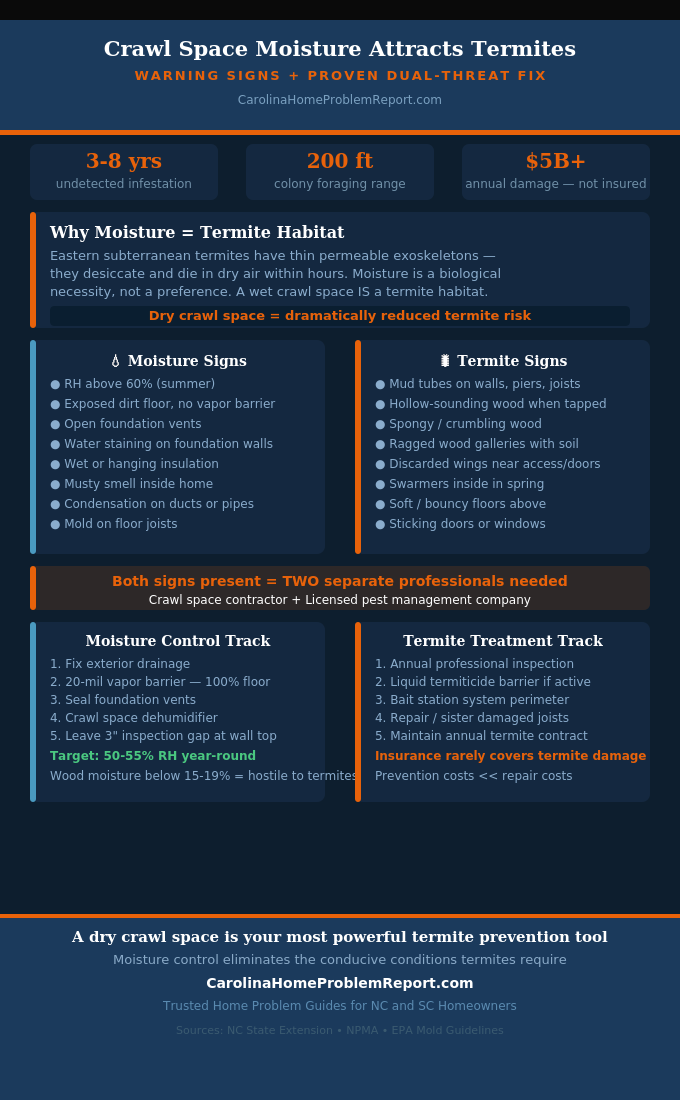
Termites have thin, permeable exoskeletons. Unlike many insects, subterranean termites have no waxy coating on their outer shells. This means they lose moisture to the surrounding environment continuously. Without access to sustained moisture, worker termites desiccate and die within hours when exposed to dry air. This is why subterranean termites travel in mud tubes — sealed tunnels of soil, saliva, and wood particles — that maintain the humid microenvironment they need to survive above the soil line.
Moisture is required for cellulose digestion. Subterranean termites digest wood through symbiotic microorganisms in their gut. These microorganisms require a sufficiently humid environment to function. The process of breaking down cellulose — the organic compound in wood that constitutes the termite food source — is impaired in conditions that are too dry. This is why dry wood termite species and subterranean termite species have different habitat preferences: subterranean termites specifically need wood that has elevated moisture content to feed on it most efficiently.
Colonies sustain themselves on moisture-softened wood. Wood at elevated moisture content — the kind produced by a persistently damp crawl space — is not just hydration for the termites. It is structurally softer and easier to consume. Termites feed on wood regardless of moisture content, but they expand faster and sustain larger colonies when feeding on wood that moisture has already begun to degrade. A crawl space that produces the mold and wood rot we have discussed in earlier articles is simultaneously producing the perfect termite feeding ground.
The conducive conditions connection
NC State Extension's pest management research uses the term "conducive conditions" to describe the environmental factors that make a home vulnerable to subterranean termite infestation. Moist wood is listed consistently as one of the most significant conducive conditions. This means that addressing crawl space moisture is not just a structural maintenance task — it is one of the most effective termite prevention strategies available to a Carolina homeowner.
Why Carolina Crawl Spaces Are Especially High Risk
The Carolinas are classified as one of the highest-risk regions in the country for subterranean termite activity. Multiple factors compound to create conditions that are particularly favorable for the Eastern subterranean termite specifically.
Mild winters keep colonies active year-round. Unlike northern states where subterranean termite colonies go dormant during hard winters, colonies in the Carolinas remain active in all but the most extreme cold periods. This means a colony established under a Carolina home is feeding, expanding, and causing damage twelve months of the year rather than eight or nine.
Clay soils hold moisture close to foundations. The heavy clay soils that characterize much of the Carolina Piedmont retain moisture long after rain events. Moist soil directly against a foundation creates a continuous moisture connection between the soil and the wood framing above. The same soil conditions that make crawl space moisture problems severe also support the subterranean colony's moisture requirements in the soil surrounding the foundation.
Crawl space construction is the dominant foundation type. Crawl space foundations are the most common foundation type across both Carolinas, particularly in homes built before 1990. Crawl spaces offer subterranean termites exactly what they need: proximity to soil, abundant wood framing accessible from below, and — in older vented crawl spaces — moisture levels that support both colony maintenance and efficient feeding.
Two termite species are active in North Carolina. The Eastern subterranean termite is present throughout both states. The Formosan termite — an even more aggressive species introduced from Asia — is established in the coastal counties of both NC and SC. Formosan colonies can reach several million individuals compared to the 200,000 to 2,000,000 of Eastern subterranean colonies, and they cause damage at a proportionally accelerated rate. In coastal Carolina homes with moisture problems, the risk profile is elevated beyond what most homeowners appreciate.
The Moisture-to-Termite Timeline
Understanding the typical progression from a wet crawl space to an established termite infestation helps illustrate why early moisture control has such disproportionate value compared to late intervention.
Crawl space humidity builds above 70% through summer. Ground evaporation from exposed soil and humid outdoor air through open vents raise wood moisture content above 19%. Mold begins colonizing floor joists. Soil surrounding the foundation stays persistently moist. Foraging termite scouts from existing soil colonies begin investigating the foundation perimeter.
Worker termites find a pathway from soil to wood — through a crack in the foundation wall, through an expansion joint, through a gap where a pipe enters the foundation, or directly through the soil floor of the crawl space. Mud tubes begin forming. Feeding on floor joists begins. The homeowner notices nothing.
The colony expands its feeding territory. Multiple mud tube routes are established. Floor joist damage extends. Moist wood conditions continue to sustain the colony efficiently. The homeowner may notice a faint musty smell (attributed to mold) but still no obvious termite signs above the floor line.
Floors begin to feel soft or spongy. Swarmers emerge in spring, sometimes inside the house. A pest inspector or crawl space contractor discovers extensive mud tube networks and significant wood damage. At this point both structural repairs and termite treatment are required. The total cost is multiples of what moisture control alone would have cost at Year 1.
A vapor barrier, sealed vents, and a crawl space dehumidifier installed in Year 1 eliminate the conducive conditions before any colony establishes. Wood moisture content stays below 15-19%. Soil near the foundation dries. The micro-environment that subterranean termites require does not exist. Colony establishment risk drops significantly. Annual termite inspections catch any early activity before it becomes structural damage.
The Dual-Threat Inspection Checklist
Because moisture and termite problems co-exist so frequently in Carolina crawl spaces, inspect for both simultaneously during any crawl space inspection. Bring a flashlight, a screwdriver for probing wood, and a hygrometer.
💧 MOISTURE CONDITIONS — check these first:
- Hygrometer reading above 60% in summer or 55% in winter
- Visible dirt floor with no vapor barrier or partial coverage
- Open foundation vents allowing humid outdoor air entry
- Water staining or tide marks on foundation walls
- Insulation hanging down, wet, or discolored between joists
- Condensation visible on pipes or HVAC ducts
- Musty smell indicating active mold from sustained moisture
🐛 TERMITE ACTIVITY — check these second:
- Mud tubes on foundation walls, piers, floor joists, or anywhere soil contacts structure — pencil-width tunnels of compacted soil and wood particles
- Wood that sounds hollow when tapped firmly along the joist length
- Soft, spongy, or crumbling wood when pressed with a screwdriver tip
- Ragged, irregular galleries inside damaged wood (distinct from smooth carpenter ant galleries)
- Discarded wings near crawl space access, windows, or doors — sign of recent swarm
- Live or dead termites visible in disturbed wood or soil
If you find both moisture conditions AND termite signs: You need two separate professionals — a crawl space contractor for moisture control and a licensed pest management professional for termite treatment. These are different companies, different interventions, and both are required for lasting protection. Neither alone solves the other's problem.
Warning Signs of Termites in Your Crawl Space
The Proven Fix — Moisture Control and Termite Treatment Together
Addressing crawl space moisture and termites requires two parallel tracks. Neither alone is sufficient. A homeowner who installs moisture control without treating termites has eliminated the conducive conditions but left an active colony consuming their structure. A homeowner who treats termites without eliminating moisture has removed the current colony but left the conditions that will attract the next one.
⚠️ The 3-inch inspection gap rule
When installing a vapor barrier or encapsulating a crawl space, always leave a 3-inch visible gap between the top of the vapor barrier and the bottom of the wood framing at the foundation wall. This gap allows pest inspectors to visually check for mud tubes during annual inspections. A crawl space that is fully encapsulated without this gap conceals mud tube construction until damage is already extensive. NC State Extension recommends this gap specifically in their closed crawl space guidance.
Frequently Asked Questions
Does fixing crawl space moisture eliminate termite risk?
Significantly reduces it. Eliminating the conducive conditions — moist soil and elevated wood moisture content — removes what subterranean termites require for colony maintenance in and around your foundation. A dry crawl space is far less attractive to subterranean termite colonization than a wet one. However moisture control does not constitute treatment for an existing infestation and does not eliminate all termite risk. Annual professional inspections remain essential in Carolina regardless of crawl space moisture control status.
How do I know if I have termites or wood rot in my crawl space?
Both indicate moisture problems. Termite damage is distinguished by the presence of mud tubes, galleries inside the wood that are ragged and often contain soil or mud particles, and in active infestations pale-colored worker termites visible inside disturbed wood. Wood rot produces soft, uniformly spongy wood without galleries and no mud tubes. A licensed pest management professional can confirm termite presence definitively. Many Carolina crawl spaces have both conditions simultaneously — each reinforcing the other.
Does homeowners insurance cover termite damage?
Almost never. Termite damage is classified by virtually all homeowners insurance policies as a maintenance issue — damage that results from neglect of preventable pest activity. This makes termite prevention and annual inspections not just a structural investment but a financial one. The cost of a termite contract and annual inspection is a small fraction of the typical repair costs for a discovered infestation.
Can termites get through a vapor barrier?
Yes. Subterranean termites can chew through standard polyethylene vapor barrier material to access the wood framing above. A vapor barrier is a moisture control tool, not a termite barrier. Its value in termite prevention is indirect — by reducing wood moisture content and soil moisture it removes conducive conditions. It does not physically stop termite movement. This is why the 3-inch inspection gap matters: the vapor barrier should not extend all the way up to conceal the wood framing, as this would prevent visual detection of mud tubes during inspections.
How often should I have my crawl space inspected for termites in North Carolina?
Annually at minimum. North Carolina's year-round termite activity and high-risk climate make annual inspection by a licensed pest management professional the standard recommendation. Many homeowners maintain an ongoing termite contract that includes annual inspection plus monitoring through bait stations. Given that infestations can go undetected for 3 to 8 years in crawl spaces and that the damage compounds continuously during that time, annual inspection is genuinely the minimum appropriate standard in this region.
Crawl space moisture attracts termites in Carolina homes not because termites are opportunistically taking advantage of a damp environment but because subterranean termites — the species responsible for virtually all termite structural damage in North and South Carolina — biologically require moisture to survive and to maintain active colonies. A wet crawl space is not a risk factor. It is a termite habitat. The homeowners who avoid structural damage and five-figure repair bills are the ones who treat moisture and termites as the linked threat they are — inspecting for both simultaneously, addressing both completely, and maintaining both moisture control and annual termite inspection as ongoing rather than one-time investments.
If your crawl space has elevated humidity, exposed soil, or any moisture warning signs, schedule both a crawl space assessment and a termite inspection. The cost of both together is a fraction of what either problem costs to repair after years of undetected damage.
Find a Crawl Space Professional Near You →The Carolina Home Problem Report editorial team researches and writes guides for homeowners across North and South Carolina. Our research draws on NC State Extension Service publications, Clemson Extension resources, EPA guidelines, Building Science Corporation data, and insights from licensed Carolina contractors. We are not contractors — we are a research team dedicated to giving Carolina homeowners clear, locally specific, unbiased answers.
Carolina Home Problem Report is an informational resource for homeowners. We are not licensed contractors or mold assessors. Always consult a qualified professional before making home repair decisions. See our Disclaimer and Affiliate Disclosure.