Standing Water in Crawl Space: 5 Causes, the 24-Hour Action Plan, and Long-Term Fixes for Carolina Homeowners
Standing water in a crawl space comes from surface water intrusion after rain, rising groundwater, plumbing leaks, foundation cracks, or failed drainage systems. In the Carolinas, heavy clay soil and a high water table make standing water far more common than in drier regions. Once you find it, the EPA and CDC 24-48 hour mold clock has already started — act immediately, not tomorrow.
⭐ Key Takeaways
- ✓The EPA and CDC both use a 24-48 hour mold clock — materials not dried within that window should be treated as mold-risk immediately
- ✓Never enter a crawl space where water is touching electrical outlets, wiring, or equipment — treat it as energized until confirmed safe
- ✓Standing water after heavy rain usually indicates a drainage or groundwater problem — not a one-off weather event
- ✓Homeowners insurance usually covers sudden accidental water but NOT gradual seepage, groundwater, or long-term moisture problems
- ✓The long-term fix is a system, not a single component — exterior drainage plus interior sump pump plus vapor barrier or encapsulation
Finding standing water in your crawl space stops most Carolina homeowners cold. It is one of those discoveries that turns a routine inspection into an emergency — and rightly so. Standing water under your home is not a minor moisture issue. It is a ticking clock that starts counting down toward mold growth, wood rot, structural damage, and pest infestation the moment the water appears.
The good news is that standing water in a crawl space is a solvable problem. But solving it correctly requires knowing where the water came from, how much time you have, what to do first, and which long-term fix matches your specific situation. Skipping straight to the most expensive solution — or worse, doing nothing and hoping it dries on its own — is how small problems become $10,000 repairs.
This guide gives Carolina homeowners a clear, step-by-step roadmap from discovery to resolution. No contractor jargon, no upselling — just the information you need to act quickly and correctly.
In This Article
- Why Standing Water Is More Common in Carolina Crawl Spaces
- The 24-48 Hour Mold Clock — Why You Cannot Wait
- 5 Most Common Causes of Standing Water in a Crawl Space
- How Serious Is It? Reading the Warning Signs
- What to Do First — The 24-Hour Action Plan
- DIY or Call a Professional? The Decision Framework
- Long-Term Fixes and What They Cost
- Will Homeowners Insurance Cover This?
- Frequently Asked Questions
Why Standing Water Is More Common in Carolina Crawl Spaces
Standing water in a crawl space is not equally common everywhere in the country. Carolina homeowners deal with it at a disproportionate rate, and the reasons are specific to this region.
The Carolinas sit at the intersection of several conditions that work against crawl space dryness: heavy annual rainfall concentrated in spring and summer, a high year-round humidity baseline, heavy clay soils throughout the Piedmont that drain poorly and hold water against foundations for days after rain, and a water table that sits naturally close to the surface in Eastern North Carolina and the South Carolina Lowcountry.
Eastern NC homeowners face an additional challenge that homeowners in drier or flatter regions rarely encounter. Many older Eastern NC homes have what crawl space professionals call a negative crawl space — meaning the crawl space floor sits below the outside grade. When the ground around the house is higher than the crawl space interior, water does not have to work against gravity to get in. It flows in naturally following the path of least resistance.
Combine this with the hydrostatic pressure that builds when saturated clay soil surrounds a foundation — pushing water laterally through block walls and footings — and you have conditions that make standing water a recurring reality for a significant portion of Carolina homeowners rather than a once-in-a-decade event.
The 24-48 Hour Mold Clock — Why You Cannot Wait
This is the most important thing in this entire guide.
The EPA and CDC both operate on the same standard: any building material that remains wet for more than 24 to 48 hours should be treated as a mold risk and handled accordingly. This is not a conservative estimate. Mold can begin colonizing damp wood surfaces in as little as 24 hours under warm, humid conditions — exactly the conditions inside a Carolina crawl space in summer. The clock starts when the water enters, not when you find it.
What this means practically: if you discover standing water in your crawl space on a Saturday morning after a Thursday rain, you may already be past the 48-hour window. This is not a reason to panic — it is a reason to act immediately rather than spending the weekend deciding what to do.
Many homeowners make the mistake of thinking a crawl space will dry out on its own between now and the next time they check. In the Carolinas, with year-round high humidity and limited air movement beneath the floor, that does not happen. Water that enters a crawl space stays there until it is actively removed.
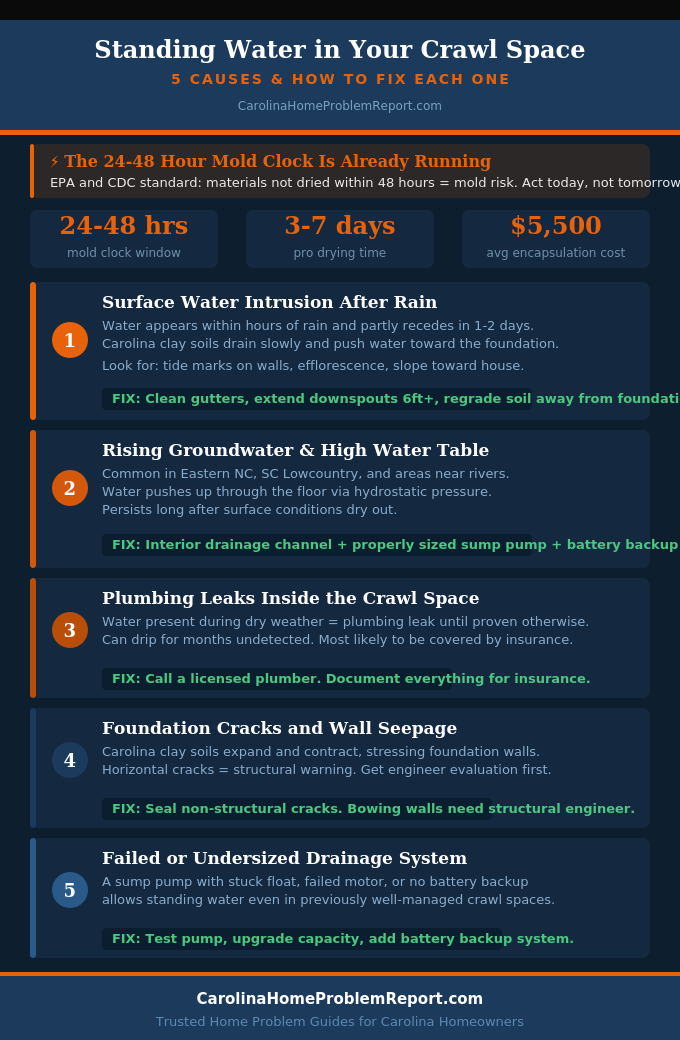
5 Most Common Causes of Standing Water in Crawl Space
How Serious Is It? Reading the Warning Signs
Not all standing water scenarios are equal. Here is how to read the severity of what you are looking at:
URGENT — Call a professional today
Water is touching electrical outlets, wiring, or equipment — or you smell sewage — or this is the second or third flood event in a season — or you see active mold growth on wood surfaces — or wood feels soft and spongy when pressed.
SERIOUS — Address within 24 hours
Standing water covering more than a small area, or water that has been present for more than 24 hours, or a single large water event with significant volume that will not drain on its own.
MANAGEABLE — Handle yourself within 48 hours
A small, isolated puddle from a clearly identified and already-stopped source (a pipe you just fixed, a single rain event with good drainage), where water volume is small and the space has good access.
What to Do First — The 24-Hour Action Plan
Check for safety before entering. Look for standing water near electrical outlets, wiring, or equipment. If water is touching anything electrical, do not enter and do not restore power until an electrician clears the space. Check for sewage odors which indicate contaminated water requiring professional handling.
Document everything before touching anything. Take photos and video of the water level, its location relative to walls and pipes, any visible staining, and any damage you can see. This documentation is critical if you file an insurance claim. The water will be gone before the adjuster arrives.
Identify the source if you can. Is it raining or did it just rain? Check for active plumbing leaks by looking at pipe surfaces and fittings for drips or staining. Is the water coming through the walls, up through the floor, or pooling in a specific area? Knowing the source before you make any calls saves significant time and money.
Remove the water. For small volumes a wet/dry shop vacuum handles the job. For anything more than a shallow puddle across a limited area use a submersible pump — direct the discharge hose at least 10 feet from the foundation so water cannot recirculate. Never pump into a drain that connects to the sanitary sewer without confirming it is appropriate to do so.
Remove wet materials. Soaked insulation batts are not salvageable — they hold moisture against wood indefinitely and should be removed and discarded. Any stored items, cardboard, or debris that absorbed water should come out. These materials extend the drying time significantly and provide ideal mold substrate.
Begin drying. With water removed, run a dehumidifier set to 45-55% relative humidity and position fans to circulate air across damp surfaces. With a commercial-grade dehumidifier and good airflow, most residential crawl spaces dry in 3 to 7 days. A consumer room dehumidifier can work for small events but will take significantly longer.
DIY or Call a Professional? The Decision Framework
Long-Term Fixes and What They Cost
After the immediate water is removed, the next conversation is permanent prevention. The right long-term solution depends entirely on the cause. Here are the main options with realistic Carolina market cost ranges:
| Solution | Best For | Cost Range |
|---|---|---|
| Grading and drainage improvements | Surface water from rain runoff | $300-$2,000 |
| Vapor barrier installation | Ground moisture, mild surface water | $1,200-$4,000 |
| Sump pump installation | Groundwater, chronic standing water | $800-$3,000 |
| French drain system | Surface and subsurface water redirection | $1,500-$8,000 |
| Interior drainage channel | Chronic groundwater intrusion | $3,000-$8,000 |
| Full encapsulation | Comprehensive moisture control | $1,500-$15,000 (avg $5,500) |
Cost ranges reflect North and South Carolina market pricing. Final cost depends on crawl space size, severity of the problem, accessibility, and specific site conditions. Always get at least three quotes from licensed contractors.
The most important thing about long-term fixes:
A dehumidifier alone will not solve standing water in craw space. A vapor barrier alone will not solve groundwater intrusion. The long-term fix for a Carolina crawl space with recurring standing water is a system — exterior drainage improvements plus interior water management (sump pump or drainage channel) plus a vapor barrier or full encapsulation — matched to the specific cause in your home.
Will Homeowners Insurance Cover This?
This is one of the most common questions — and the answer depends entirely on the cause of the water.
✓ Usually covered under standard homeowners policy:
Sudden and accidental water damage from internal sources — a burst pipe, a failed water heater, a plumbing fitting that let go overnight. Document the damage immediately and call your insurer before any cleanup to preserve your claim.
✗ Usually NOT covered under standard homeowners policy:
- Gradual seepage or long-term moisture problems
- Groundwater intrusion or rising water table
- Flood water from outside the home — requires separate flood insurance through NFIP
- Maintenance issues the homeowner neglected over time
If you are unsure whether your situation qualifies, call your insurer before any cleanup work and ask specifically about cause-of-loss language in your policy. Do not assume coverage — and do not assume you have no coverage without asking.
Frequently Asked Questions
Is it normal to have standing water in a crawl space after heavy rain?
No. While temporary dampness can occur in some crawl spaces after extreme rain events, actual standing water — visible puddles that persist — is not normal and indicates a drainage or groundwater problem that will recur and worsen without active correction. A single occurrence is worth investigating. Repeated occurrences require a permanent solution.
How long does it take to dry out a crawl space after standing water?
With same-day water extraction and professional drying equipment, most residential crawl spaces dry in 3 to 7 days. Small, clean-water events with good access push toward the short end. Contaminated water, large volumes, difficult access, or materials that need to be removed before drying begins push toward the long end. A consumer room dehumidifier alone will take significantly longer — potentially weeks in Carolina summer humidity.
Can I remove standing water from my crawl space myself?
Sometimes, if the water is from a known and already-stopped source, is clean water (not sewage or floodwater), is not touching electrical equipment, and you can safely access the space and begin extraction today. Do not attempt DIY removal if the water source is sewage, storm surge, or flooding — if it is touching any electrical equipment — or if anyone in your household has asthma, mold allergies, or immune suppression.
Will standing water in a crawl space attract termites?
Yes. Subterranean termites — the most common and destructive termite species in the Carolinas — are strongly attracted to moisture. Standing water in a crawl space softens wood, raises humidity, and creates exactly the conditions subterranean termites look for when establishing new colonies. A crawl space that floods repeatedly is significantly more vulnerable to termite infestation than a dry one.
How much does it cost to fix standing water in a crawl space in the Carolinas?
Costs vary widely depending on cause and severity. Simple drainage improvements outside start at $300-$2,000. Sump pump installation runs $800-$3,000. French drain systems cost $1,500-$8,000. Full encapsulation averages around $5,500 in the NC and SC market, ranging from $1,500 to $15,000 depending on size and scope. The most expensive outcome is always doing nothing and dealing with structural damage, mold remediation, and foundation repair later.
Standing water in a Carolina crawl space is almost always a symptom of a water management problem that has been building for longer than the homeowner realizes. Carolina clay soils, the region's heavy rainfall, and the naturally high water table in much of Eastern NC and the SC Lowcountry make standing water more likely here than in most of the country. When you find it, the 24-48 hour mold clock has already started. Act immediately, document everything, identify the source, and remove the water. Then get the right long-term system in place — not just a dehumidifier, but a complete exterior and interior drainage solution matched to your specific cause.
If you are dealing with standing water right now or have had repeated flooding events, a professional inspection is the right next step. A qualified crawl space contractor can identify the source, scope the damage, and recommend the right permanent solution for your home and budget.
Find a Crawl Space Professional Near You →The Carolina Home Problem Report editorial team researches and writes guides for homeowners across North and South Carolina. Our research draws on NC State Extension Service publications, Clemson Extension resources, EPA guidelines, Building Science Corporation data, and insights from licensed Carolina contractors. We are not contractors — we are a research team dedicated to giving Carolina homeowners clear, locally specific, unbiased answers.
Carolina Home Problem Report is an informational resource for homeowners. We are not licensed contractors or mold assessors. Always consult a qualified professional before making home repair decisions. See our Disclaimer and Affiliate Disclosure.