What to Do With a Crawl Space [The Complete Carolina Framework — Assess, Fix, Maintain, and How to Do Each One Right]
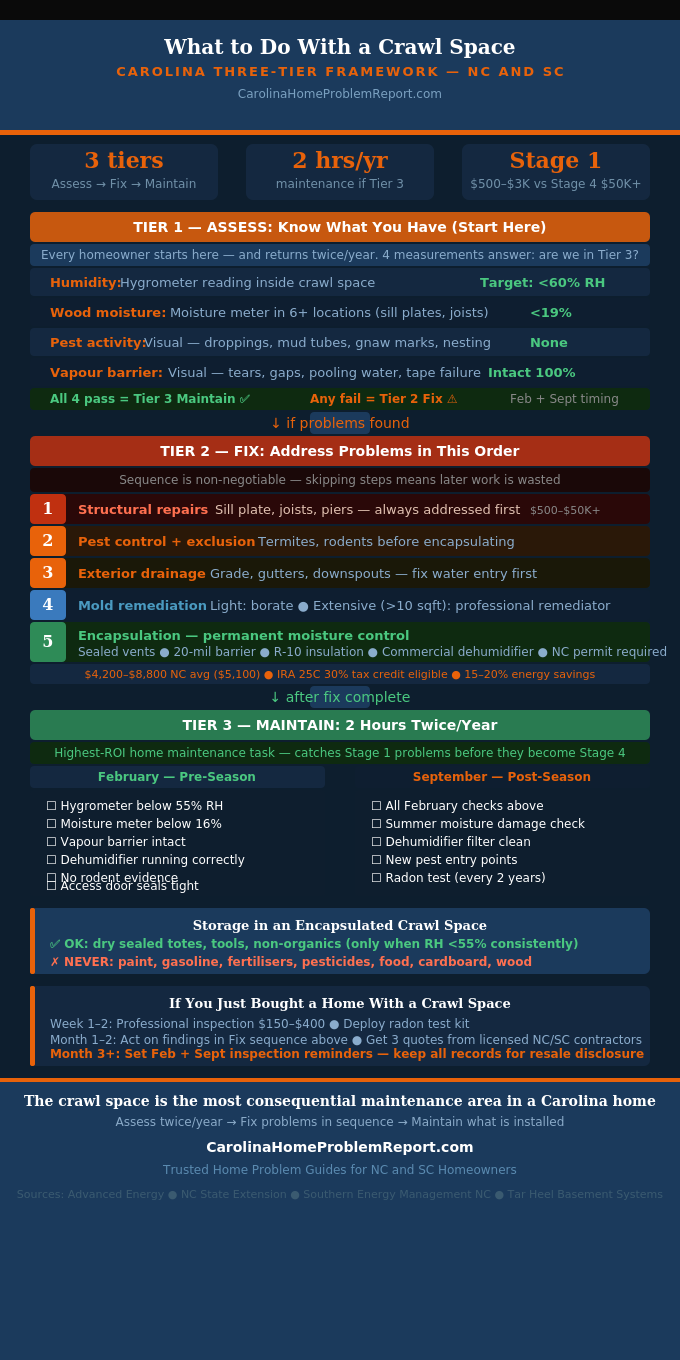
What to do with a crawl space follows a clear three-tier framework: Assess what you have, Fix what is wrong in the right order, and Maintain what you have installed. For most Carolina homeowners with unmanaged vented crawl spaces, the action sequence is: inspect, address structural issues first, address drainage, address moisture with encapsulation, then maintain with annual inspections. A crawl space in good condition requires just twice-yearly inspection and dehumidifier maintenance — the highest-ROI maintenance task in the home.
⭐ Key Takeaways
- ✓The three-tier framework — Assess, Fix, Maintain — applies to every crawl space regardless of current condition. The tier you start in depends on what you find in your assessment.
- ✓Structural issues come first in the fix sequence — there is no point encapsulating a crawl space with compromised floor joists or failed piers. Fix the structure before sealing anything in.
- ✓Maintenance of a properly encapsulated crawl space takes about two hours twice a year — inspect the vapour barrier, check the dehumidifier, check the moisture readings, look for pest entry. The lowest-effort, highest-ROI home maintenance task.
- ✓Carolina homeowners should never use their crawl space to store chemicals — paint, gasoline, fertilisers, pesticides — even in a well-sealed space. Any connectivity between the crawl space and the home means these fumes enter the living space.
- ✓A well-managed encapsulated crawl space can be used for light dry storage — but only after the system is fully installed, the dehumidifier is maintaining below 55% RH consistently, and no pest activity is present
The question "what to do with a crawl space" is asked by Carolina homeowners in two distinct situations. The first is the new homeowner who has just moved into a home with a crawl space and wants to understand their responsibilities. The second is the existing homeowner who has noticed symptoms — musty smell, soft floors, high energy bills — and wants to know what action sequence to follow. Both need the same framework, applied from different starting points.
According to Advanced Energy's North Carolina crawl space field research, the crawl space is the most consequential maintenance area in a Carolina home — both for the scale of damage that accumulates when neglected and for the performance gains that result from proper management. Understanding what to do with it — and in what order — is the foundation for everything else.
This article gives Carolina homeowners the complete framework: what to assess, what to fix and in what order, what to maintain and how often, what to store (and what never to store), and what professional help looks like at each stage. It is the overview article that connects everything else on this site.
In This Article
- The Three-Tier Framework — Assess, Fix, Maintain
- Tier 1 — Assess: What to Look For and How to Know What You Have
- Tier 2 — Fix: The Correct Sequence for Addressing Problems
- Tier 3 — Maintain: The Annual Maintenance Calendar
- Can You Use a Crawl Space for Storage?
- If You Just Bought a Home With a Crawl Space — Start Here
- Frequently Asked Questions
The Three-Tier Framework — Assess, Fix, Maintain
Every crawl space management decision fits into one of three tiers. The tier you are in determines your immediate actions:
Tier 1 — Assess: What to Look For and How to Know What You Have
Assessment answers four questions about your crawl space. Each question has a specific measurement or observation that provides the answer:
| Question | How to measure | Target / Threshold | If threshold exceeded |
|---|---|---|---|
| Is the humidity acceptable? | Hygrometer reading inside crawl space | Below 60% RH | Move to Fix tier — moisture control needed |
| Is the wood structurally sound? | Moisture meter on sill plates, rim joists, floor joists in 6+ locations | Below 19% moisture content | Move to Fix tier — structural assessment needed |
| Is there pest or rodent activity? | Visual inspection — droppings, mud tubes, nesting, gnaw marks | None visible | Move to Fix tier — pest control before encapsulation |
| Is the vapour barrier intact? | Visual inspection — tears, gaps, pooling, tape failure | 100% coverage, no tears or gaps | Repair or replace barrier sections |
What a healthy assessment looks like:
- Hygrometer reads below 55% RH — the dehumidifier is working and maintaining target conditions
- Moisture meter reads below 16% in all 6+ locations — wood is well within the safe range
- No visible mold, no musty smell, no rodent droppings or evidence
- Vapour barrier fully intact — seams taped, walls covered to the termite gap, no tears or pooling
- Dehumidifier operating normally — condensate line clear, filter clean, set point at 50–55% RH
- No standing water, no new moisture stains on foundation walls
If all of the above is true: you are in Tier 3. Your task is maintenance. This is the best situation to be in.
Tier 2 — Fix: The Correct Sequence for Addressing Problems
If assessment reveals problems, they must be addressed in the correct sequence. The reason for the sequence: each later step is wasted if earlier steps have not been completed. There is no point sealing in a structurally compromised crawl space.
Tier 3 — Maintain: The Annual Maintenance Calendar
A properly encapsulated Carolina crawl space requires just two maintenance visits per year. According to NC State Extension's house inspection guidance, the best timing is February (before the humid season) and September (after it). Each visit takes about an hour. This is the total annual time investment for protecting the largest maintenance area in your home.
What triggers an unscheduled inspection:
- Any musty smell appearing or intensifying inside the home
- A significant increase in energy bills with no other explanation
- Soft spots, squeaking, or unevenness in the floor
- Water bill increase suggesting a plumbing leak below the floor
- Any flood event, major rainfall event, or plumbing failure
- Evidence of pest activity in the living space (rodent droppings above the floor)
Can You Use a Crawl Space for Storage?
Yes — with important conditions. An encapsulated crawl space with a concrete floor over the vapour barrier and consistent dehumidification below 55% RH can be used for light dry storage. The conditions that must be met:
✅ Acceptable for storage (with conditions met)
- Sealed boxes of dry, non-organic items
- Holiday decorations in plastic totes with lids
- Tools and hardware in sealed containers
- Seasonal equipment that is clean and dry
Only when: RH maintained below 55%, concrete or clean vapour barrier floor, no pest activity
✗ Never store in a crawl space
- Chemicals: paint, gasoline, fertilisers, pesticides, solvents — fumes enter living space via stack effect
- Food: attracts rodents and pests into the enclosed space
- Paper, cardboard, wood: organic material invites mold and provides food for rodents and termites
- Anything moisture-sensitive: even with encapsulation, humidity spikes during system failure
The chemical storage rule is non-negotiable
Southern Energy Management's guidance for NC homeowners is explicit: do not store any chemicals in the crawl space that you would not store inside the home. Even in a well-sealed encapsulated system, there is connectivity between crawl space air and living space air. Gasoline, paint thinner, and pesticide fumes stored below the floor will enter the home above it.
If You Just Bought a Home With a Crawl Space — Start Here
For new Carolina homeowners, the first 90 days of crawl space ownership should follow this sequence:
Get a professional crawl space inspection. Cost: $150–$400. This gives you a documented baseline — moisture readings, wood condition, pest evidence, structural observations — that you can act on with full information. Do not skip this even if the home inspector covered the crawl space; a dedicated crawl space inspector goes deeper.
Deploy a radon test kit. Leave in the crawl space for the full test period. NC Piedmont and mountain counties have elevated radon levels in documented cases. A short-term test kit costs $15–$25. Results take 48–96 hours (short-term) or up to 90 days (long-term). If above 4 pCi/L, contact a radon mitigation contractor before encapsulation.
Act on inspection findings. If the inspector found moisture problems, structural issues, or pest activity, address them in the Fix sequence (structural first, drainage second, pests third, moisture fourth). Get quotes from licensed Carolina crawl space contractors. A permit is required in NC for encapsulation work.
Establish your maintenance calendar. Set reminders for February and September inspections. Add a note to the dehumidifier installation with the next filter change date. Keep all inspection reports, contractor documentation, and permit records in a folder — these are required at resale in the disclosure process.
Frequently Asked Questions
What should I do with my crawl space?
The action depends on your current situation. If you have never inspected it: start with a professional assessment. If you have moisture, mold, or pest problems: follow the Fix sequence (structural first, drainage second, pests third, moisture fourth). If it is already encapsulated and functioning: follow the twice-yearly maintenance schedule. The framework is Assess → Fix → Maintain — and the goal is to reach Tier 3 maintenance mode as efficiently as possible.
How often should a crawl space be inspected?
Twice per year — February and September — for a properly managed encapsulated crawl space. February before the humid season starts; September after the high-humidity summer. Each visit takes approximately one hour with the right instruments (hygrometer, moisture meter, headlamp). The February visit is the more important one in Carolina because it sets the space up for the summer humidity season. Unscheduled inspections whenever symptoms appear.
Can I use my crawl space for storage?
Yes — under specific conditions. The space must be fully encapsulated with a dehumidifier maintaining below 55% RH consistently, and the floor must be either the vapour barrier or a concrete surface over it. Store only in sealed plastic totes — dry, non-organic items. Never store chemicals (paint, gasoline, fertilisers, pesticides, solvents) — these fumes enter the living space above via the stack effect. Never store food, cardboard, or wood, which attract rodents and termites.
What happens if I ignore my crawl space?
Progressive structural damage following a predictable pattern. Stage 1 (moisture present, no visible damage): $500–$3,000 to fix. Stage 2 (mold on surfaces, insulation fallen): $3,000–$8,000. Stage 3 (active wood rot, sill plate damage): $8,000–$20,000. Stage 4 (structural failure, joist replacement, piering): $15,000–$50,000+. The time from Stage 1 to Stage 3 in an unmanaged Carolina crawl space can be as little as 5–10 years. Annual inspection catches problems at Stage 1 cost consistently.
What is the most important thing to do with a crawl space in NC or SC?
Inspect it. Most crawl space damage in Carolina homes compounds silently for years before any symptom reaches the living space. The homeowner who inspects twice yearly and catches problems at Stage 1 spends a fraction of what the homeowner who discovers Stage 3 damage at an inspection or resale event spends. Two hours of inspection time per year is the single highest-ROI maintenance task in a Carolina home.
What to do with a crawl space in Carolina is simpler than most homeowners expect once the framework is clear: Assess what you have, Fix what is wrong in the right order, Maintain what you have installed. The most common mistake is skipping the assessment — going directly from "I have a problem" to "I need encapsulation" without checking whether structural or drainage issues need to be addressed first. The second most common mistake is fixing but not maintaining — treating the crawl space as a set-and-forget system after encapsulation rather than the twice-yearly maintenance task it actually requires.
The crawl space is the most consequential maintenance area in a Carolina home. The homeowners who understand what to do with it — and in what order — are the ones who avoid the $15,000–$50,000 repair bills that show up when years of neglect are discovered at the worst possible moment.
Get a Free Crawl Space Assessment →Research draws on Advanced Energy NC field studies, NC State Extension publications, Southern Energy Management NC, Tar Heel Basement Systems, Dry Pro Foundation NC, Mount Valley Foundation Services SC, and Falcone Crawl Space Charlotte.
Carolina Home Problem Report is an informational resource for homeowners. We are not licensed contractors. Always consult a qualified professional before making decisions about structural or moisture control work. See our Disclaimer.