Crawl Space Floor Joist Repair [Dangerous to Ignore — Complete Sistering vs Replacement Cost Guide for NC and SC]
Crawl space floor joist repair costs between $150–$325 per joist for sistering and $500–$2,500 per joist for full replacement in the NC and SC market. The correct repair method depends on the type and extent of the damage — rot-damaged joists, mechanically notched or cut joists, and termite-damaged joists each have different repair approaches. The most important rule in Carolina crawl space floor joist repair is this: fix the moisture problem first. Any joist repair done before moisture is controlled will fail again within a few seasons.
⭐ Key Takeaways
- ✓Sistering is the most common repair — a new joist installed alongside the damaged one. Costs $150–$325 per joist and is appropriate when damage is localised and the joist is not fully failed.
- ✓Floor joist repair is structural work that requires permits and licensed contractors in most NC and SC jurisdictions — confirm before any work begins
- ✓A structural engineer assessment is needed when main girders are compromised, when extensive rot spans multiple bays, or when the source of the damage is unclear
- ✓Notched or over-drilled joists from plumbing or electrical installations are a hidden cause of bouncy floors that many homeowners incorrectly attribute to rot
- ✓Sill plate repair — where joists bear on the foundation — is the most expensive and most impactful repair, costing $100–$120 per linear foot
Crawl space floor joist repair is the structural intervention that Carolina homeowners face when a moisture problem has been left unaddressed long enough — or when mechanical damage from plumbing or electrical work has compromised the floor framing in a way that makes floors soft, bouncy, or uneven. It is not a single type of repair. Floor joist issues in Carolina crawl spaces have multiple causes, each with a different correct repair approach and different associated costs.
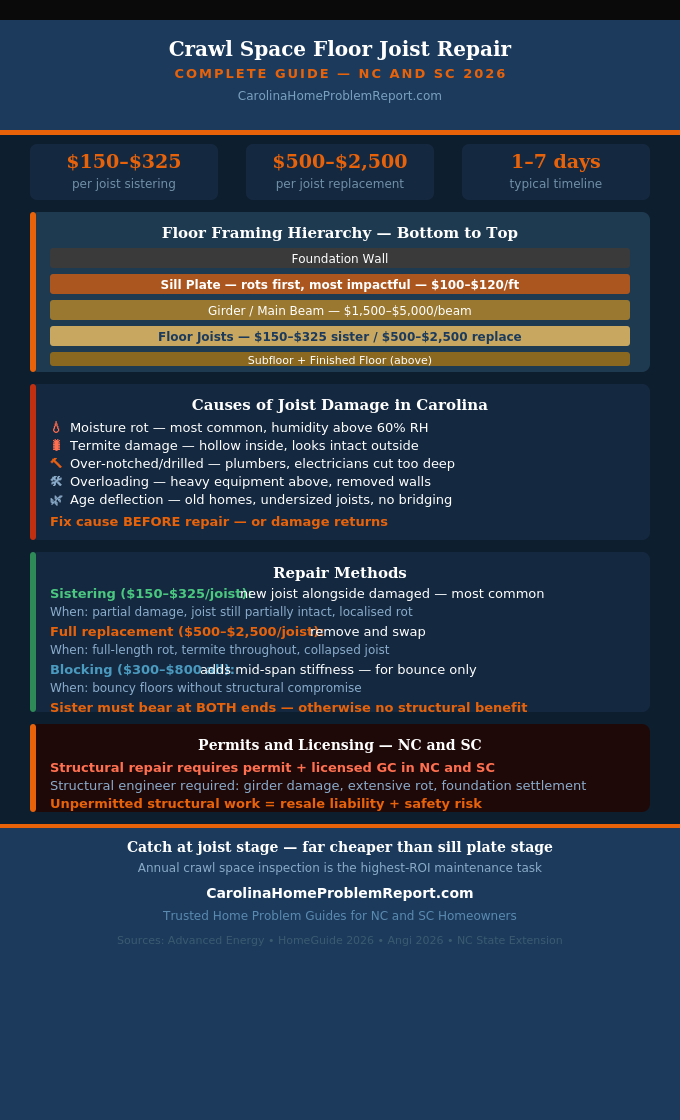
The most important concept to understand before any floor joist repair work begins is the hierarchy of the floor framing assembly. Floor joists do not work alone — they depend on the sill plates they bear on, the girders that support them at mid-span, and the subfloor they carry above. Damage to a sill plate affects every joist that bears on that section. Damage to a girder affects every joist it supports across its full span. Understanding which member is damaged — and how far up the structural hierarchy the damage has progressed — determines the repair scope and cost more than any other factor.
According to Advanced Energy's North Carolina crawl space research, moisture-related structural damage in Carolina crawl spaces typically follows a predictable progression — from sill plate contact points to rim joists to individual floor joists to subfloor. Catching the damage at the individual joist stage is dramatically less expensive than catching it at the sill plate or girder stage. That progression is what makes regular annual inspections — even just a visual scan and screwdriver test — one of the highest-return maintenance tasks a Carolina homeowner can perform.
In This Article
- The Floor Framing Hierarchy — Which Member Is Damaged Matters
- Causes of Floor Joist Damage in Carolina Crawl Spaces
- Signs Your Floor Joists Need Repair
- Repair Methods — Sister, Block, or Replace
- Floor Joist Repair Costs in NC and SC — 2026 Data
- When You Need a Structural Engineer
- Permits and Licensing Requirements in NC and SC
- Frequently Asked Questions
The Floor Framing Hierarchy — Which Member Is Damaged Matters
Before assessing any floor joist problem, understand the load path from top to bottom. The floor you walk on is supported by a specific hierarchy of structural members, each of which carries the combined load of everything above it:
Sill plate — the foundation connection
The horizontal lumber member that sits directly on top of the foundation wall. Every floor joist in the exterior walls bears directly on the sill plate. When sill plates rot, every joist bearing on that section is destabilised. Sill plate damage is the most impactful — and most expensive — floor framing damage in a Carolina crawl space. Cost to repair: $100–$120 per linear foot.
Rim joist — the perimeter framing
The outermost joist that runs perpendicular to the floor joists around the perimeter of the home. The rim joist bears on the sill plate and the floor joists bear into or against it. Rim joists are particularly vulnerable to moisture because they sit at the top of the foundation wall where outdoor air condensation is highest in Carolina summers. A rotted rim joist requires sistering or replacement before or alongside any individual joist work.
Girder or beam — the mid-span support
The main horizontal beam running through the middle of the crawl space, supported by posts at intervals. Floor joists bear on the girder at mid-span. A compromised girder affects every joist it supports — which may be the entire floor of a room. Girder repair requires temporary house jacking and is the most structurally significant repair in a crawl space. Cost: $1,500–$5,000 per girder.
Floor joists — the direct floor support
The individual joists running from the sill plate or rim joist to the girder. Each carries the load of the subfloor and finished floor above a single bay. Individual joist damage is the most common and most accessible repair scenario — sistering typically resolves it without removing flooring from above. Cost: $150–$325 per joist to sister, $500–$2,500 for full replacement.
Subfloor — the floor deck
The structural plywood or OSB sheet layer nailed to the top of the joists. When joists are damaged for long enough, the subfloor above them also absorbs moisture and rots. Subfloor replacement requires removal of finished flooring from above and is significantly more disruptive and costly. Subfloor patching in localised areas: $100–$300 per area. Full subfloor replacement in a room: $1,500–$5,000+.
Causes of Floor Joist Damage in Carolina Crawl Spaces
Not all floor joist damage is caused by moisture and rot. Understanding the cause determines the repair approach — and the cause must be fixed before repair work has any lasting value.
Moisture and rot — most common in Carolina
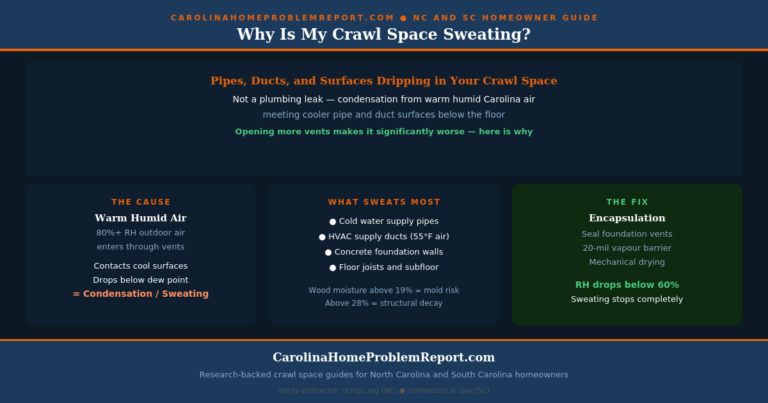
Persistent crawl space humidity above 60% RH drives wood moisture content above the 19% fungal colonisation threshold. Over 2–10 years of unmanaged moisture, joists soften from within. The sill plate and rim joist typically show damage first. Repair requires moisture control system installation before or simultaneously with structural repair. See the Article on crawl space wood rot for the complete rot identification guide.
Termite damage — significant in coastal and Piedmont Carolina
Eastern subterranean termites — the most destructive species in NC and SC — consume wood from the inside out, leaving a hollow shell. A termite-damaged joist may look completely intact from the outside while being structurally hollow. The screwdriver test and sounding test reveal this. Termite damage requires pest treatment to eliminate the active colony before any structural repair. Sistering a joist alongside an active termite infestation is a temporary fix at best.
Mechanical notching and over-drilling — hidden cause of bouncy floors
Plumbers and electricians routinely cut notches and drill holes through floor joists to route pipes and wires. When these penetrations violate the IRC code limits — notches that are too deep, holes that are too large or too close to the bearing point — they structurally weaken the joist without any rot present. This is a significant and underdiagnosed cause of soft or bouncy floors in Carolina homes, particularly after plumbing renovations. The fix is sistering alongside the compromised section, not moisture treatment.
IRC code limits for joist holes and notches: Holes must be at least 2 inches from joist edges and no larger than 1/3 of joist depth. End notches cannot exceed 1/4 of joist depth. Middle-third of span — no notches permitted. When these limits are violated, the joist needs reinforcement regardless of moisture status.
Overloading — heavy equipment or structural changes
When a heavy appliance is added above a crawl space floor without considering the point load — a heavy cast iron bathtub, a water softener, an oversized safe — the joists can crack under the concentrated load. Renovation projects that remove walls (removing a load-bearing wall changes the load distribution) can also transfer unexpected loads to floor joists designed for a different configuration.
Age-related deflection — normal span creep in older homes
Older homes in Carolina — particularly pre-1960 construction — were often framed with smaller joist dimensions and wider spans than modern code requires. Over decades, these joists deflect at mid-span under the cumulative live and dead load. The result is a gradual floor sag that is not structural failure but exceeds acceptable deflection limits. Sistering or adding mid-span support posts resolves this without full replacement.
Signs Your Floor Joists Need Repair
Signs you will notice INSIDE YOUR HOME:
- Floors that feel soft, spongy, or springy — especially near exterior walls, in bathroom corners, and near the kitchen sink
- Noticeable floor bounce when you walk — more flex than there used to be
- Floors that are visibly sloping, dipping, or uneven at a specific location
- A distinct creak or crack sound at the same location every time you walk over it
- Tiles cracking near the perimeter walls or popping loose without obvious cause
- A gap developing between the baseboard and floor — indicates floor has dropped slightly relative to walls
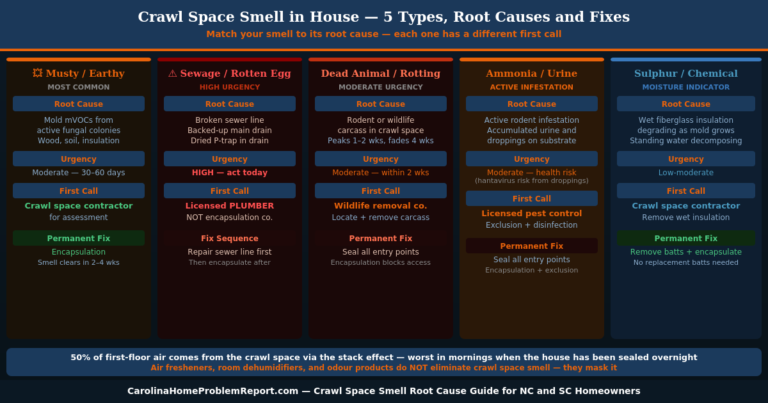
- Persistent musty smell — while not specific to joist damage, always present when rot has progressed to structural members
Signs you will find IN THE CRAWL SPACE:
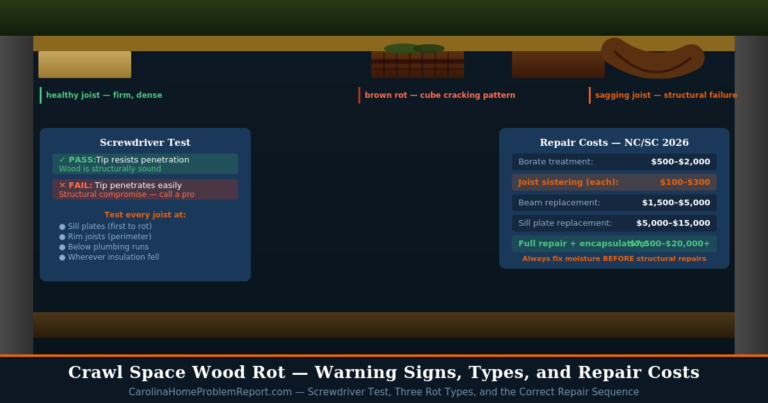
- Joists that fail the screwdriver penetration test — tip penetrates under moderate hand pressure
- Visible cracking, splitting, or checking along the length of joists
- Joists that visibly sag or bow at mid-span
- Discolouration — brown, black, or orange staining distinct from natural wood colour
- Mud tubes on joists or foundation walls — Eastern subterranean termite evidence
- Notches or holes in joist edges or the middle-third zone that exceed code limits
- Sill plates that crumble, compress, or show separation from the foundation wall surface
Repair Methods — Sister, Block, or Replace
Floor Joist Repair Costs in NC and SC — 2026 Data
| Repair Type | Cost Range | Timeline | Best For |
|---|---|---|---|
| Sistering (per joist) | $150–$325 | 1–2 days | Partial rot, notching, minor cracks, deflection |
| Full replacement (per joist) | $500–$2,500 | 2–5 days | Extensive rot, full termite damage, collapsed members |
| Blocking and bridging | $300–$800 | 1 day | Floor bounce without structural compromise |
| Girder replacement (per beam) | $1,500–$5,000 | 1–3 days | Main support beam compromise |
| Sill plate (per linear foot) | $100–$120 | 3–7 days | Foundation contact rot — most impactful |
| Subfloor patch (per area) | $100–$300 | 1 day | Localised subfloor rot — requires floor removal from above |
When You Need a Structural Engineer
Most crawl space floor joist sistering work can be designed and supervised by a licensed general contractor without a separate structural engineer. However, a structural engineer is required or strongly recommended in these specific situations:
- Main girder or beam is compromised — the engineer determines the repair specification for a load-carrying member supporting multiple joists
- Extensive rot spanning multiple adjacent bays — when more than 25–30% of the floor joist bays in a room show damage, an engineer determines whether the floor system needs reinforcement beyond individual joist repairs
- Foundation settlement is suspected — if floors are sloping toward an exterior wall with no clear rot present, the sill plate may be dropping due to foundation settlement rather than just rot. An engineer distinguishes rot damage from settlement
- Walls above the crawl space have structural role — before making any modifications to floor framing under load-bearing walls, an engineer confirms the load path and repair specification
- The building permit requires it — in some NC and SC jurisdictions, structural repair permits require a stamped drawing from a licensed PE (Professional Engineer). Confirm when pulling the permit.
- Any work in a home that has had previous unpermitted structural work — unknown modifications to the framing history require professional assessment before further structural work
Permits and Licensing Requirements in NC and SC
Floor joist repair is structural work. The permit and licensing requirements are stricter than for moisture control work.
North Carolina:
- Structural repair work — sistering, joist replacement, girder work, sill plate replacement — requires a building permit in virtually all NC jurisdictions
- Must be performed by a licensed general contractor in NC (General Contractor license, Limited Building tier or higher)
- Work is inspected by the local building department — do not cover any structural repairs until inspection sign-off
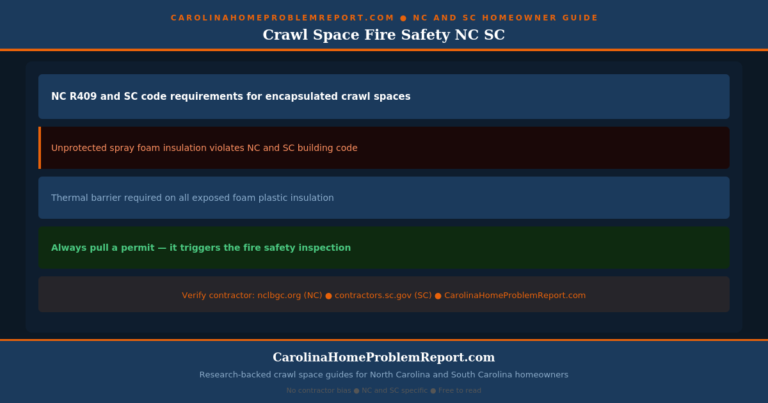
- Adding a moisture control system (encapsulation) simultaneously may also require a separate mechanical or building permit component — the GC typically handles both permit applications as a combined project
South Carolina:
- Same principle — structural repair requires permits and licensed contractors
- SC contractor licensing is handled at the state level by the SC Contractor's Licensing Board — verify your contractor's license before signing any contract
- Requirements vary somewhat by county for specific scope thresholds — always confirm locally
⚠️ Always ask your contractor for license number and permit confirmation
A contractor who performs structural floor joist repair without pulling a permit creates serious liability for you at resale. Verify the contractor's NC or SC license number on the state licensing board website before signing. Ask specifically: "Will you pull the structural repair permit before work begins?" If the answer is no, find a different contractor. Unlicensed structural work is not just a resale problem — it creates unknown safety risk if the repair does not meet code.
Frequently Asked Questions
How much does it cost to repair crawl space floor joists in NC or SC?
Sistering — the most common repair — costs $150–$325 per joist in the NC and SC market. A typical project involving 10–15 compromised joists runs $1,500–$4,875 for the sistering work. Full joist replacement costs $500–$2,500 per joist. Add the moisture control system that must accompany the repair — $3,000–$8,000 for a complete encapsulation — and a comprehensive repair project typically runs $5,000–$15,000 depending on damage severity and crawl space size.
Can I sister floor joists myself in my crawl space?
Technically a capable DIYer can sister floor joists — it involves cutting lumber to length, carrying it into the crawl space, positioning it alongside the damaged joist, and fastening with structural screws. However, structural repair requires a building permit in NC and SC, and permitted work must be performed by a licensed contractor and inspected. Unpermitted structural work creates resale liability. The practical recommendation is to hire a licensed contractor, pull the permit, and get the inspection sign-off that confirms the repair meets code.
Why are my floors bouncy if there is no rot?
Bouncy floors without rot have three common causes: over-spanning joists in older construction that lacks mid-span bridging, excessive notching or drilling by plumbers or electricians, or deflection from point loads above (a heavy bathtub, appliance, or safe). A structural assessment identifies which of these applies. The fix is typically sistering alongside notched sections, adding mid-span blocking, or installing an additional support post under the girder — none of which require moisture remediation.
How do I know if I need a structural engineer for my crawl space floor repair?
You need a structural engineer when the main girder or beam is affected, when damage spans multiple adjacent bays, when foundation settlement is suspected as a contributing factor, or when the local building department requires a stamped engineering drawing for the repair permit. For isolated joist sistering in a crawl space with confirmed rot from moisture, a licensed general contractor can typically scope and perform the repair without a separate engineer. When in doubt, the cost of an engineering assessment — typically $300–$600 for a crawl space structural assessment — is money well spent before committing to a repair scope.
Crawl space floor joist repair in Carolina follows a consistent pattern: moisture damage progresses from the sill plate inward, catching it at the individual joist stage saves thousands compared to catching it at the sill plate or girder stage. The repair method — sistering, replacement, or blocking — is determined by the extent and cause of damage. The moisture control system is not optional alongside structural repair — it is what makes the repair permanent rather than a repeated expense.
According to NC State Extension's Healthy Homes program, the combination of structural repair and moisture control is what protects the long-term structural health of a Carolina home's floor system. Either alone is a partial solution.
Find a Licensed Crawl Space Contractor Near You →The Carolina Home Problem Report editorial team researches and writes guides for homeowners across North and South Carolina. Our research draws on Advanced Energy field studies, NC State Extension Healthy Homes, HomeGuide and Angi cost data, and insights from licensed NC and SC contractors and structural professionals. We are not contractors or engineers — we are a research team dedicated to giving Carolina homeowners clear, locally specific, unbiased answers.
Carolina Home Problem Report is an informational resource for homeowners. We are not licensed contractors or structural engineers. Always consult a qualified licensed professional before making structural repair decisions. See our Disclaimer.