Warning: What Causes Crawl Space Moisture in Carolina Homes [6 Hidden Sources + Complete Fix Guide]
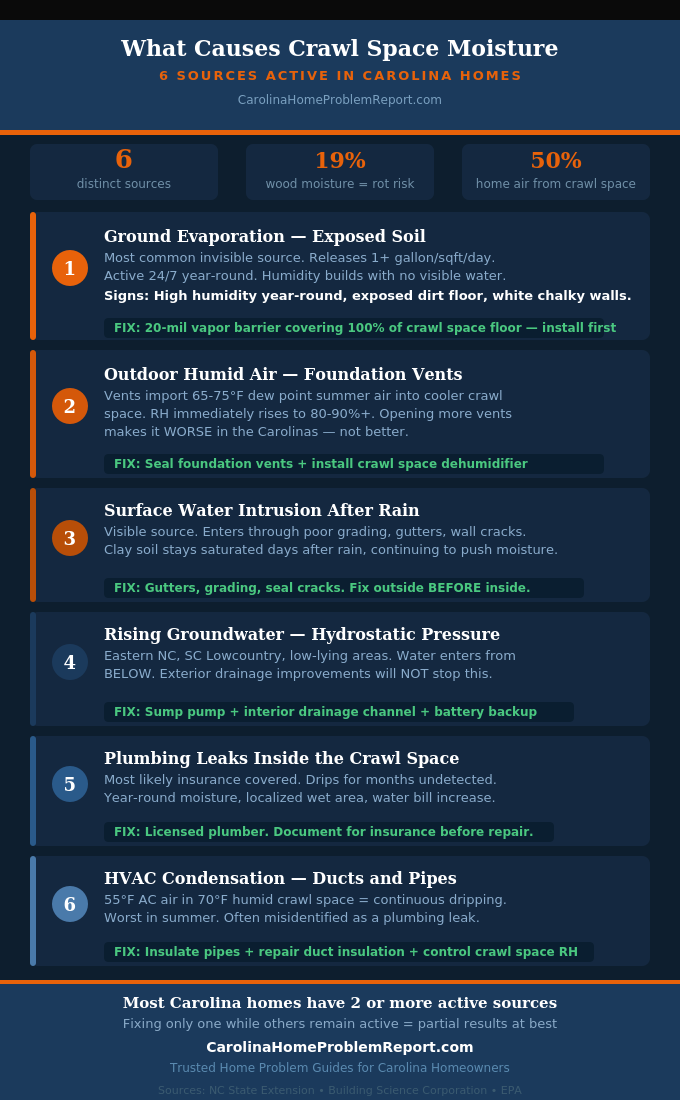
What causes crawl space moisture in Carolina homes comes down to six distinct sources working alone or in combination: ground evaporation from exposed soil, outdoor humid air through foundation vents, surface water intrusion after rain, rising groundwater, plumbing leaks, and HVAC condensation. Most Carolina crawl spaces have more than one active source simultaneously. The fix that works depends entirely on correctly identifying which source or sources you are actually dealing with — which is why so many homeowners spend money on the wrong solution first.
⭐ Key Takeaways
- ✓What causes crawl space moisture is rarely a single source — most Carolina homes have two or more active causes working simultaneously
- ✓Identifying the correct source first is the most important step — the wrong fix wastes money and leaves the problem intact
- ✓Carolina's clay soils, high humidity baseline, and older vented construction make crawl space moisture more severe here than in most of the country
- ✓Ground evaporation from exposed soil is the most common and most controllable source in older Carolina homes
- ✓NC State Extension research confirms that wood moisture content above 19% triggers the fungal growth that causes wood rot in crawl space framing
What causes crawl space moisture is the question every Carolina homeowner eventually asks — usually after finding something that should not be there. A musty smell drifting up through the floorboards. Insulation hanging in wet clumps from between the joists. Dark staining spreading across floor joists that were clean the last time you looked. The floors above that have begun to feel slightly softer than they used to.
The frustrating truth is that crawl space moisture in a Carolina home almost never has a single tidy cause. It tends to arrive through multiple pathways simultaneously — ground evaporation meeting outdoor humid air meeting residual saturation from the last rain event — compounding each other and making the overall humidity level higher than any single source would produce on its own. This is why homeowners who address only one cause often see improvement without resolution, and why contractors who jump straight to encapsulation without diagnosing the moisture sources sometimes create sealed, humid spaces that are worse than what they replaced.
This guide maps every major source of crawl space moisture specific to Carolina homes, explains how to identify which ones are active in your crawl space, and shows how they interact with each other so you can understand what you are actually dealing with before spending money on a fix.
In This Article
Why Carolina Homes Are More Vulnerable Than Most
Crawl space moisture is a national problem but it is a particularly intense one in North and South Carolina. The region sits at the convergence of several conditions that combine to produce higher moisture loads in crawl spaces than homeowners in drier climates ever experience.
The climate baseline is persistently humid. The Carolinas are classified as a humid subtropical climate — meaning high year-round relative humidity, hot and wet summers, and a dew point that regularly exceeds 65°F from May through September. This is not occasional weather. It is the background condition against which every moisture source in a crawl space operates. A crawl space in Arizona is fighting moisture occasionally. A crawl space in Raleigh or Columbia is fighting it continuously.
Clay soils hold water longer and push harder. The red clay soils of the Carolina Piedmont and the mixed soils of the coastal plain both have lower permeability than the sandy soils found in drier regions. After rainfall, these soils remain saturated for days, holding water against foundations and releasing ground moisture slowly upward. The same clay that makes Carolina gardens challenging makes crawl space moisture management a chronic rather than episodic problem.
Most older homes were built with vented crawl spaces. The North Carolina Building Code adopted the closed crawl space standard in 2004. Every home built before that — the large majority of homes in both states — has open foundation vents that actively import high-humidity outdoor air into the cooler crawl space below. What was intended as a drying mechanism has been confirmed by research to be a significant moisture source in the Southeast.
The water table is close to the surface in large parts of the region. Eastern North Carolina, the SC Lowcountry, and areas near rivers and creeks have naturally shallow water tables that rise with seasonal rainfall. This adds a groundwater pressure dimension to crawl space moisture that surface drainage improvements alone cannot address.
The 6 Sources of Crawl Space Moisture — Explained
How Multiple Sources Compound Each Other
Understanding what causes crawl space moisture in any individual home requires understanding how these six sources interact. They do not simply add to each other arithmetically. They compound.
A real-world compounding scenario — typical Carolina Piedmont home built in the 1980s:
The exposed dirt floor releases moisture continuously, raising the baseline humidity inside the crawl space to 65-70% even in dry weather.
Open foundation vents import summer outdoor air at 75% RH. This combines with the ground evaporation to push crawl space humidity to 80-85%.
At 80-85% RH, AC ducts and cold water pipes begin sweating heavily in summer. Condensation drips onto the soil and joists below, adding more liquid water to an already saturated environment.
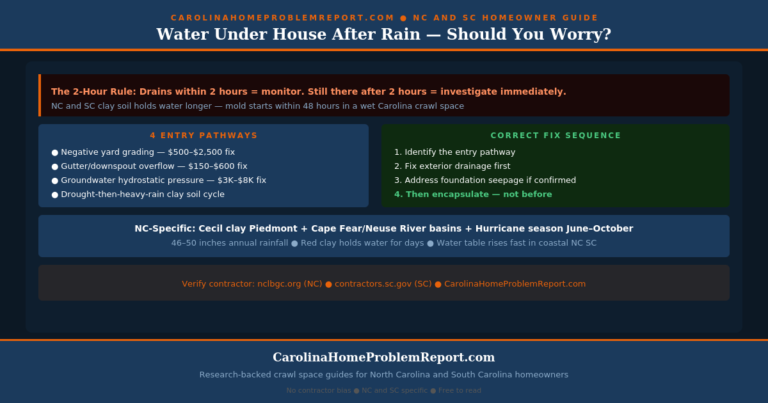
Heavy July rain sends surface water through a small foundation crack. Even after the visible water drains, the soil is now fully saturated and evaporation rate triples for the next five days.
The result: crawl space RH sustained above 85% for six to eight weeks during July-August. Wood moisture content in floor joists reaches 22-25% — above the 19% fungal growth threshold. Mold begins colonizing. By October the homeowner notices a musty smell in the first floor rooms.
This is not a worst-case scenario. It is a description of what happens in a large number of older Carolina crawl spaces every summer — often for years or decades before anyone investigates.
How to Identify Which Sources Are Active in Your Crawl Space
Use this diagnostic framework during a crawl space inspection. Bring a flashlight, a hygrometer, and old clothes. Check each of these observations and match them to the sources above.
| What You Observe | Most Likely Source |
|---|---|
| Humidity high year-round, no visible water, exposed soil floor | Source 1 — Ground evaporation |
| Humidity spikes in summer, improves in winter, open foundation vents | Source 2 — Outdoor humid air |
| Humidity spikes after rain, water stains on walls, tide marks | Source 3 — Surface water intrusion |
| Water seeping up from floor, persists after drainage fixed, low-lying area | Source 4 — Rising groundwater |
| Wet area in one spot, water bill up, pipe staining, year-round problem | Source 5 — Plumbing leak |
| Dripping from ducts or pipes, wet duct insulation, worse in summer | Source 6 — HVAC condensation |
Most crawl spaces show signs of more than one source. Address all active sources — fixing only one while others continue producing moisture will deliver partial results at best.
What Crawl Space Moisture Does to Your Home Over Time
Understanding the sources matters most because of what they produce over time if left unaddressed. Crawl space moisture damage follows a predictable progression in Carolina homes:
Humidity builds above 60% RH. Mold spores begin colonizing wood surfaces. Insulation begins absorbing moisture and losing R-value. Stack effect carries humid, musty air into living spaces. Energy bills begin rising as HVAC works harder against increased moisture load.
Visible mold growth on floor joists and rim joists. Wood moisture content reaches levels that support fungal decay. Insulation falls from between joists. Musty smell noticeable inside the house. Metal components begin showing corrosion.
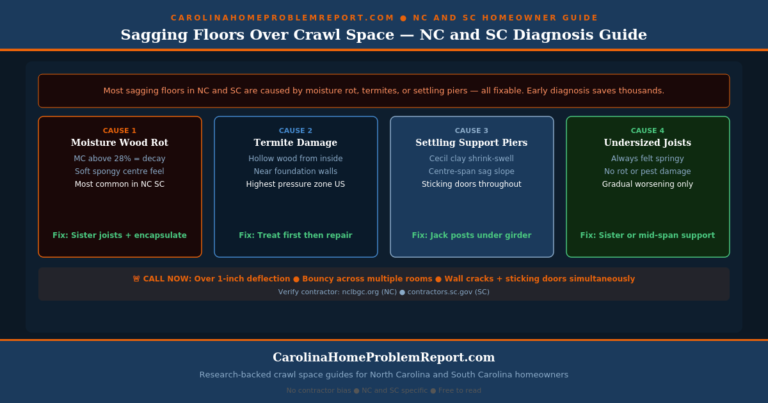
Wood rot advances in floor joists, rim joists, and sill plates. Floors above begin to feel soft or bouncy. Structural repair costs emerge — sistering damaged joists, replacing rim joists, subfloor work. Termites may have established colonies attracted by the moisture and softened wood.
Significant structural compromise. Subfloor replacement may be needed. Foundation elements affected. Total repair costs can exceed $20,000-$50,000 in severe cases. All of this traceable back to moisture sources that cost $1,500-$5,000 to address at the outset.
Frequently Asked Questions
What causes crawl space moisture in a home that has no visible leaks or flooding?
The two most common invisible sources are ground evaporation from exposed soil and outdoor humid air entering through foundation vents. Neither produces visible water. Both produce significant humidity that builds over weeks and months until it reaches levels that cause mold and structural damage. A hygrometer placed in the crawl space will confirm if humidity is elevated even without any obvious water source.
Can crawl space moisture come from inside the house?
Yes, through plumbing leaks in supply lines and drain pipes that run through the crawl space, and through HVAC condensate line failures. In homes where the crawl space has been partially sealed but not fully conditioned, moisture from living areas can also migrate downward through gaps in the subfloor. This is why comprehensive air sealing of the subfloor is part of a complete encapsulation job.
Why does my crawl space moisture problem keep coming back after treatment?
Almost always because only one source was addressed while others remained active. The most common pattern is a dehumidifier installation without sealing foundation vents or installing a vapor barrier — the unit runs constantly fighting incoming moisture but never fully wins. A lasting solution requires identifying and addressing all active sources, not just the most obvious one.
Is crawl space moisture worse in new homes or old homes?
Significantly worse in older homes, for two reasons. First, homes built before 2004 in North Carolina have open foundation vents by design — importing humid outdoor air as a standard feature. Second, older homes are more likely to have exposed dirt floors, deteriorated foundation wall mortar, and aging plumbing that is more prone to slow leaks. Newer homes built to the closed crawl space standard still need proper vapor barriers and dehumidification, but they start from a significantly better baseline.
How do I know if my crawl space moisture is causing structural damage?
Go in with a flashlight and press a screwdriver tip firmly against multiple floor joist locations. Healthy wood resists the tip. Compromised wood feels spongy, soft, or crumbles. Look for black, white, or grey fuzzy growth on wood surfaces. Press the subfloor from below in multiple spots. Check rim joists at the perimeter. Soft floors above the crawl space — especially near exterior walls — are a warning sign that can be investigated by pressing on the subfloor from below. If you find any of these signs, get a professional assessment before proceeding with moisture control work.
What causes crawl space moisture in a Carolina home is almost always a combination of sources — not a single problem with a single fix. The region's persistent humidity baseline, clay soils, aging vented construction, and shallow coastal water table create a moisture environment that is significantly more demanding than most of the country. The homeowners who protect their homes over the long term are the ones who correctly identify every active source, fix them in the right order, and do not confuse treating symptoms with solving causes.
If you are unsure which sources are active in your crawl space, a professional inspection with moisture measurements and a wood moisture meter reading is the most reliable starting point. The cost of an inspection is a fraction of the cost of a misdiagnosed fix — and a tiny fraction of the cost of structural repairs that result from moisture sources left active too long.
Find a Crawl Space Professional Near You →The Carolina Home Problem Report editorial team researches and writes guides for homeowners across North and South Carolina. Our research draws on NC State Extension Service publications, Clemson Extension resources, EPA guidelines, Building Science Corporation data, and insights from licensed Carolina contractors. We are not contractors — we are a research team dedicated to giving Carolina homeowners clear, locally specific, unbiased answers.
Carolina Home Problem Report is an informational resource for homeowners. We are not licensed contractors or mold assessors. Always consult a qualified professional before making home repair decisions. See our Disclaimer and Affiliate Disclosure.