Spiders in Crawl Space [Warning — Which Are Dangerous, Which Are Harmless, and What to Do in Carolina]
Most spiders found in Carolina crawl spaces are completely harmless — cellar spiders, wolf spiders, and house spiders that pose no health risk and are actively reducing the insect population under your home. There are two species that genuinely require caution: the black widow, which is common in crawl spaces and whose bite is medically significant, and the brown recluse, which is rare in NC and SC but whose bite can cause serious tissue damage. Knowing which species you are looking at — and what the danger level actually is — turns a frightening discovery into a manageable situation.
⭐ Key Takeaways
- ✓The black widow is the most medically significant spider in Carolina crawl spaces — it genuinely lives in crawl spaces, garages, and woodpiles, and its bite requires medical attention
- ✓The brown recluse is genuinely rare in NC and SC — most suspected brown recluse sightings are actually wolf spiders, southern house spiders, or yellow sac spiders
- ✓The cellar spider (daddy long legs) is the most common spider in Carolina crawl spaces — harmless despite its reputation, and actively beneficial as a predator of other insects
- ✓Large spider populations in a crawl space confirm high humidity and a healthy insect prey population — both of which are resolved by encapsulation
- ✓Bug bombs and foggers are not effective for crawl space spiders — NC State Extension explicitly states this — and are hazardous if they contaminate HVAC systems
Spiders in a crawl space are one of the most common and least dangerous discoveries a Carolina homeowner makes during a crawl space inspection — and one of the most frequently misreacted-to. The fear response that spiders trigger is understandable. The danger that reaction creates often exceeds the danger the spider poses. A homeowner who grabs a container to trap what they believe is a brown recluse is more likely to suffer a bite than one who steps back and assesses the situation from a safe distance.
According to NC State Extension's guide to spiders in and around homes, spiders have a largely undeserved reputation as dangerous to people and pets. In truth, the vast majority of spiders found in Carolina homes are beneficial predators that consume insects we consider pests. The crawl space is simply one of their preferred habitats — dark, undisturbed, and usually well-stocked with the insect prey they need.
This guide identifies every spider species commonly found in Carolina crawl spaces, gives each one an honest danger rating, explains what their presence tells you about your crawl space conditions, and gives you the correct response for each situation — from the cellar spider that deserves nothing more than acknowledgment to the black widow that warrants professional attention and careful handling protocol when entering the space.
In This Article
- Why Crawl Spaces Attract Spiders
- Carolina Crawl Space Spiders — Complete Danger Rating Guide
- Black Widow — The Genuine Crawl Space Risk
- Brown Recluse — Rare in Carolina but Serious
- Harmless Species — What Most Crawl Space Spiders Actually Are
- What Spider Populations Tell You About Your Crawl Space
- How to Safely Enter a Crawl Space With Spiders
- Treatment — What Works and What Does Not
- Frequently Asked Questions
Why Crawl Spaces Attract Spiders
Spiders do not enter crawl spaces randomly. They are following a food source — insects — and the crawl space provides an ideal habitat for both. Understanding the chain of attraction makes the permanent solution obvious:
MOISTURE
high humidity + damp soil
INSECTS
camel crickets, roaches, beetles
SPIDERS
follow their prey supply
FIX
encapsulate → dry → seal
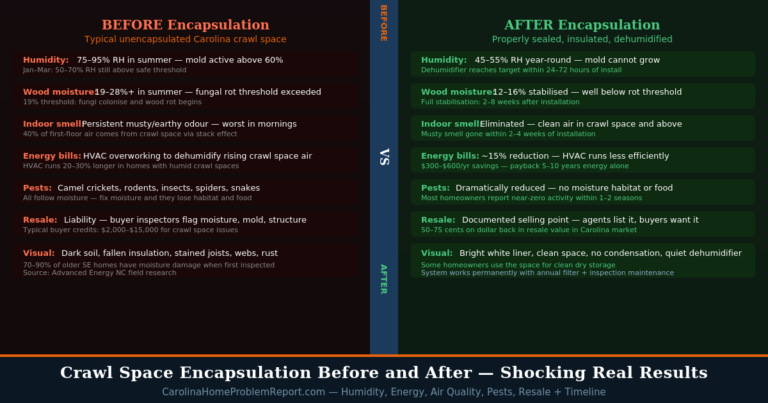
A damp, unencapsulated crawl space with exposed soil and open foundation vents provides everything spiders need: abundant insect prey from the moisture-driven insect population, darkness and undisturbed web sites, stable temperature, and multiple entry and exit points. Eliminate the moisture with encapsulation and you eliminate the insect population that supports spiders — which is a far more effective long-term spider control measure than any pesticide treatment.
Dark undisturbed spaces also provide ideal conditions for web-building species to maintain webs indefinitely. A black widow web in a crawl space corner may have been there for months — the spider returns to it regularly. This is why the hazard from black widows in crawl spaces is not from active pursuit but from accidental contact with webs and the spider inside them.
Carolina Crawl Space Spiders — Complete Danger Rating Guide
Here is every spider species commonly found in Carolina crawl spaces, rated by actual danger level:
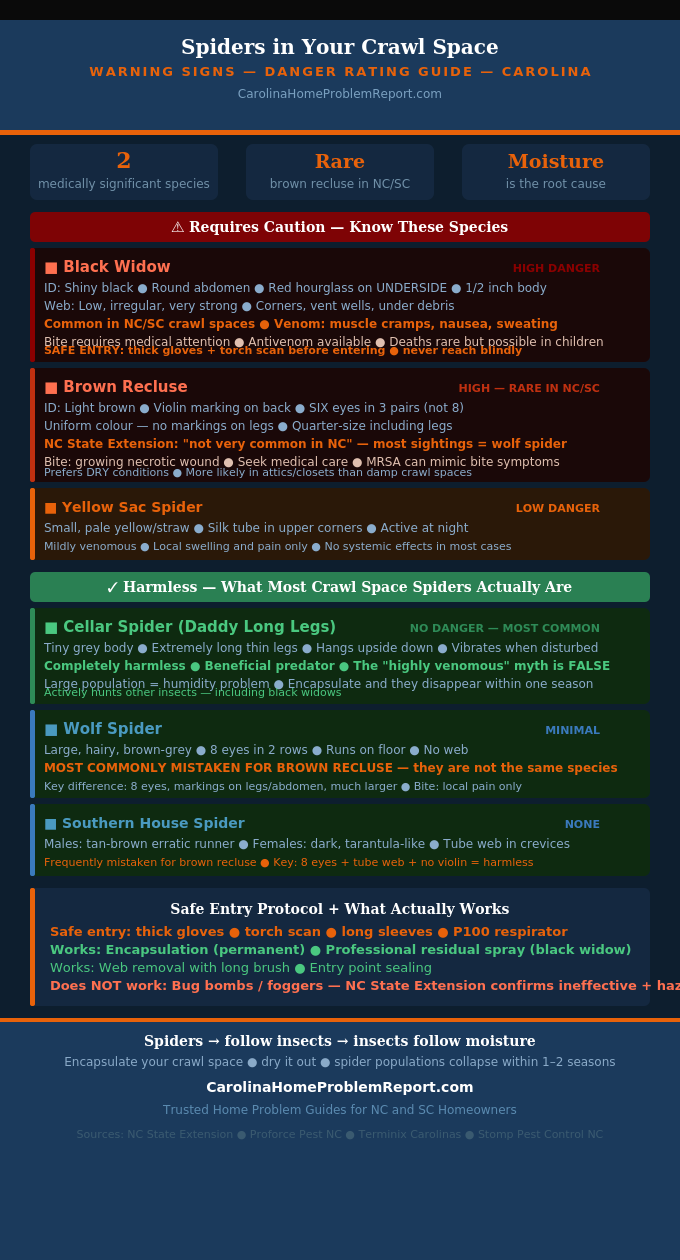
Black Widow — Latrodectus mactans
Identification:
- Female: shiny black body, round abdomen, red hourglass marking on the underside of abdomen
- Body length approximately 1/2 inch — total length including legs about 1.5 inches
- Male and juveniles: tan-grey with orange and white markings — less dangerous than adult female
- Web: irregular, low to ground, strong and sticky — not the neat circular webs of orb weavers
Where found in crawl spaces:
Low-lying corners, under debris and stored materials, near foundation walls, around plumbing penetrations, in vent well edges. Prefers dark, sheltered, low-traffic areas. The NC State Extension specifically lists crawl spaces as a primary black widow habitat.
Bite and danger:
Black widow venom contains alpha-latrotoxin, which affects the nervous system. Symptoms include immediate sharp pain at the bite site, followed by muscle cramps, sweating, nausea, and in severe cases elevated blood pressure. Seek medical attention promptly for any suspected black widow bite — antivenom is available and effective when administered. Death from black widow bite is extremely rare in healthy adults but is possible in children and elderly individuals.
Safe entry rule: Before entering any crawl space, scan visible areas with a torch and look for the characteristic black widow web — low, irregular, very strong. Wear thick gloves. Never reach into dark corners or under debris without checking first.
Brown Recluse — Loxosceles reclusa
The brown recluse is genuinely rare in NC and SC
NC State Extension explicitly states: "Although brown recluse spiders can be found in North Carolina, they are simply not very common." Most suspected brown recluse sightings in NC and SC turn out to be wolf spiders, southern house spiders, or yellow sac spiders — all of which are harmless or only mildly venomous. Misidentification causes significant unnecessary anxiety. Confirm your identification using the six-eye test below before concluding you have brown recluses in your crawl space.
Identification (the only reliable features):
- Six eyes in three pairs — most spiders have eight eyes. The brown recluse has only six, arranged in three pairs of two. This is the most reliable identification feature.
- Violin-shaped marking behind the head — darker brown fiddle shape on a lighter brown background
- Uniform light to medium brown colour — no markings on legs or abdomen
- Size: roughly the size of a quarter including legs
- Builds irregular web in dark, dry, undisturbed areas — note: prefers dry conditions, not damp crawl spaces
Bite and danger:
A brown recluse bite may go unnoticed for 3–8 hours before the area reddens, swells, and becomes tender. In some cases, a necrotic wound develops — tissue death that can expand if untreated. Not all bites cause necrosis — many cause only mild local reaction. Seek medical attention if you develop a growing wound, a bluish or purplish discolouration, or if you have confirmed a brown recluse bite.
Important: NC State Extension notes that growing wounds are often caused by MRSA bacteria rather than brown recluse bites — a physician can determine the actual cause and provide appropriate treatment.
Harmless Species — What Most Crawl Space Spiders Actually Are
The large majority of spiders you find in a Carolina crawl space belong to these harmless species. Identifying them correctly eliminates unnecessary alarm and unnecessary pesticide use.
What Spider Populations Tell You About Your Crawl Space
The species and population size of spiders in a crawl space is diagnostic information about the conditions beneath your home. Read the signs:
| What You See | What It Means | Action |
|---|---|---|
| Large cellar spider population | High humidity + abundant insect prey. Moisture problem confirmed. | Schedule moisture assessment — encapsulation |
| Wolf spiders running across floor | Active insect prey population present. Common in all Carolina crawl spaces. | Monitor — reduce prey by reducing moisture |
| Black widow web in corner or vent | Black widow present. Standard risk for most Carolina crawl spaces. | PPE required for entry — professional treatment if numerous |
| Abundance of webs everywhere | Large insect population sustaining a large spider population — moisture-driven | Moisture control is the primary fix — spiders follow insects |
| Few or no spiders after encapsulation | Moisture and insect prey eliminated — crawl space inhospitable to spider populations | Expected outcome — encapsulation working correctly |
How to Safely Enter a Crawl Space With Spiders
The primary risk from crawl space spiders is accidental contact with black widow webs while performing inspections or maintenance work. These precautions eliminate that risk:
- Wear thick gloves — leather or nitrile work gloves with no gaps at the wrist. Black widow bites in crawl spaces almost always occur when an ungloved hand contacts an unseen web.
- Wear long sleeves and long trousers tucked into socks — reduce exposed skin surface area throughout the inspection.
- Scan with a torch before entering — shine a torch across the floor and into visible corners from the access opening before entering. Black widow webs are strong and may be visible by the reflected shine of the torch beam.
- Do not reach blindly into corners, under pipes, or behind stored materials — these are prime black widow locations. Look before you touch anything.
- Wear a P100 respirator — not for spider protection but for the mold spores and dust that accompany a humid crawl space with large insect and spider populations.
- Never crawl across old webs or debris without checking — if you need to pass through a web-heavy area, clear it with a long stick first before passing through.
Treatment — What Works and What Does Not
⚠️ Bug bombs and foggers do NOT work for crawl space spiders
NC State Extension explicitly states that "simply setting off foggers ('bug bombs') is not likely to be effective and can be hazardous, particularly if you contaminate your heating / AC ventilation system." Foggers cannot reach into the dark crevices, corners, and web sites where spiders actually live — they only treat open air. And if the crawl space connects to HVAC ductwork, the chemical fog enters the duct system and the living space. Never use foggers in a crawl space connected to HVAC.
Most effective — encapsulation (permanent)
Eliminating the moisture eliminates the insect population that feeds spiders. A dry, sealed encapsulated crawl space consistently has significantly fewer spiders than a damp open one. This is the only permanent solution — it addresses the root cause rather than the symptom.
Effective for black widows — professional residual spray
For black widow control specifically, a licensed pest control professional applying a residual pyrethin or pyrethroid spray to the foundation walls, corners, and vent wells is effective. Professional application reaches web sites that foggers cannot. NC State Extension recommends professional treatment for crawl space spider problems over DIY fogger approaches. Cost: typically $150–$350 for a crawl space spider treatment.
DIY — web removal and physical exclusion
Regular web removal with a long-handled brush disrupts spider habitat and removes egg sacs before they hatch. This does not eliminate spiders but reduces established populations. Combined with sealing entry points at the foundation — stopping the insect prey from entering — it produces a meaningful reduction without pesticide use.
Ineffective — foggers, bug bombs, sticky traps alone
Foggers do not reach web sites as confirmed by NC State Extension. Sticky traps catch spiders that cross them but do nothing for established web-building populations like black widows which rarely leave their web sites. Neither addresses the root cause.
Frequently Asked Questions
Are spiders in my crawl space dangerous?
Most are not. The cellar spider, wolf spider, house spider, and southern house spider — which make up the majority of crawl space spiders in Carolina — pose no meaningful health risk. The black widow is a genuine risk and is genuinely found in crawl spaces — wear thick gloves and scan with a torch before entering any Carolina crawl space. The brown recluse is rare in NC and SC and most suspected sightings are misidentified wolf spiders or southern house spiders. If you are uncertain, do not handle any spider and call a pest professional for identification.
What are the big spiders in my crawl space?
Large spiders in Carolina crawl spaces are almost always wolf spiders — robust, hairy, brown to grey, 1/2 to 2 inches in body length, running actively on the floor. They are harmless and the most common large spider species encountered. The southern house spider is another large species — females are dark and somewhat tarantula-like in appearance. Neither is medically dangerous. If the large spider is shiny black with a round abdomen and the body is roughly 1/2 inch across, that is the profile for a black widow female and requires caution.
How do I get rid of spiders in my crawl space?
The permanent solution is encapsulation — eliminate the moisture that drives the insect population that feeds the spiders and populations decline naturally. For black widow control specifically, a professional residual pesticide application by a licensed pest control company is effective and is the approach recommended by NC State Extension over DIY foggers. Web removal with a long brush removes egg sacs and disrupts habitat. Never use foggers in a crawl space connected to your HVAC system.
How do I identify a black widow in my crawl space?
The adult female black widow is unmistakable: shiny black body, round abdomen, and a red hourglass marking on the underside of the abdomen. She is roughly 1/2 inch in body length. Her web is irregular, low to the ground or in corners, very strong and sticky — it has a characteristic crackling feel when disturbed with a stick. She hangs upside down in the web. The male and juveniles are tan-grey with orange and white markings — far less dangerous. If you see what you believe is a black widow, do not handle it — wear thick gloves for any work in that area of the crawl space.
Will encapsulation get rid of crawl space spiders?
Yes — significantly. Encapsulation eliminates the moist, insect-rich environment that supports large spider populations. A properly sealed and dehumidified crawl space has far fewer insects and therefore far fewer spiders. Most Carolina homeowners who encapsulate report a dramatic decline in spider activity in the crawl space within the first season. Some black widow presence may remain since they can tolerate drier conditions — a professional treatment immediately post-encapsulation addresses any remaining population. After that, annual inspections are sufficient.
Spiders in a Carolina crawl space are overwhelmingly a moisture indicator rather than an independent pest problem. The cellar spiders, wolf spiders, and house spiders you find there followed the insect population that the moisture produced. Fix the moisture and the insect population collapses — and the spider population follows within one to two seasons.
The exception is the black widow, which is a genuine crawl space resident in Carolina and which warrants specific precautions every time you enter the space — thick gloves, torch scan, never reaching blindly. A professional residual treatment after encapsulation provides additional assurance. According to Sawyer Exterminating NC, sealing crawl space entry points and removing food sources is the most effective long-term control measure for any crawl space pest — spiders included.
Get a Free Crawl Space Assessment →The Carolina Home Problem Report editorial team researches and writes guides for homeowners across North and South Carolina. Spider information draws from NC State Extension's guide to spiders in and around homes, Proforce Pest NC species research, and insights from licensed Carolina pest control professionals. We are not pest control professionals — always call a licensed company for black widow treatment or if you suspect a brown recluse bite.
Carolina Home Problem Report is an informational resource for homeowners. We are not licensed pest control professionals. If you suspect a venomous spider bite, seek medical attention immediately. See our Disclaimer.